























![Kingdom Hearts Collection [I-III] Review](https://gazettely.com/wp-content/uploads/2026/10/Kingdom-Hearts-Collection-I-III-1-360x180.webp "Kingdom Hearts Collection [I-III] Review: KHII Holds Steady as Newer Entries Fluctuate 40")
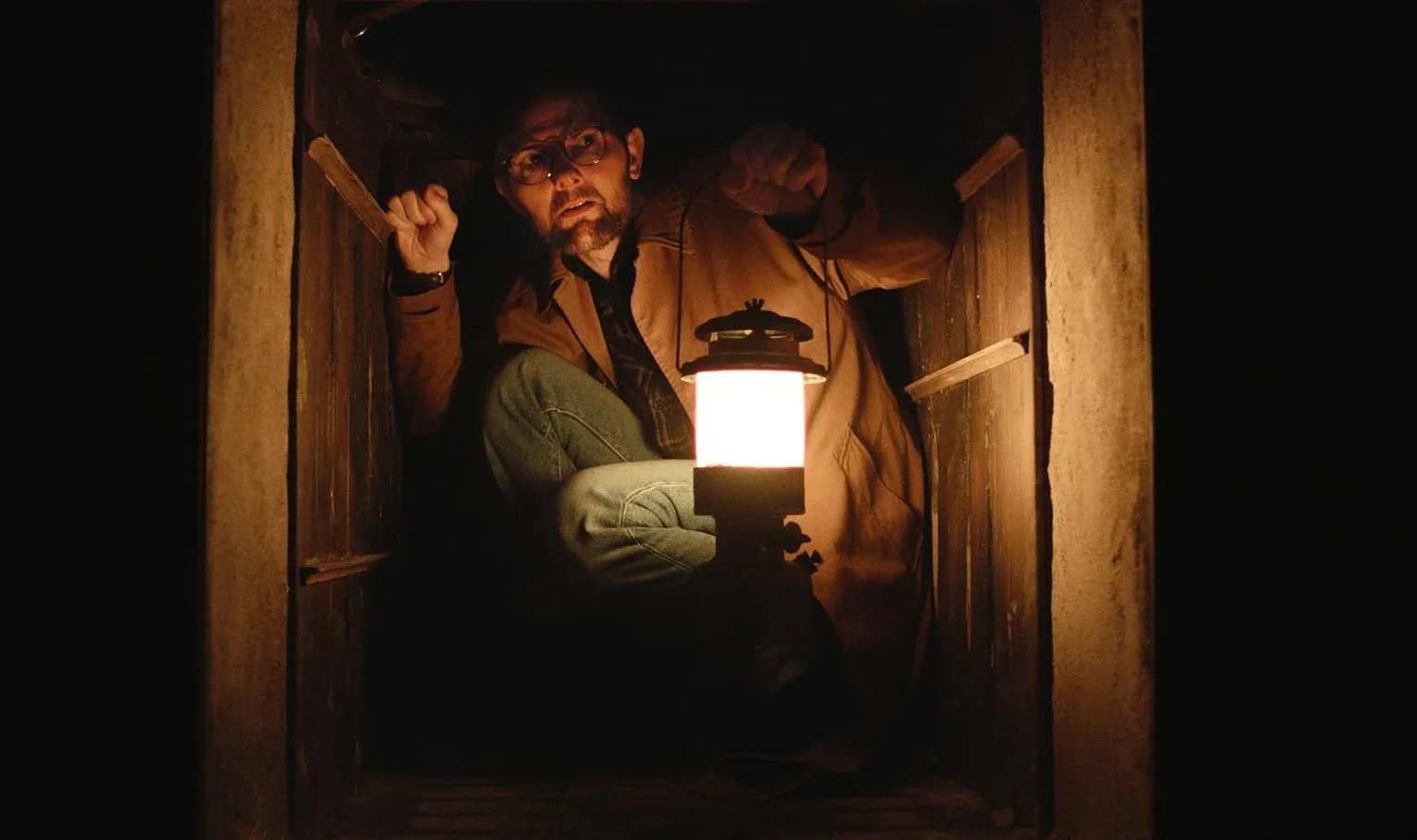

Ohm Bauman moves through Ireland like a man carrying ashes in both hands, one visible and one hidden. He is a successful writer of fantasy novels, and he has come to this hotel in search of an ending. The place once held his parents during their honeymoon, and now it waits for him with damp walls, stale air, and a memory that refuses to settle. His invented tale of a conquistador drifting through a desert begins to seep into the waking world.
That wandering figure searches for treasure trapped inside a glass bottle that will not break. The hotel keeps its own sealed object in reserve, the Honeymoon Suite. Rumor places a witch behind its door. Ohm dismisses the local talk with the impatience of a man who mistakes education for wisdom.
Then Fiona disappears behind the routine of an ordinary evening, and that vanishing draws him into hallways where personal failure and something much older begin to share the same breath. His guilt and the hotel’s dead seem to recognize one another. He learns, slowly and with pain, that some narratives demand blood before they yield their final sentence.
Architecture of the Misanthrope
Ohm Bauman is shaped as a portrait of abrasion. He moves through the world with the temper of a man who has traded warmth for the machinery of a writing career. Alcohol shadows him with quiet persistence. His manner toward the staff carries a sharp contempt, and that contempt feels like evidence of damage that has been festering for years.
Adam Scott plays him with a cold precision that gives the character an almost ceremonial unpleasantness. Silence becomes one of his sharpest tools. It communicates superiority, exhaustion, and a private contempt that words would cheapen. When anger breaks through, it lands with the clean force of an incision. He carries himself like a minor deity of his own invented worlds, one who has lost any capacity for tenderness toward what he creates.
The people around him reflect pieces of his failure back at him. Fiona offers a brief, fragile warmth, and he lacks the emotional shape needed to receive it. Her kindness glows faintly in a place steeped in shadow. Once she is gone, the emptiness she leaves becomes the first force strong enough to stir him from self-absorption. Mr. Cobb stands as a figure of stern old belief, a man whose sense of the world grants folklore the gravity of law. Alby the bellhop and Mal the concierge sound their warnings, yet Ohm’s vanity dulls his hearing.
Jerry, living from a van near the forest, brings another form of knowledge. He knows the soil in chemical terms and in spiritual ones. He stands closer to the ground than the others, and that grounded presence gives him a strange authority. These people are not ornaments around Ohm’s crisis. They reveal the emptiness within his disbelief and expose the vanity that he has mistaken for intelligence.
The Geometry of Decay
The hotel feels alive in the worst possible way. It traps, watches, and endures. Its body is built from rustic decay, and the production design leans fully into the sensation of time curdled in place. Dust-coated fixtures and old plumbing suggest a structure abandoned by the present tense. The Honeymoon Suite concentrates that dread into a single chamber. Victorian heaviness fills it.
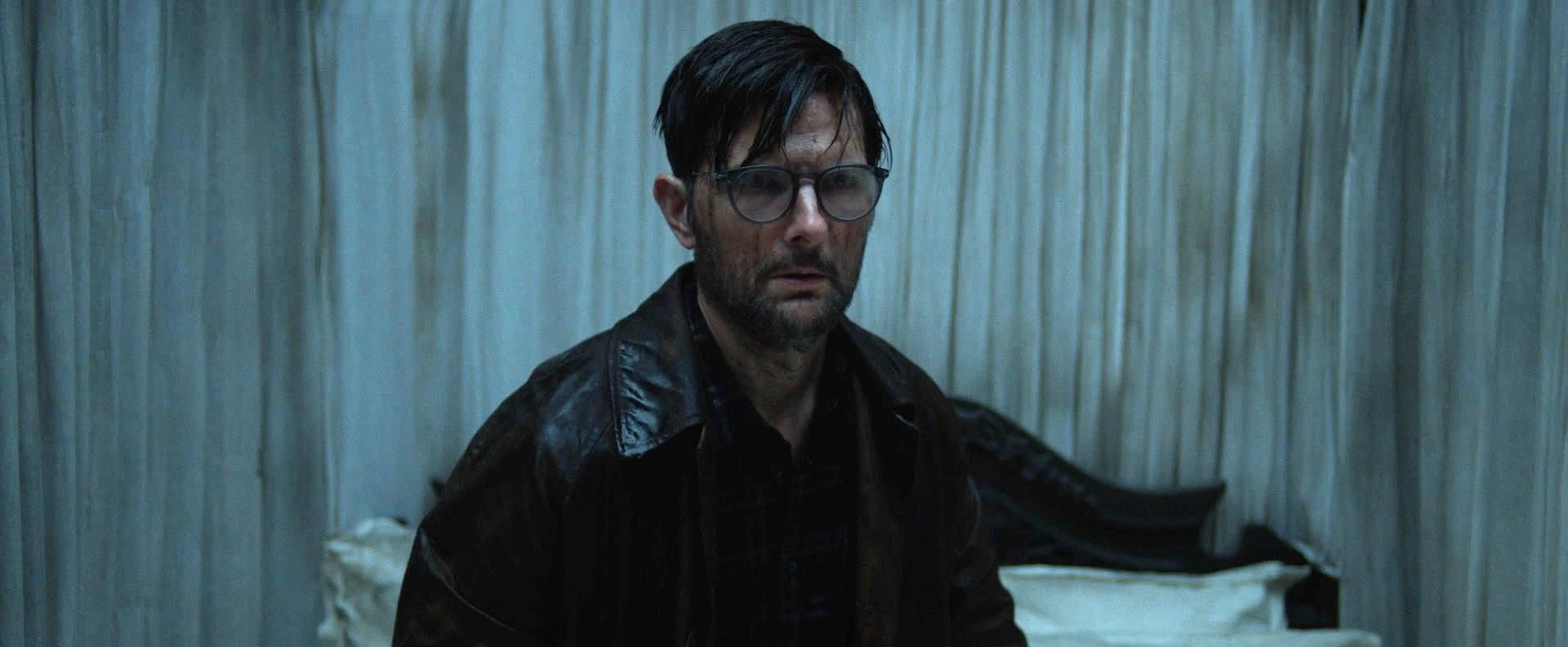
Velvet hangs with funerary weight. The room feels prepared for bodies that still breathe. Objects inside it carry menace through their material presence. The bell system and the dumbwaiter do not sit there as decorative relics. They belong to a haunting that favors wood, metal, and mechanism. The supernatural enters through matter.
The film’s visual patterns deepen that atmosphere of distortion. A mechanical clock crowned by a cherubic figure measures time with an ugly patience. Each half hour feels less like a neutral division and more like a sentence drawing closer to completion. Fragments of warped children’s television drift through the film and produce a special kind of unease, the sort that rises from memories once thought harmless.
These images suggest that childhood never vanishes cleanly. It lingers, replaying itself from damaged frequencies. The pagan decor and the gourds scattered through the lobby point toward traditions older than the hotel itself. They root the terror in land, season, and inherited ritual. Fear here belongs to rooms, objects, surfaces, and air. It lives where hands rest and where footsteps echo.
The Syntax of Silence
The film builds much of its power through absence. The camera lingers on corners, thresholds, and patches of darkness that seem to lean inward. It teaches the eye to search for a figure that may exist, or may simply be waiting for belief to give it shape. The cinematography binds itself to Ohm’s perspective, and that choice creates a suffocating intimacy.
We see what he sees and remain enclosed inside the narrow field of his perception. That limitation turns darkness into an active thing. Gray tones and muted colors dominate the frame. The world looks drained, emptied, and spiritually weathered. Light exists, yet it never feels cleansing. The landscape remains stained by dread.
Sound works with equal care. The score breaks into silence like a body taking a startled breath. It springs tight in the nerves and releases in sharp pulses. The film refuses the restless tempo common to many thrillers and chooses a slower rhythm, one marked by waiting, delay, and pressure. Fear accumulates instead of exploding. The clock’s chime returns again and again until it becomes almost physical, a small violence carried by sound.
The film understands anticipation as its own form of torment. Anxiety enters first, and the thing being feared arrives later. This approach works on the body before it works on the intellect. The atmosphere hunts by touch, by rhythm, by the slow persuasion of dread settling into muscle.
The Ancestral Weight
Ohm’s suffering grows from maternal loss. He remains haunted by his mother’s sudden death, and that event hangs over his life with the force of an original wound. It shattered the emotional order of his family and left his father stranded inside alcoholic grief. Scattering their ashes should offer release, yet the hotel interrupts that hope and turns the act into something closer to ritual failure.
The narrative treats guilt as a living presence. The spirits attached to the Honeymoon Suite feel like outward forms of pain Ohm has never faced in full. His trip to Ireland becomes an encounter between his hunger for closure and his inability to forgive himself for surviving in the shape he did.
The witch of local folklore gives the film its moral grammar. She is dangerous, ancient, and profoundly indifferent to human comfort. She carries the law of the land in a form that predates modern skepticism. In this setting, intellect offers little protection to a man built on arrogance. Isolation strips Ohm of performance. No audience remains for his sarcasm.
No easy superiority survives the pressure of what the place demands he acknowledge. The film treats folklore with severe conviction. It proposes that old warnings persist because something in them remains true. The witch embodies a past that will not stay buried beneath reason or mockery. She arrives like judgment that has waited patiently for its hour, and Ohm has spent years running from exactly that kind of reckoning.
The Epilogue of the Damned
The conquistador from Ohm’s manuscript reflects him with eerie precision. That opening image of a man unable to break a glass bottle expresses the writer’s own emotional paralysis. He searches for impact in a world that gives way beneath him. His cruelty toward fictional figures reveals something plain and ugly in his spirit.
He uses the page as a chamber where control can still be exercised, where suffering can be arranged into obedient shapes. Finishing the manuscript begins to matter as deeply as staying alive. Art and survival draw frighteningly close to one another.
The closing movement reaches its resolution through pain honestly endured. Ohm completes his book by choosing an ending that turns away from the senseless violence he once preferred. That decision suggests a shift inside him, quiet yet real. He releases something of himself through the act of finishing the story. Writing becomes a path toward atonement, harsh and narrow, yet still a path.
The film’s symmetry gives this transformation a grave beauty. It opens with a man searching for a period and closes with the hush of a page finally completed. Horror becomes the road that carried him there. It breaks him into a shape capable of finishing the sentence. It gives him the force needed to break the bottle at last.
Hokum is a supernatural horror film that made its world premiere at the South by Southwest (SXSW) Film & TV Festival on March 14, 2026, where it garnered significant acclaim for its atmospheric tension. As of mid-April 2026, the film is preparing for its wide theatrical release in the United States, scheduled for May 1, 2026, under the distribution of Neon. Audiences in the United Kingdom and Ireland can expect to see the film via Black Bear Pictures. The story centers on a reclusive novelist, played by Adam Scott, who encounters a terrifying legend involving an ancient witch while visiting a remote Irish inn to scatter his parents’ ashes.
Where to Watch Hokum (2026) Online






Full Credits
Title: Hokum
Distributor: Neon, Black Bear Pictures
Release date: March 14, 2026 (SXSW Premiere), May 1, 2026 (United States)
Rating: R
Running time: 101 minutes
Director: Damian McCarthy
Writers: Damian McCarthy
Producers: Roy Lee, Steven Schneider, Derek Dauchy, Ruth Treacy, Julianne Forde, Mairtín de Barra
Executive Producers: Ryan Friscia, Jeff Deutchman, Evan O’Brien, Ken Kao, Josh Rosenbaum
Cast: Adam Scott, Peter Coonan, David Wilmot, Florence Ordesh, Michael Patric, Will O’Connell, Brendan Conroy, Austin Amelio, Ezra Carlisle, Mallory Adams
Director of Photography (Cinematographer): Colm Hogan
Editors: Brian Philip Davis
Composer: Joseph Bishara
The Review
Hokum
Damian McCarthy delivers a meditation on the permanence of grief and the weight of artistic cruelty. The film functions as a chilling intersection of Irish folklore and personal atonement. Adam Scott’s cold performance anchors a narrative that finds its power in the physical decay of its setting and the silence between its scares. It is a work of atmospheric precision that takes its ghosts as seriously as its human failures. This is a haunting of the soul and the soil.
PROS
- Precise use of negative space to generate dread.
- Adam Scott’s brave portrayal of an abrasive protagonist.
- A rich sense of place created through tactile production design.
- Grounded treatment of folk legends.
CONS
- Some jump scares feel telegraphed.
- The narrative occasionally feels overstuffed with competing villainous threads.
- Certain childhood visions lack clear integration with the primary plot.