





























After ten years away from cinema, South Korean director Na Hong-jin returns with Hope, a massive, 160-minute blockbuster epic driven by violent genre collision. The Wailing was shaped by quiet, metaphysical dread; Hope moves with the convulsive force of action, horror, and science fiction gathered into one unstable body.
The story begins in Hope Harbor, a remote coastal port town under the heavy shadow of the Demilitarized Zone. History has hardened there into architecture. Landmine warnings and anti-spy propaganda sit inside ordinary life like old scars that have learned to pass for furniture.
That daily reality breaks open on a lonely road, where a mutilated cow carcass has been ripped apart by enormous claw marks and left with the pungent odor of old, decaying fish. Police chief Bum-seok, played by Hwang Jung-min with frantic energy, first reads the killing as an exotic tiger attack, a soothing error that disintegrates almost at once. Some unimaginable destructive force is moving toward the village. What follows becomes an inquiry into civilian readiness at the moment natural law stops behaving like law.
The Topography of Ruin
The film’s first hour sets a striking formal standard through the luminous, severe collaboration between Na Hong-jin and cinematographer Hong Kyung-pyo. Total civic devastation is filmed with wide lenses and broad daylight, exposing disaster without the protective veil of shadows or nighttime storms.
The brightness becomes merciless. The eye must confront the full scale of the ruin, and the violence acquires an almost forensic clarity. The production design carries a gratifying analog texture, using the physical destruction of real Jeju Island locations, weathered storefronts, and narrow alleyways in place of the immaculate weightlessness of modern digital stages.
In these early, frantic passages, Na withholds the monster from view because terror gains power as unseen pressure. The camera stays grounded within the chaos, following flying vehicle doors, collapsing ceramic tile roofs, and obliterated human remains with a grim attention to matter in motion.
The dread feels physical before it feels knowable. Squelchy, visceral sound design gives each impact a wet finality, and Michael Abels’ rhythmic, propulsive score pushes the panic forward like a pulse nearing failure. Technical craft turns the small town into a theater of existential violence, where practical stunts and tangible debris reveal how quickly human construction can lose its claim to permanence under daylight scrutiny.
The spectacle draws its terror from real-world texture. We feel the concussive force of the threat long before we understand its shape, and that formal control makes the first wave of destruction feel alarmingly near.
Archetypes of Survival
Inside this landscape of immediate catastrophe, the characters function as spare archetypes of survival. Their thin backstories place emphasis on the human form under instinctive pressure, stripped down to fear, duty, and motion. Hwang Jung-min bends the polished image of the cinematic action hero through Bum-seok.
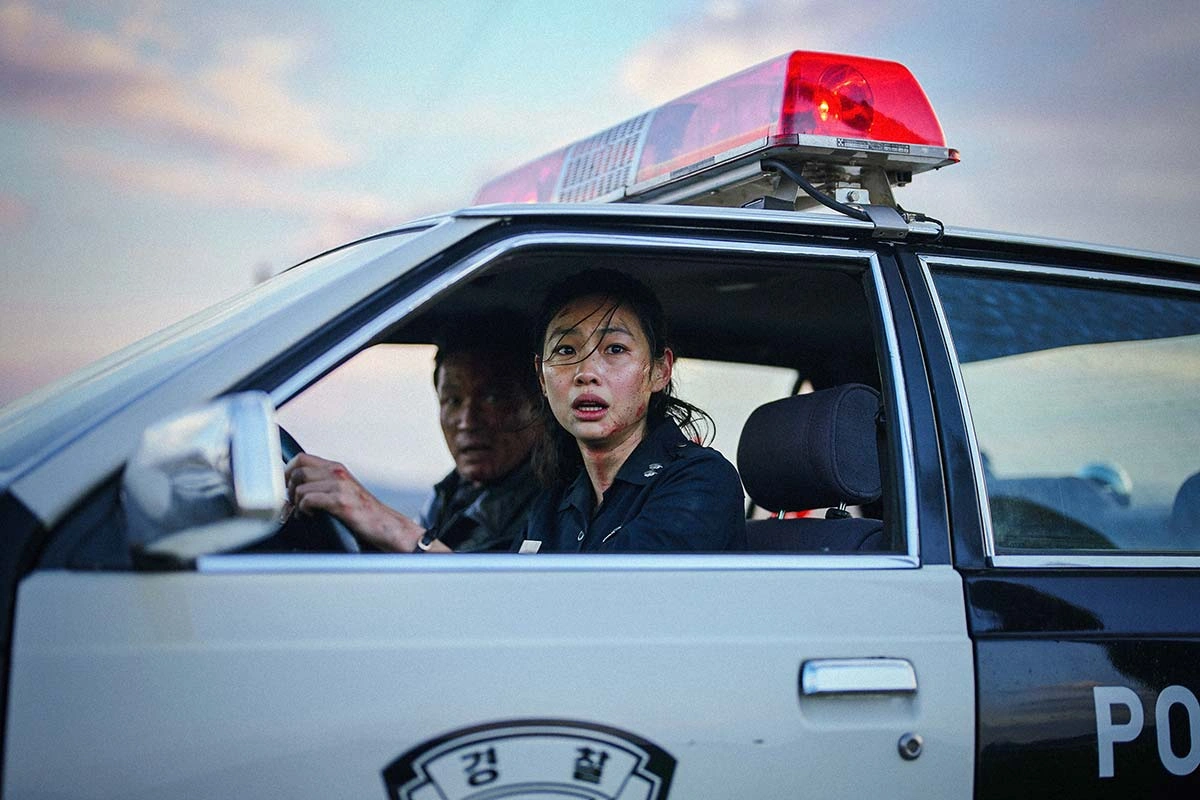
He presents a careworn, ordinary authority figure ruled by jittery nerves and sudden bodily panic, yet held in place by a stubborn, quiet civic duty that stops him from running. Hoyeon’s breakout performance as rookie officer Sung-ae carries a different charge. Foul-mouthed, poised, and fiercely capable, she handles heavy-duty weaponry with effortless confidence and gives the film its steadiest emotional anchor.
Zo In-sung’s tracker Sung-ki brings the supporting ensemble a jagged charisma. A headstrong local figure with reckless survival instincts, he sharpens the tension around Bum-seok’s trembling hesitation. His presence builds toward a kinetic, high-stakes pursuit involving a horse-and-car chase beside a speeding police vehicle, one of the clearest signs of the film’s commitment to practical stunt choreography.
Together, these performances chart several human responses to the absurdly horrific: terrified paralysis, civic obligation, brute competence, and frantic momentum. The human element survives the scale of the production because each body seems to be asking the same ancient question: what remains of the self when fear becomes the weather?
The Geography of Ignorance
After its grounded opening, the narrative shifts from coastal South Korea to the dense, forested mountain slopes of Romania, marking a thematic expansion that strains the film’s formal strength. Around the 50-minute mark, the creature is fully revealed, and the second act suffers a jarring aesthetic break. The video-game-style digital effects lack the physical texture that made the early practical filmmaking so persuasive.
A terrifying force becomes a weightless digital asset, and the illusion of reality fractures. Tonal detours further complicate the structure, including a grotesque creature autopsy and a long sequence that joins vital cosmological exposition with crude, extended jokes.
Hope then grows into global science fiction, using international actors Michael Fassbender, Alicia Vikander, and Taylor Russell to speak an invented language beneath heavy digital augmentations. This mythological layer pulls the film away from claustrophobic monster-thriller pressure and reshapes it into tragic commentary on provincial ignorance and reactionary hostility toward the outsider.
The final act reveals a deeply cynical world, leaning into franchise preparation and sequel-baiting as it suggests that the true horror lies in humanity’s violent fear of the unknown. Its last joke is a dark one, leaving behind an unresolved question about human beings facing a reality larger than their own provincial borders.
Hope premiered on May 17, 2026, in the main competition section of the prestigious Cannes Film Festival, marking a major cinematic milestone as the most expensive film project in South Korean production history. Following its high-profile festival debut, the blockbuster is scheduled for a theatrical launch in South Korea later this summer, with international distribution handled by Neon for North American territories and Mubi across multiple global regions for subsequent streaming and theatrical runs this upcoming fall.
Where to Watch Hope (2026) Online




Full Credits
Title: Hope
Distributor: Plus M Entertainment, Neon, Mubi
Release date: May 17, 2026
Running time: 160 minutes
Director: Na Hong-jin
Writers: Na Hong-jin
Producers and Executive Producers: Na Hong-jin, Saemin Kim, Saerom Kim
Cast: Hwang Jung-min, Zo In-sung, Jung Ho-yeon, Taylor Russell, Cameron Britton, Alicia Vikander, Michael Fassbender
Director of Photography (Cinematographer): Hong Kyung-pyo
Editors: Kim Sunmin
Composer: Michael Abels
The Review
Hope
Hope operates as a thunderous sensory assault that trades structural discipline for pure adrenaline. The exhilarating, practical mayhem of the opening hour delivers some of the finest genre execution in contemporary cinema. However, the experience fractures significantly during the second half, burdened by a sluggish geographic shift, distracting digital weightlessness, and uneven comedic detours. It remains a fascinatingly unhinged experiment that buckles under its own blockbuster weight.
PROS
- The choice to shoot immense destruction in broad daylight on real locations creates a grounding sense of reality.
- Hoyeon provides a magnetic presence, matching Hwang Jung-min’s subversion of the typical action hero.
- The squelchy sound design pairs with Michael Abels’ propulsive score to maximize the tension of the early hunt.
CONS
- The transition to weightless, computer-generated creatures breaks the physical illusion established early on.
- Lengthy detours into crude humor and a drawn-out autopsy sequence severely damage the second-act pacing.
- The characters function strictly as survival mechanisms, lacking deep development or internal complexity.