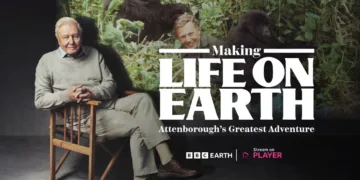
























This documentary marks David Attenborough’s hundredth birthday and the fiftieth anniversary of the beginning of his most influential work. It functions as a history of the thirteen-part series that reshaped television’s relationship with biological science.
The film also captures a major act of institutional self-correction. Attenborough stepped away from a senior administrative future as BBC Director-General and returned to the field, trading bureaucratic command for direct contact with the living world. Television, in that exchange, gained a new visual grammar for nature.
The documentary keeps a loose, amiable rhythm. Candid clips and archival stories reveal Attenborough’s jocular side, softening the familiar authority without diminishing it. The figure viewers meet here has wit, improvisational calm, and an almost absurd tolerance for production chaos.
The film tells the story of a specific project that mapped the history of life while building a durable television legacy. It also shows how a cultural phenomenon gets made: through technical ambition, personal stamina, institutional risk, and a public desire for science presented with clarity and scale.
Technological Shifts and the Rise of the Nature Blockbuster
Production shifted to the Natural History Unit in Bristol, launching three years of demanding work across several continents. The timing mattered. Color television sets were entering living rooms, aviation had become easier for film crews, and lightweight cameras allowed teams to escape studio confinement. Those changes gave the series its cultural force. It could bring remote environments into domestic space with a freshness that made biological science feel immediate, visual, and shared.
The thirteen-episode structure carried huge ambition. It aimed to explain the global progression of life through a grand, unified narrative, a format that challenged older television habits. This was educational programming with the scale and confidence of spectacle. The financial and logistical risks were enormous, and the BBC committed major funds and top staff to a project with limited assurance of success. The wager was simple and slightly radical for its era: audiences might want rigorous education presented with cinematic reach.
That wager now looks prophetic. The series helped set the template for the expensive nature epics that dominate current streaming services. Its move from static observation to planetary cinema anticipated a viewing culture in which factual television competes through immersion, scale, and visual astonishment. It also reflected a shift in Western media’s engagement with the global environment. The natural world became a shared screen experience, accessible to mass audiences through technology, travel, and institutional nerve.
Field Obstacles and the Human Reality of Production
The calm images carried a much messier production reality. In the Grand Canyon, Attenborough suffered an allergy to donkey hair, and his eyes swelled shut during a vital shot. The crew filmed him from a distance to disguise the medical accident. It is a wonderfully ridiculous detail, the kind of thing television history often hides behind solemn narration and a steady voice.

The Galápagos Islands brought their own comedy of scale, with giant tortoises collapsing the team’s tents. These anecdotes reveal field production as a discipline built on patience, improvisation, and mild humiliation. The polished image of nature depended on crews adapting to whatever the landscape, animals, and weather decided to do.
Political conditions were equally unstable. In the Comoros Islands, a coup threatened the crew’s presence. Attenborough used his French fluency to handle officials and keep his permits. In Iraq, during a search for early writing artifacts, producer Mike Salisbury moved ahead of the main team and faced the danger of being taken hostage by the regime. His capture would have been less catastrophic for the production than losing its star, a grim calculation that says plenty about the strange ethics of television logistics.
Biological patience demanded its own endurance. A cameraman spent two weeks watching a Darwin’s frog to record a single birth. These stories expose the labor behind the seamless broadcast image. The finished program offered order, progression, and wonder. The process involved swollen eyes, collapsed tents, political danger, and long stretches of waiting for nature to perform on its own schedule.
The Rwandan Encounter and Global Influence
The encounter with mountain gorillas in Rwanda remains the series’ defining image. Attenborough describes a profound connection with the animals, and the scene changed how humans perceived their position within the biological hierarchy. Its cultural power came from intimacy. The sequence brought viewers close to animals often treated as distant symbols and asked them to recognize proximity, intelligence, and kinship.
The aftermath of the shoot carried serious danger. Soldiers stopped the crew near an army compound in Kigali, and the team feared they might be shot. One crew member protected the gorilla footage by switching labels on the film canisters. That quick decision preserved a piece of media history. It also reveals how fragile landmark television can be before it reaches the screen. A scene that later seemed inevitable survived through nerve and luck.
When the series aired, it reached fifteen million people. Its popularity was so intense that pubs reportedly lost business on Tuesday nights. That detail feels almost comic now, especially in an age of fragmented streaming habits, yet it explains the scale of the achievement. The project proved that audiences would gather for substance and education when the storytelling carried enough visual and emotional force.
The series created the expensive model for every nature documentary that followed. Its legacy continues to shape how global stories appear on digital platforms, where scale, access, and spectacle remain central selling points. It established a standard for visual storytelling that still holds power, and it confirmed Attenborough as a primary bridge between scientific knowledge and the general public.
“Making Life on Earth: Attenborough’s Greatest Adventure” premiered on May 6, 2026, in the United States on PBS and is scheduled for its UK broadcast on BBC One and iPlayer on May 8, 2026. This special commemorates Sir David Attenborough’s 100th birthday by looking back at the three-year production of the 1979 landmark series “Life on Earth.” The film explores the technical risks and personal challenges faced by the crew across 40 countries, including archival footage and new interviews with the original team. Viewers can currently stream the documentary through the PBS app in North America or via BBC iPlayer in the United Kingdom.
Full Credits
Title: Making Life on Earth: Attenborough’s Greatest Adventure
Distributor: BBC One, BBC iPlayer, PBS, PBS.org, Sony BBC Earth, BBC Player
Release date: May 6, 2026
Rating: TV-PG
Running time: 60 minutes
Director: Victoria Bobin
Writers: Victoria Bobin
Producers and Executive Producers: Mike Davis, Sue Aartse-Tuyn, Victoria Bobin, Diana El-Osta, Anuschka Schofield, Jack Bootle, Sreya Biswas
Cast: David Attenborough, Mike Salisbury, Christopher Parsons, Lynda Checketts, Mike Davis, Sue Aartse-Tuyn, Victoria Bobin
The Review
Life on Earth: Attenborough's Greatest Adventure
The documentary provides a sharp look at a production that defined modern nature media. It succeeds by stripping away the polished exterior of the 1979 series to reveal the physical and political labor involved. Attenborough’s decision to choose the field over the office remains a defining moment for the BBC and the public. This film captures the tension and technical ambition that birthed a new visual language. It is a vital record of a cultural shift.
PROS
- Provides rare, candid footage of a younger David Attenborough.
- Details the dangerous political and physical realities of 1970s field production.
- Highlights the technical risks that established the blueprint for modern nature documentaries.
CONS
- Relies heavily on nostalgia for the original series.
- Maintains a largely celebratory tone rather than a critical institutional analysis.