












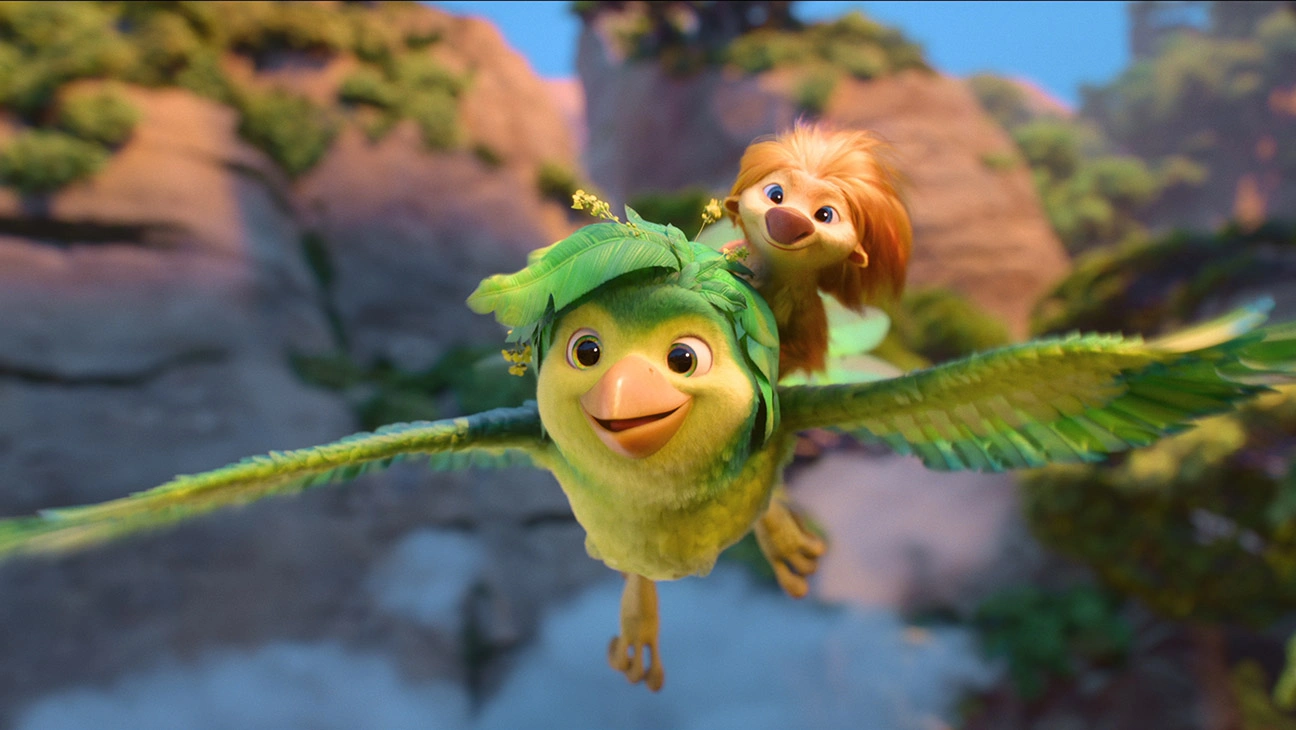

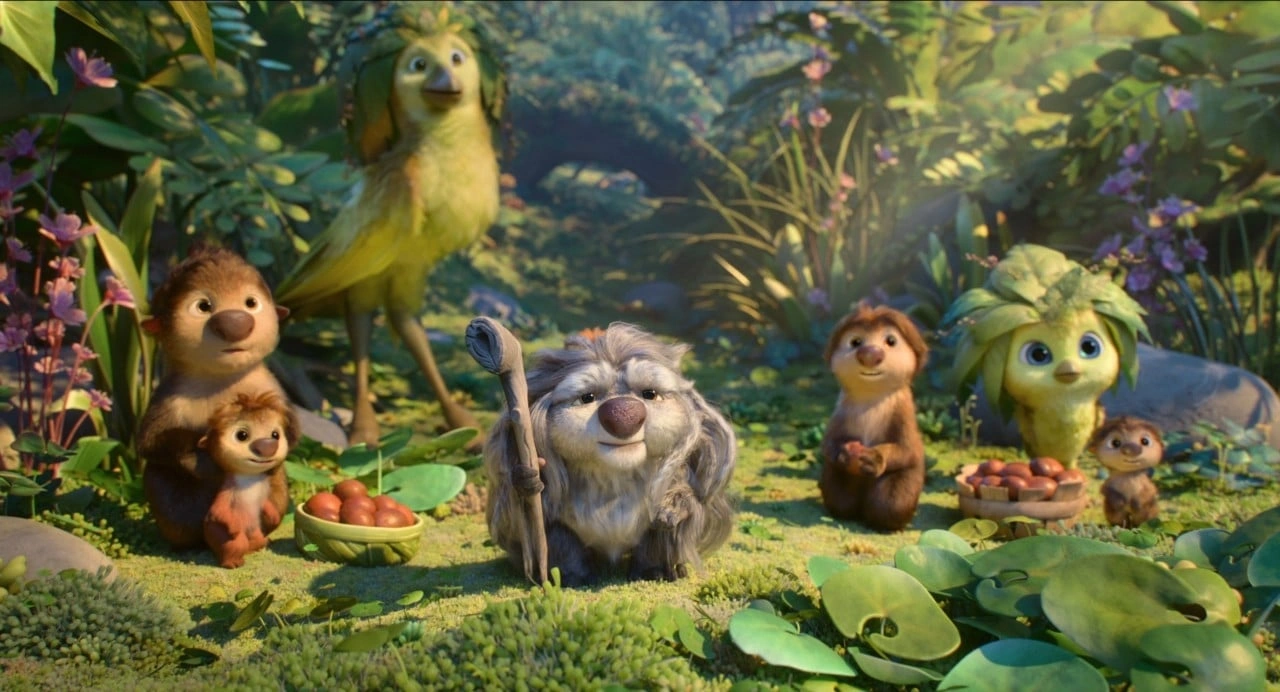
The Valley has one survival rule for the Pookoo: stay hidden. These small mammalian burrowers live in permanent caution, shaped by shadow and scarcity. Above them, the Javans control the air. These large birds stand as the main threat in an ecosystem with little food to spare.
Director Nathan Greno builds the story around that inter-species pressure. Ollie, an inquisitive Pookoo voiced by Michael B. Jordan, once made a choice that changed his tribe’s history. Years earlier, he shared a rare food source with a young Javan, creating a resource imbalance that almost destroyed his people. In the present, a magical glowing pod changes the rules of perception.
Ollie and Ivy touch the plant and wake inside the bodies of their rivals. Survival now demands that they work against their own instincts. The film uses polished visuals to shape a human-free world, and the Valley plays like a reactive system where every action carries a cost. The opening crisis sends the story straight into a tactical survival quest.
Tactical World-Building and Visual Systems
The Valley’s visual design runs on a biological logic that gives every creature a clear function. Tree wolves carry leafy tails. River stones move with the mass of grizzly bears. Fish haul moss gardens across their scales. The environment feels built like a puzzle, and the animation gives that design enough texture to feel immersive. Water moves with striking fluidity during the river chases.
Mountain-climb lighting creates a primeval mood. The Javans cut sharply through the forest palette, with yellow-chartreuse plumage that feels almost psychedelic against the deep greens below. The Firewolf becomes the main visual threat through direct, readable design. His body is made of literal flames, turning him into an obvious danger to the lush terrain around him. Scale expands when the Dzo enter the film.
These giant tree-beasts read as landscape until they shift their weight, and that delayed recognition gives the screen a strong sense of awe. Ollie also helps define the world through practical problem-solving. He builds working tools, including snorkel gear, from scavenged materials. That mechanical ingenuity grounds him inside the magic of the setting. The ecosystem feels packed with detail, rewarding closer attention to the background. The setting functions as a living story system.
Vocal Logic and Physicality
The character work depends on the link between vocal personality and animated body language. Michael B. Jordan gives Ollie a fast-talking charge that fits a survivor pushing against his tribe’s inherited fear. Juno Temple gives Ivy a self-assured tone that carries Javan pride. Their early alliance gains friction from those clashing instincts.
The body swap brings physical comedy through specific movement choices. Ivy cocks her furry Pookoo arms as if her wings should still answer her command. That small gesture gives the transformation a playful internal logic. Tracy Morgan supplies the comic anchor as Boogle the fish.
His discombobulated forthrightness keeps the group moving through punishing terrain. The growth of the leads plays almost like a sequence of skill unlocks, which gives the fantasy premise a pleasing game-like structure. Ollie has to learn the physics of flight. Ivy has to use a Pookoo’s sense of smell to track a route through darkness.
Each new discovery shifts the emotional rhythm of their partnership and moves them closer to the goal. Cedric the Entertainer and Justina Machado give extra weight to the Pookoo community. Their voices suggest the history of a tribe that has endured through isolation. The lead chemistry feels earned because it develops under pressure.
Systemic Empathy and Narrative Arcs
The story uses physical transformation as a direct empathy mechanic. By placing Ollie and Ivy inside enemy bodies, the script turns perspective into action. The idea works because the characters must learn the rules of unfamiliar forms before they can understand unfamiliar lives. The dialogue pacing can slow down during the tense scenes, and some reactions carry a slight delay.
That rhythm creates uneven patches in moments that need sharper momentum. The Firewolf works as a metaphor for the fear blocking cooperation between groups. He is a destructive force that ignores tribal lines, which keeps the survival stakes clear. The film balances light slapstick with a serious message about shared resources and the strain of limited food.
A late plot twist involving a hidden villain changes the stakes of the final act. I found the quiet opening especially effective, since the lack of dialogue lets the visual world teach its own rules. The attention to inter-generational bias shows fear moving through families as inherited behavior. Younger characters have to reject those lessons to protect their home from collapse.
The arc gives change a personal starting point. The script resists simple answers to the food crisis and stresses the labor required to build trust. The film is strongest when its visual systems carry the emotional and thematic weight, letting the world itself express the lesson.
Swapped premiered globally today, May 1, 2026, as a major new addition to the Netflix animation library. Produced by Skydance Animation and directed by Nathan Greno, the film offers a fresh take on the transformation trope by dropping its leads into a vibrant, plant-animal hybrid ecosystem known as the Valley. You can watch the movie exclusively on Netflix, where it is now available for streaming to all subscribers following a limited theatrical engagement earlier this year.
Where to Watch Swapped (2026) Online


Full Credits
Title: Swapped
Distributor: Netflix
Release date: May 1, 2026
Rating: PG
Running time: 102 minutes
Director: Nathan Greno
Writers: John Whittington, Christian Magalhaes, Robert Snow, Adam Karp, Nathan Greno
Producers and Executive Producers: John Lasseter, David Ellison, Dana Goldberg, Mary Ellen Bauder Andrews, Rafael Garrido
Cast: Michael B. Jordan, Juno Temple, Tracy Morgan, Cedric the Entertainer, Justina Machado, Ambika Mod, Lolly Adefope, Táta Vega, Nate Torrence, John Ratzenberger
Director of Photography (Cinematographer): Christophe Brejon
Editors: Tim Mertens, William J. Caparella
Composer: Siddhartha Khosla
The Review
Swapped
Swapped stands as a visually stunning exercise in biological imagination. While the script sticks to a basic survival loop for younger audiences, the hybrid creature designs and ecological systems provide a dense world to explore. The transformation mechanic effectively literalizes the need for empathy without relying on heavy exposition. It feels like a beautiful tech demo for a world that needs more complex writing to reach its full potential.
PROS
- Inventive flora-fauna hybrid creature designs.
- Solid vocal work from Michael B. Jordan and Juno Temple.
- High quality technical execution of water and lighting effects.
- Effective use of character skills as narrative milestones.
CONS
- Noticeable lag in dialogue timing during action.
- Predictable story for older audiences.
- Abrupt reveal of the final antagonist.