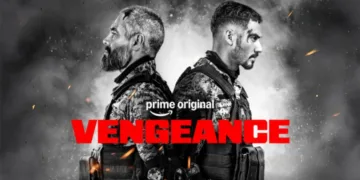































Carlos Estrada faces a military podium with the rigidity of carved stone, medal in hand, honor curdled into insult. The ceremony records the capture of Héctor Luna, a victory Estrada understands as theater staged for corrupt men in clean uniforms. His voice reaches the microphone in a flat, frightening line.
He names the rot inside the room. That public act carries the shape of conscience and the temperature of a death sentence. Retaliation comes at a sunlit resort, where Katori’s camera holds the scene with cold, static cruelty. The assassins erase a home life in seconds.
Alicia, Estrada’s wife, dies amid glass and lead. Estrada lives through it, stripped of the man who once filled the uniform. He sinks into chemical suspension, alcohol and grief turning time viscous. Then the lottery win of one billion pesos tears through the film’s internal logic with wild, almost comic violence. The money becomes capital for a private war. The narrative shifts from mourning into a high-tech assault on the state.
The Capital of Retribution and the Professional Cohort
Estrada’s passage from gutter ruin to multimillionaire warlord depends on a stroke of absurd luck so brazen it nearly salutes itself. He buys a stack of lottery tickets from a street vendor with nihilistic indifference. The jackpot of one billion pesos lands as a cynical deus ex machina, giving the script permission to leap over the ordinary limits of vigilantism.
Money becomes weapon, camouflage, command structure. The personal vendetta expands into a small military operation. Estrada purchases concealment itself. He recruits former colleagues, each one a fragment of the machine that trained him. Miguel Díaz brings reluctant conscience, tied to the presence of his own family. Dolores Ramirez and Aurelio Salazar supply the tactical discipline needed for professional insurgency. Their mission has the shape of revenge and the rhythm of administration. Grim paperwork, with ammunition.
Colonel Gabriela Rangel, the chief antagonist, gives institutional decay a human outline. She is graft rendered as strategy, calculation given rank. The film studies the acquisition of a high-tech arsenal with procedural concentration, almost forensic in its attention to components and planning.
Also Read






Preparation scenes move with measured pace. The lottery’s absurdity is tempered by the logistical weight of the gear, the transport, the personnel, the method. A dry joke sits under the premise: a gambling windfall becomes the funding model for destroying a state institution. In a society where corruption functions as currency, a billion pesos becomes protest with a receipt.
The film’s logic remains severe. Power must be gathered, counted, loaded, aimed. Justice, in this framework, requires mechanics. Estrada’s team moves with rhythmic precision, arranging planned strikes with professional calm. The suspense shifts toward method: how the assault will unfold, how much force this wounded man can place against former superiors, how far money can carry grief before grief starts issuing orders.
Expressionistic Frames and the Blue Hour of the Soul
Rodrigo Valdés shows a taste for stylistic rupture. The animated opening sequence appears nearly twenty minutes into the runtime, breaking the established reality with the snap of an underground comic panel. It introduces the characters through kinetic pulp energy, a nod to genre roots scrawled in ink and velocity.
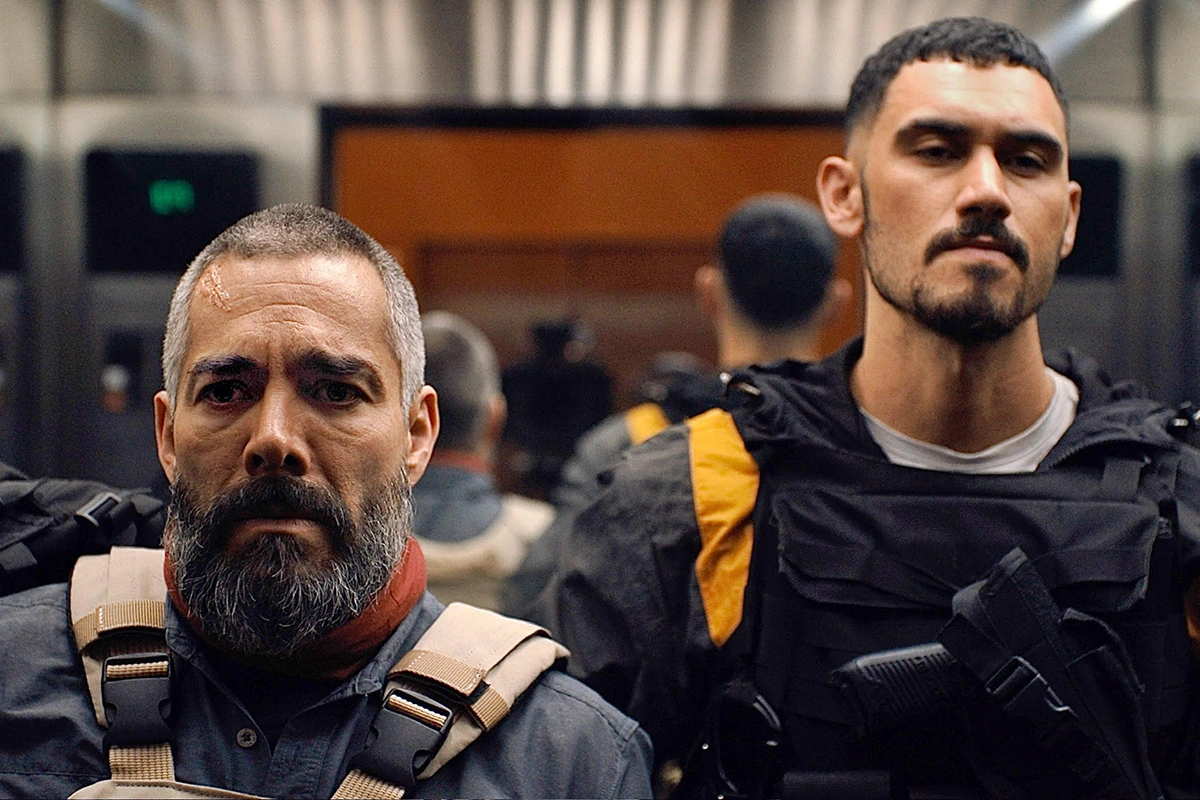
Kenji Katori’s cinematography, by comparison, favors discipline. The frame is patient. Static camera placements stress architectural geometry, turning rooms and corridors into moral diagrams. Dialogue scenes often rely on low angles, lending the characters tragic mass. They appear sculptural, trapped inside a drama already casting them in stone. The visual grammar is precise, almost judicial.
The lighting creates the film’s strongest psychological texture. Night sequences are soaked in deep, muted blues, forming a digital chiaroscuro with oppressive density. This blue hour mirrors Estrada’s mental haze, while it sometimes makes tactical motion difficult to parse.
The viewer must work through the darkness, squinting into moral and literal fog. The daytime images cut with harsh clarity. The final act in the abandoned building is lit with stark, blinding force. Sunlight exposes decay and gives the violence a raw surface. The beach resort’s luxury and the skeletal urban ruins carry the film’s social fracture inside their design. These spaces act as visible pressure points in the conflict.
The camera moves with slow, deliberate grace, keeping distance from the frantic cutting common to many modern thrillers. That restraint alters audience psychology. Tension has room to breathe. Each movement registers. Each pause lengthens. Perception becomes anxious because the image refuses to panic on the viewer’s behalf. The style remains scholarly and exact, devoted to composition, light, and spatial pressure. Sensory overload can take the afternoon off.
The Mechanics of Impact and Improvised Malice
The action rejects polished stunt elegance and enters the harsher grammar of impact. Its physicality privileges the sound of bone against concrete, the ugly music of damage. Choreography is brutal, economical, and fast. Every strike feels medically consequential. Fighters seek dismantling, using professional speed in place of decorative exchange. Estrada’s weapons reflect a desperate tactical intelligence.
Firearms, knives, and axes pass through his hands with the same cold efficiency. The hotel room brawl becomes the film’s claustrophobic set piece, a cramped study in improvisational murder. Ordinary objects turn lethal. A telephone cord becomes a ligature. A toilet tank lid lands as blunt force. A wine corkscrew enters a lethal exchange with grim comic timing. The bar for hospitality has rarely been lower.
The urban car chase keeps the violence heavy and dangerous. The pursuit favors actual metal on metal, giving mass and threat to every collision. The final confrontation in the abandoned building displays the tactical synergy of Estrada’s unit. They move as one lethal organism, trained by the same system they now strike. The style echoes the relentless velocity of modern tactical cinema, while its grit carries a distinctly Mexican charge.
Omar Chaparro gives the role fierce physical commitment. He moves with the stiffness of a man loaded with lead and grief. Combat becomes character writing. The clean, professional motion of the opening raid yields to messy, personal brutality in the later killings. Estrada’s inner condition appears in the way he ends lives.
Violence becomes his language, and his fluency grows as his connection to humanity thins. The sound design sharpens that perception: impacts arrive with blunt finality, making the viewer feel the body as a failing machine. Each hit diagnoses the soul. Estrada breaks enemies while breaking himself.
The Institutional Abyss and the Hallucinated Wife
The film presents the military as a sealed world, operating apart from civilian life with its own codes, rituals, and permissions. Its treatment of the “bad apple” narrative is acidly skeptical. Corruption appears as a structural feature of the hierarchy. Estrada and his unit rebel against that structure using violence, sacrifice, and tactical discipline, the same instruments that shaped them.
The ethical field turns gray and stays gray. The film refuses simplification. Estrada is a noble leader. He is also a man who drives nails into enemy legs. The torture scene changes the viewer’s alignment with him, asking where justice mutates into sadism. A fair question. An unpleasant one.
Alicia’s recurring hallucinations carry the psychological cost of the mission. She appears in the quiet gaps between bloodletting, a vision of the past that Estrada cannot release. Her presence suggests grief becoming apparition, memory becoming fracture. Revenge here is heavy and nutritionally useless. The film examines the futility of his campaign with grim patience. Estrada cannot kill enough men to restore his wife. Each death gives him a hollow victory, polished and empty.
The Mexican special forces setting gives the fictional odyssey a hard surface of reality. It anchors the billion-peso lottery absurdity inside a world of real weapons and real blood. The film argues that institutional inertia can be shaken by a force of equal, unhinged intensity. Estrada becomes that force, an antihero losing his identity while pursuing a righteous end. The story leaves him in moral suspension. His objective is complete. His selfhood has been spent. He is a ghost who has finished haunting the house and discovered he still has nowhere to sleep.
Vengeance premiered in Mexican theaters on February 26, 2026, before being released globally on the Prime Video streaming platform in April 2026. The film follows Carlos Estrada, a decorated special forces captain whose life is shattered when a criminal network retaliates against him by murdering his wife. After an improbable lottery win provides him with immense wealth, Estrada converts his fortune into a high-tech arsenal and recruits his former elite squad to wage a private war against the corrupt military officials responsible for his loss. You can currently watch this action thriller on Prime Video.
Where to Watch Vengeance (2026) Online


Full Credits
Title: Vengeance
Distributor: Amazon MGM Studios, Cinépolis Distribución
Release date: February 26, 2026
Rating: TV-MA
Running time: 1 hour 43 minutes
Director: Rodrigo Valdés
Writers: Yalun Tu, Daniel Krauze
Producers and Executive Producers: Pablo Cruz, Abel Cruz, Omar Chaparro, Rodrigo Valdés
Cast: Omar Chaparro, Alejandro Speitzer, Paola Núñez, Natalia Solián, Luis Alberti, Iazua Larios, Lizeth Selene, Gustavo Sánchez Parra, Vasil Simeonov
Director of Photography (Cinematographer): Kenji Katori
Editors: Yibran Asuad
Composer: Dan Zlotnik
The Review
Vengeance
Vengeance stands as a visceral examination of tactical grief. The film succeeds through its brutal physicality and the disciplined eye of Kenji Katori. The lottery pivot introduces a jarring element of the absurd. The production remains committed to a gritty, neo-noir atmosphere. It avoids the polished artifice of Hollywood. It offers a study of a man becoming the weapon he once wielded. The execution remains sharp. The dim lighting of its nocturnal sequences remains a hurdle. It is a potent, if imperfect, contribution to the genre.
PROS
- Visceral combat choreography.
- Disciplined camera work by Kenji Katori.
- Strong physical commitment from Omar Chaparro.
- Creative animation in the character introductions.
CONS
- Improbable lottery plot device.
- Muddy nocturnal lighting.
- Surface level treatment of systemic rot.