






















The low-budget British science fiction thriller Voidance, directed by Marianna Dean and written by Simon X. Frederick, uses a compact cosmic setting to examine institutional testing, repeated failure, and the political machinery behind public order. The story follows Alana Toro, an aspiring recruit played by Zoe Cunningham, as she faces her final operational assessment. Her goal is placement inside ATIC, an elite intergalactic law enforcement organization.
The evaluation takes place amid political instability shaped by historic tension between the neighboring planets Atopia and Cho-Hacha. Alana enters a simulated space station bar, a rough transit stop populated by interstellar truck drivers. Her assignment asks her to find a missing transport vessel and stop a localized terrorist attack.
The film builds its structure through a device familiar from interactive media. Alana wears a wrist-mounted reset tool that gives her a limited number of attempts to finish the exercise. Each failed cycle sends her back to the start with her memory preserved, while the simulated patrons return to their original behavioral patterns without recollection of the earlier timelines.
Loops, Systems, and Institutional Doubt
The simulation creates tension between story pressure and system design. A multi-attempt environment meant to measure real field competence produces a built-in paradox that reduces dramatic risk. Since the space is openly artificial, the background characters occupy a strange moral zone. Their bodies appear threatened, yet the film tells the audience that their world is a test. That framing can distance global viewers trained by high-stakes genre cinema to expect consequence, loss, and irreversible damage.
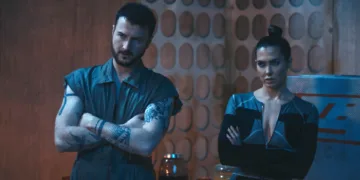
The loop progression recalls roguelike video games, where learning through failure becomes the real path forward. Alana repeats conversations with odd regulars, including the anxious, karaoke-loving Fir Jie and the elusive barfly Ede. These meetings give the early scenes a local comic texture, the kind of personality that helps a modest genre piece feel handmade.
The rhythm weakens as the script leans heavily on explanatory dialogue to define changing rules and hidden parameters. Dean lingers on repeated violent confrontations with planetary gunmen, returning to familiar beats after the structure has already made its point.
That repetition connects with the film’s anti-authoritarian current. Across successive cycles, Alana finds data suggesting that her ATIC superiors function as manipulative state managers presenting themselves as benevolent guardians.
The screenplay then shifts toward questions of personal conscience, the protection of human life, and the right to think beyond official instruction. These ideas carry intellectual force, tied to a recognizably British distrust of institutional control. The problem is timing. The ideological turn arrives late, leaving the ethical payoff separated from much of the main action.
The Human Geometry of the Agent
Zoe Cunningham gives Alana an unusual screen presence for a science fiction lead. Her black leather jacket, loose trousers tucked into practical boots, and sharply cut baby bangs place her between military readiness and street-level ordinariness. The costume design makes her feel like a civilian absorbed into a formal system, which fits the film’s suspicion toward official authority.
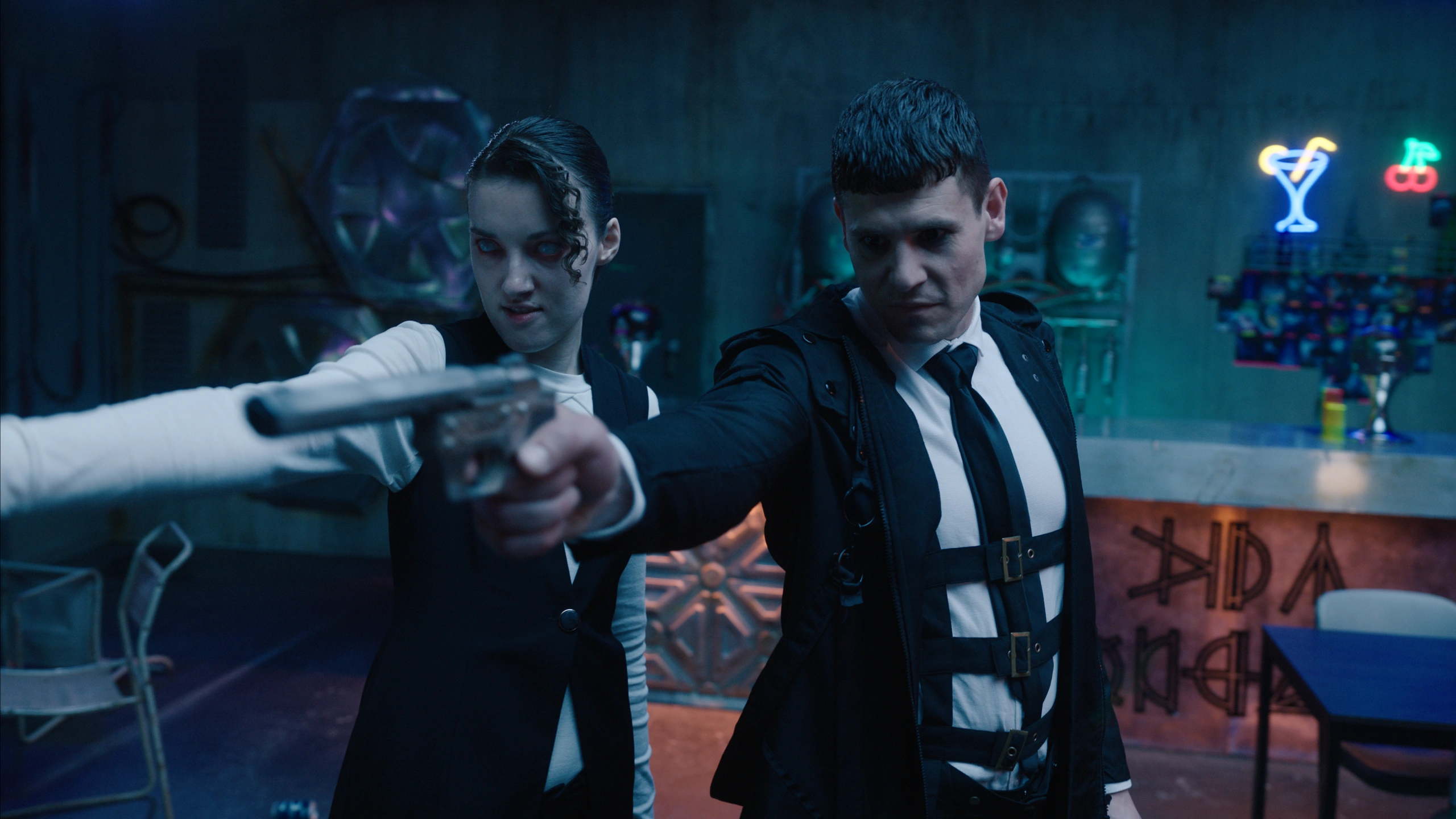
Her physical work carries visible tensions. Cunningham lacks the familiar kinetic stance or command-heavy body language associated with elite screen operatives, and the weakness becomes clear during scenes involving futuristic blasters.
She answers that limitation through Alana’s open-faced sincerity and practical intelligence. The performance emphasizes a young recruit trying to solve problems in real time, and that choice gives her concern for the simulated inhabitants a credible moral charge. A sterile military exercise begins to feel like a human dilemma.
The supporting cast works in a different register. Veteran actor James Cosmo appears remotely through a static hologram, supplying command authority from a distance. The remaining ensemble faces the harder task of carrying the script’s dense terminology. Several performers struggle to make the clunky exposition sound like natural speech, which creates a mechanical effect at odds with the lived-in qualities of the bar.
Tactical Materials and Minimalist Space
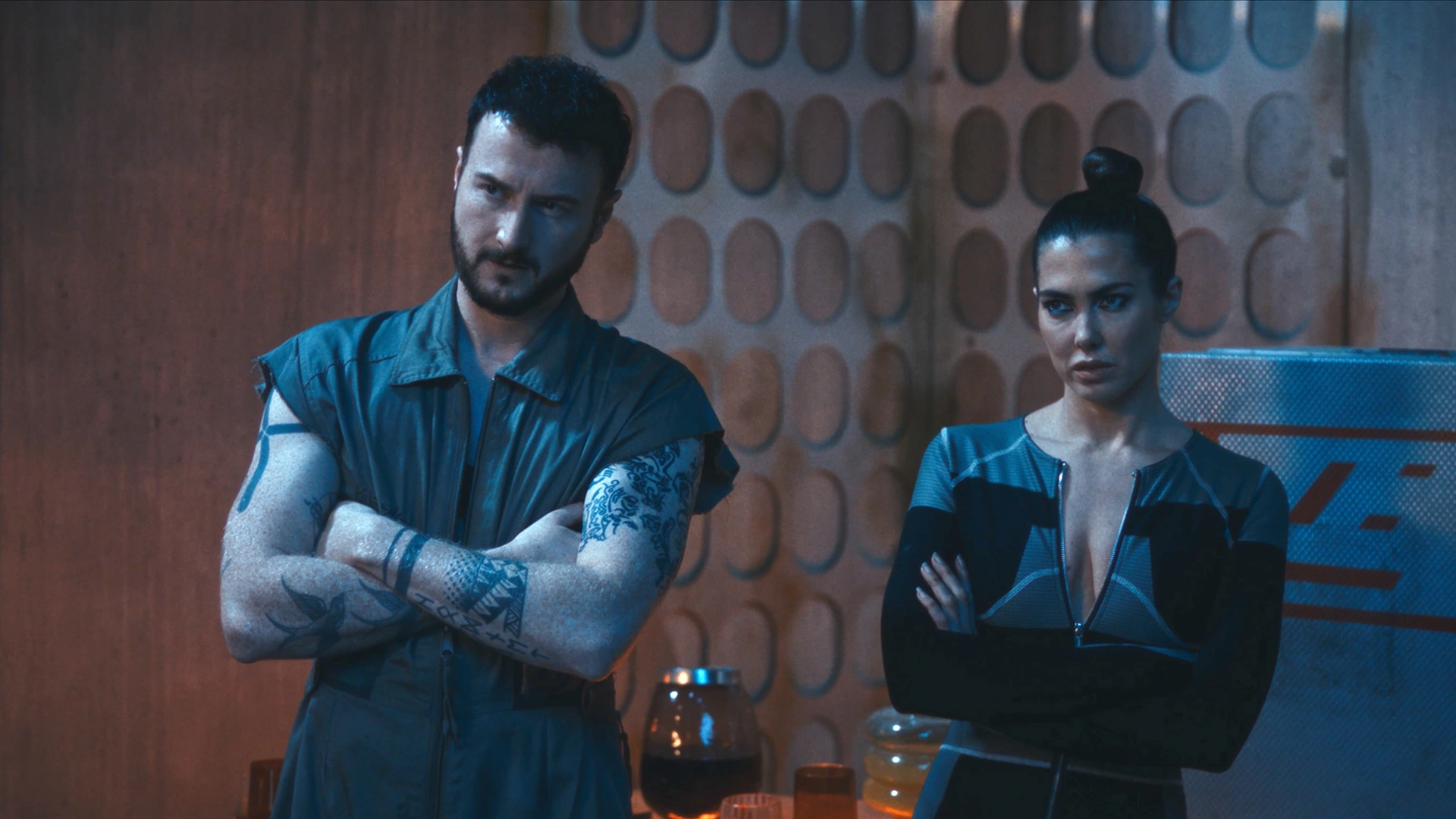
Marianna Dean handles limited resources through attention to physical space. The film avoids the slick emptiness that can come with inexpensive digital spectacle and gives priority to constructed environments. Jamie Foote’s greasy, grimy production design turns the bar into an industrial truck stop with material weight.
This approach shares formal DNA with the minimalist Canadian thriller Cube, where spatial restriction shapes the psychological atmosphere. The same confinement creates a practical challenge here, since the repeated use of tight rooms can make the visual field feel too uniform and weaken immersion.
Ciéranne Kennedy Bell strengthens the setting through tactile costume work. The clothes mix retro-cyberpunk gestures with cheap-looking accessories, giving the background figures a street-level quality linked to regional working-class British style. That grounded texture sits against a far larger sonic scale. Christoph Allerstorfer and James Griffiths compose a broad symphonic score that points toward a grander cinematic canvas than the image track can always support.
The sound design creates its own friction by using a recurring public address announcement to mark resets, a cue that turns irritating through repetition. Dean’s best control comes through silence and close observation. Tight framing catches micro-expressions, side glances, and localized tension between performers. That attention to small human exchanges keeps the film alive during slower passages, while awkward fight movement and slack pacing strain the forward motion of the narrative.
The British science fiction thriller Voidance premiered as the closing film of the SCI-FI-LONDON Film Festival on May 17, 2026. The movie follows an ambitious trainee agent who must navigate a high-stakes, time-looping simulation within a space station bar to foil a terrorist threat and secure her position in an elite security force. Following its festival debut, the feature film rolled out globally across major home entertainment platforms, becoming available for digital rental and purchase in the United Kingdom on May 25, 2026, with consecutive digital releases scheduled for the United States, Canada, Australia, and New Zealand.
Where to Watch Voidance (2026) Online




Full Credits
Title: Voidance
Distributor: Elli Films
Release date: May 17, 2026
Running time: 86 minutes
Director: Marianna Dean
Writers: Simon X. Frederick
Producers and Executive Producers: Zoe Cunningham, Marianna Dean, Tom Taplin
Cast: Zoe Cunningham, James Cosmo, Neil Bishop, Mim Shaikh, Billy Price, Chris Charles, Eloise Lovell Anderson
Director of Photography (Cinematographer): Rick Joaquim
Editors: Stephen Hedley
Composer: Christoph Allerstorfer, James Griffiths
The Review
Voidance
Voidance operates as a commendable, small-scale sci-fi experiment that succeeds in texture but stumbles in momentum. While the repetitive nature of its simulated time loop drains the narrative stakes, the film derives strength from its tangible, tactile production design and a relatable lead performance by Zoe Cunningham. It presents an intelligent critique of authority, even if its late-stage thematic shifts arrive too slowly to fully land.
PROS
- Tangible, grimy physical set design that avoids cheap digital effects.
- Expansive and atmospheric musical score.
- A grounded, charismatic lead performance that provides a strong emotional anchor.
CONS
- Repetitive loop mechanics that dilute the dramatic stakes.
- Clunky, exposition-heavy dialogue that slows down the narrative.
- Sluggish pacing and awkward action choreography.