































The Hilton Addis Ababa sits like a fixed marker in a capital defined by change. Built in 1969 under Emperor Haile Selassie’s mandate, the hotel operates as a historical object and a high-end administrative machine. Ruth Beckermann enters this space through a childhood memory of the “King of Kings,” recalled as silent, somber, and charged with immense authority. She frames her inquiry through Pierre Bourdieu’s idea that altered reporting begins with altered subjects. From there, the film studies the meeting point between private memory and national history.
The lobby carries a disciplined rhythm. Guests arrive, luggage is moved with polished efficiency, and international organizations conduct meetings behind velvet ropes. Status is preserved through procedure. Beckermann uses the hotel as the film’s organizing lens, turning one building into a narrative device for reading Ethiopia after the Emperor’s fall. The method is precise: let the institution speak through routine, gesture, and hierarchy.
Isolation Behind the Velvet Rope
Beckermann treats the hotel as a controlled stage where social rank can be observed in motion. Morning briefings show the staff preparing for another day of seamless service, while repeated physical labor keeps the fiction of luxury intact. These scenes sit beside wedding receptions and fashion shows, where the current Ethiopian professional elite occupy the same carefully managed space.
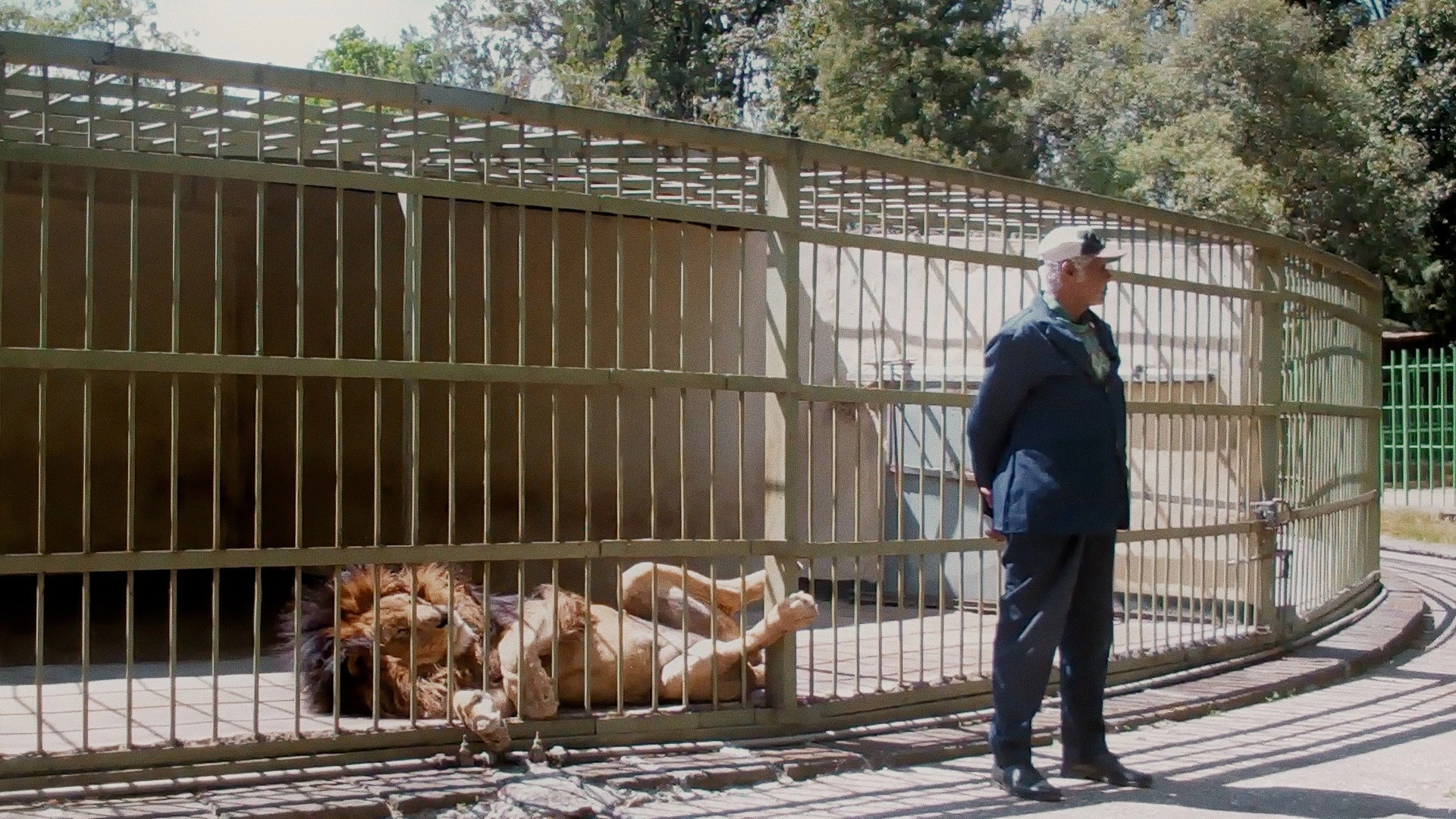
Her interviews have a bluntness that gives the film its sharper edge. She asks concierges about arranging illicit services for guests, forcing the hospitality system to reveal the transactions usually hidden beneath its immaculate surface. The film’s cleanest visual argument arrives from a balcony: the Hilton’s luxury looking out over shanty dwellings. The shot makes class separation literal. Height, distance, and money share the same frame.
Beckermann also refuses the old documentary trick of pretending the camera has no owner. She recognizes her position as a European visitor, which keeps the film from slipping into cold anthropological inspection. That self-awareness matters. It lets her read the layers of Ethiopian life around her while avoiding any false claim of belonging. The result feels alert, sometimes uncomfortable, and usefully honest.
Contesting the Imperial Image
Haile Selassie’s shadow shapes the film through competing versions of history. Beckermann draws on Ryszard Kapuściński’s The Emperor to present Selassie as an autocratic ruler. She then stages readings from the book by staff and local writers, with Samuel Yirga’s music giving those passages a measured, uneasy rhythm. The device turns historical disagreement into performance.
Selassie’s legacy remains divided. Some regard him as the visionary who abolished slavery and modernized the state. Others recognize the authoritarian figure described by Kapuściński. Beckermann widens the debate through Selassie’s elderly valet and young Ethiopians who distrust Western accounts of their past. The film’s structure benefits from that range. It keeps history active, contested, and personal.
Archival footage extends the argument, showing Selassie’s political activity in the 1930s and his visit to Jamaica, where the Rastafarian movement viewed him as divine. The irony in his private habits is equally revealing. He maintained a way of life modeled on European royalty, employed European chefs, and adopted domestic styles associated with Western imperial houses. His political image and personal taste pull in different directions, giving the film one of its most productive tensions.
Hidden Meanings in a Changing City
The title points to Sam-enna Worq, or Wax and Gold, a linguistic tradition in which a visible surface meaning carries a hidden truth. Beckermann uses that idea as a structural key for a country that follows its own systems of time, language, and interpretation. Ethiopia uses a thirteen-month calendar and a clock that begins at 6 a.m., placing the present year in the late 2010s by local count.
In the lobby, young Ethiopians speak about the difficulty of explaining their country’s distinct identity to the world. Their exchange becomes one of the film’s clearest narrative beats: a generation trying to define a nation that avoided colonization while still absorbing pressure from outside forces. Beckermann does well here by letting conversation carry the weight. The scene needs little decoration.
The film eventually leaves the hotel and moves into Addis Ababa’s streets. The city is being rebuilt through large-scale Chinese financial investment. New skyscrapers rise above areas where infrastructure cannot serve public need. The camera watches citizens waiting in long queues for transport, a final image that completes the film’s structural movement from lobby to street. Ethiopia appears suspended between imperial memory and a modern future still taking shape.
Wax & Gold is a 2026 documentary feature directed by Ruth Beckermann that explores the architectural and political legacy of Ethiopia. The film had its world premiere on February 15, 2026, at the 76th Berlin International Film Festival as part of the Berlinale Special Gala. It uses the Hilton Addis Ababa—a hotel commissioned by Emperor Haile Selassie in the late 1960s—as a central site to examine the country’s historical contradictions and its rapid modern evolution. As of today, May 5, 2026, the film is continuing its run through international film festivals, including CPH:DOX and Diagonale, with a wide theatrical release in Austria set for September 18, 2026.
Full Credits
Title: Wax & Gold
Distributor: Filmladen Filmverleih GmbH, Celluloid Dreams
Release date: February 15, 2026
Running time: 97 minutes
Director: Ruth Beckermann
Writers: Ruth Beckermann
Producers and Executive Producers: Ruth Beckermann, Carlo Hintermann, Gerardo Panichi
Cast: Ruth Beckermann, Yasser Bagersh, Samuel Yirga, Haile Selassie, Ryszard Kapuściński
Director of Photography (Cinematographer): Johannes Hammel
Editors: Dieter Pichler
Composer: Samuel Yirga
The Review
Wax & Gold
Ruth Beckermann avoids the standard historical documentary format. She treats the Hilton Addis Ababa as a living archive where the past and present collide. The film provides a patient examination of how memory shapes a nation. By focusing on the tradition of hidden meanings, she highlights the contradictions of Ethiopia’s identity without forcing easy answers. It is a quiet, thoughtful piece of cinema that respects the complexity of its subject.
PROS
- Clear focus on the hotel as a microcosm of social structures.
- Intelligent use of archival footage and literary readings.
- Avoidance of Western generalizations.
CONS
- Limited view of life outside the hotel walls.
- Slower pacing that requires viewer patience.