
























![Kingdom Hearts Collection [I-III] Review](https://gazettely.com/wp-content/uploads/2026/10/Kingdom-Hearts-Collection-I-III-1-360x180.webp "Kingdom Hearts Collection [I-III] Review: KHII Holds Steady as Newer Entries Fluctuate 37")




Grind Survivors, developed by Pushka Studios and published by Assemble Entertainment, delivers a fast roguelike bullet-hell built around pressure, repetition, and long-tail optimization. It drops the player into a minimalist post-apocalyptic world, with a lone Demon Hunter cutting through huge waves of hellspawn. The story stays bare-bones, functioning as a clean trigger for the action. That lean setup keeps attention on the combat loop, where movement, upgrades, weapon identity, and resource pressure do most of the expressive work.
The roster includes several playable survivors, beginning with the default character, Cascade. The remaining survivors open through milestone challenges spread across difficulty tiers. Grind Survivors works inside the wave-survival frame made popular by games like Vampire Survivors, then reshapes that familiar structure through its persistent gear economy. A run is less about building a huge weapon set from nothing and far more about learning how one chosen tool, permanent upgrades, and player positioning feed into each other.
Directing the Chaos of Battle
Active combat starts with a meaningful control decision. Autofire Mode manages targeting and abilities on its own, letting the player concentrate on movement, spacing, and survival lines. The manual twin-stick setup asks the player to handle movement, aiming, and firing separately. That configuration gives sharper control over enemy priority and pushes the game closer to a traditional top-down shooter.
The dash gives combat its main tactical rhythm. It runs on a short cooldown and deals collision damage as the player passes through enemies. A retreat can become an attack if timed well, which gives movement a stronger role than simple evasion. The best runs come from reading enemy density, slipping through pressure points, and turning narrow escape routes into damage opportunities.
Defeated enemies drop experience orbs that trigger level-ups during a run. Each level presents four randomized stat perks or elemental augments. Matching chill, fire, lightning, or curse components creates stronger mechanical synergy, giving each run a small build puzzle inside the chaos. Exploration adds another layer through random portals and altars. These landmarks grant localized, rarity-tiered perks, provided the player holds position inside an activation radius under fire.
Weapon choice changes the entire feel of a run because each attempt locks the player into one firearm. Dual SMGs offer speed and mobility with lighter impact. The shotgun gives a wide spread suited to crowd control. Slow-reloading revolvers create a tense, high-risk style where missed shots can collapse a run fast. Boss fights sharpen this pressure through sudden red barrier lines that shrink the arena, forcing tight movement as regular enemies keep flooding the enclosed space.
Mechanics of the Hub and Persistent Progress
Battlefield success feeds permanent growth back at the hub. Progression uses two currencies. Standard Ash adjusts current gear, and rarer Hell Dust, gathered from elite targets and bosses, unlocks lasting advantages.

The Forge handles inventory management through a clear rarity ladder: green, blue, purple, and orange. Weapon fusion asks the player to sacrifice four duplicate items of the same type and tier to create one weapon at the next rarity level. This gives the loot economy a slow, deliberate cadence, closer to RPG gear chasing than the usual wave-survival upgrade sprint.
Ash-based stat tuning brings a sharp risk-reward decision into the loop. Rerolling attributes carries a visible failure chance that can reset weapon stats to base values and consume the invested currency. Optimization has another limitation, since lower-level base weapons cannot be raised into higher difficulty tiers. Progress keeps asking the player to let go of old gear and work with new drops as tougher stages unlock.
Permanent growth beyond gear sits inside three progression trees: Pride, Greed, and Wrath. These branches grant incremental percentage bonuses to reload speed, pickup range, and dash cooldowns. The full tree can be reset freely without penalty, which supports experimentation across characters, weapons, and difficulty levels. A secondary Rune system adds over thirty unlockable passive traits. These connect to the Codex, which tracks long-term combat milestones and grants new permanent bonuses.
Aesthetic Choices and Technical Execution
The visual style uses a simple, cartoon-inspired look built from bold silhouettes that resemble sci-fi miniatures. Enemy designs have distinct demonic shapes and stay readable during dense combat, which matters in a game that can fill the screen with bodies, bullets, and effects. The three biomes are the burned forest, the bastion, and the scorched grounds. Their arenas are functional, with a repetitive palette built around brown, gray, and deep red.
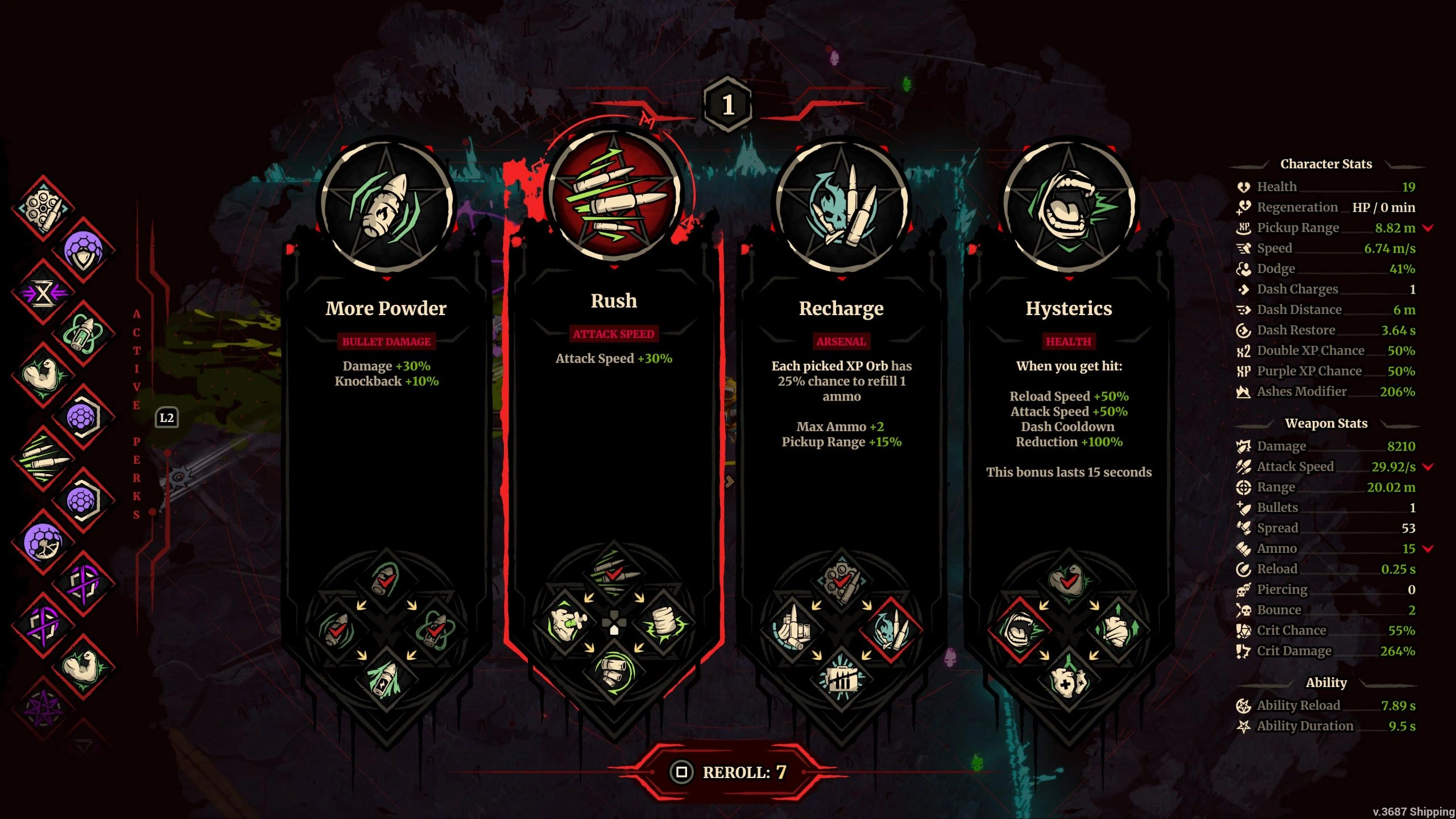
Some visual quirks appear during intense shootouts. Muzzle flash lighting can clip through the main character model on a regular basis, giving effects a flatter and less dynamic feel than the action suggests. The issue rarely disrupts play, yet it stands out because readability and feedback are so central to the game’s rhythm.
Audio supports the loop in a serviceable way. Weapon effects are clean and easy to parse, though they lack heavy physical force. The heavy metal soundtrack gives the action steady background energy and matches the pace of the swarming combat, yet it does not leave many distinct motifs behind.
The technical performance is the game’s strongest execution point. Grind Survivors keeps frame rates stable and load times fast on modern consoles, even with hundreds of sprites active at once. Accessibility options include color-blind modes, text scaling, and user interface adjustments. The automated targeting toggles also make total one-handed play comfortable, which gives the control design a practical accessibility benefit without weakening the core combat loop.
The Review
Grind Survivors
Grind Survivors successfully injects tension into the wave-survival genre through its risky, persistent Forge economy and rewarding build synergies. While its bare-bones narrative and highly repetitive biome grind prevent it from truly transforming the formula, its flawless technical performance and tactical weapon restrictions keep the action highly engaging. It is an addictive loop that rewards patience and careful planning.
PROS
- Addictive persistent weapon upgrading and crafting.
- Tense risk-versus-reward stat re-rolling.
- Flawless performance with hundreds of enemies on screen.
- Flexible, completely refundable skill trees.
CONS
- Excessive grind required to unlock new biomes.
- Minimal narrative and lack of lore.
- Repetitive, muddied environmental art design.