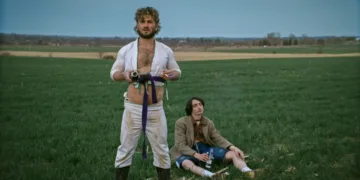





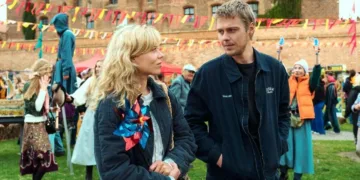


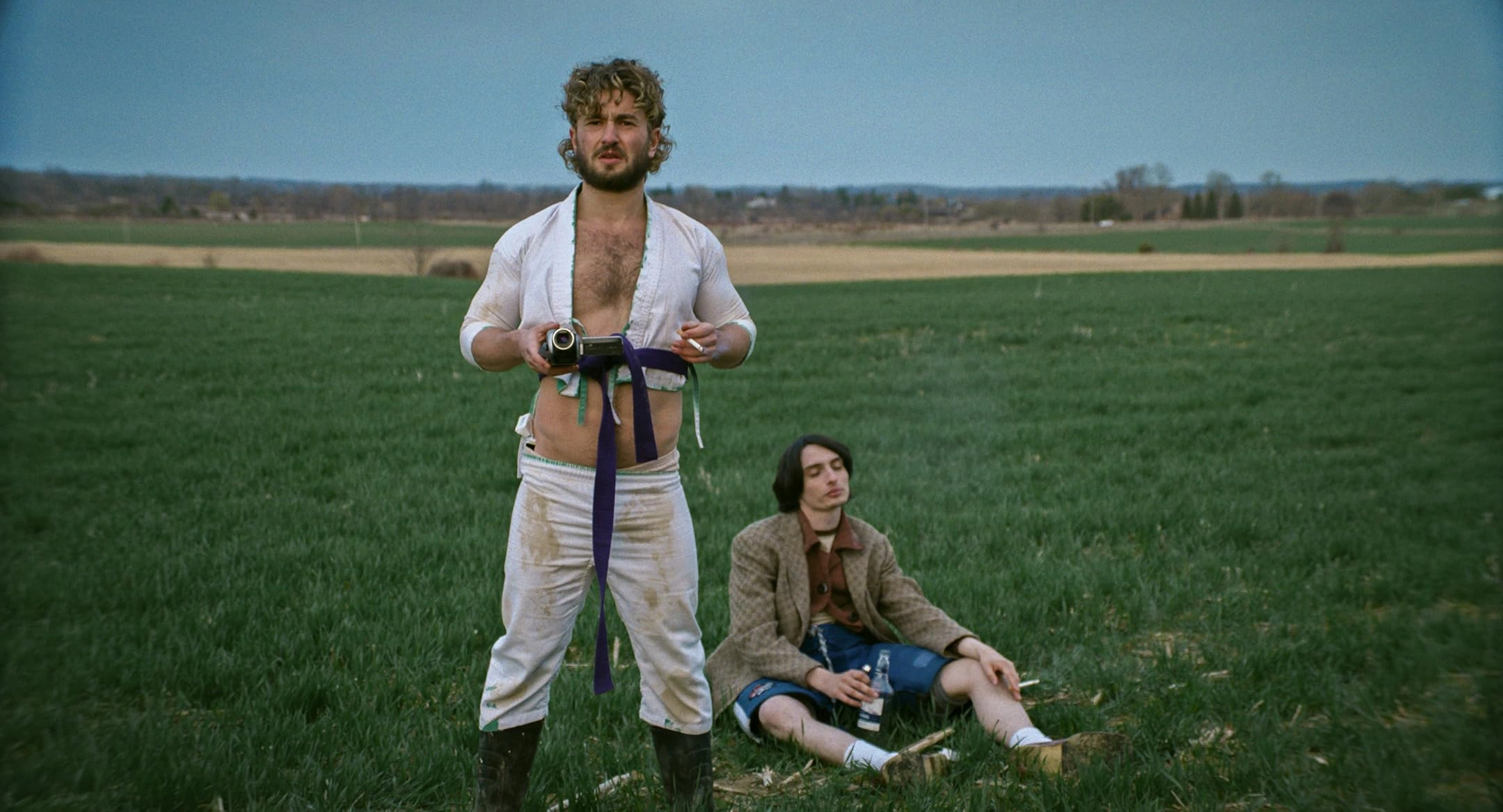

Crash Land has the posture of a prank and the pulse of an elegy. Dempsey Bryk’s feature directorial debut plants its low-budget Canadian tragicomedy in Inch, a rural town where boredom has settled into the soil like old engine oil. Clay, Lance, Darby, and Sander spend their days filming crude stunts on cheap cameras, turning bodily harm into friendship ritual. Then Darby dies after a stunt-adjacent accident, and the joke curdles.
Clay and Lance respond with the logic of boys who know pain better than language: they decide to make a “real movie” for him. Old footage of Darby will be stitched into the project, while Clay wears a paper mask as a stand-in. It is absurd. It is sad. It is also the kind of terrible idea that feels entirely honest to these characters.
Noah Parker plays Clay with wounded softness, Gabriel LaBelle gives Lance a volatile comic charge, Finn Wolfhard brings anxious strangeness to Sander, Abby Quinn grounds Jemma in quiet perception, and Billy Bryk’s Darby lingers like a ghost preserved on tape.
Homemade Cinema as Mourning Ritual
The boys’ idea of cinema is wonderfully primitive: explosions, guns, fights, car chases, girls, maybe elves if the budget permits. Their artistic vocabulary sounds assembled from overheard pop culture, masculine panic, and a desire to make noise loud enough to scare death away.
In that crude checklist, Crash Land finds its philosophy. These boys are not making a film because they understand film. They are making one because Darby’s absence has produced a hole, and the camera gives them something to point at it.
Clay becomes the film’s most delicate fracture point. He senses that the stunt videos, once a shared language, may also be a trap. Free will here looks suspiciously like poor options. Inch offers little beyond repetition, bad jobs, and the slow calcification of people who have stopped expecting escape. Clay’s grief pushes him toward self-recognition, which frightens him because identity has always been communal. To change is to risk betraying the group.
Lance resists that possibility with spectacular stupidity. LaBelle makes him funny, then lets the danger leak through. His bravado works like armor made from bottle caps. Sander, meanwhile, treats directing like a cursed assignment from a school he never attended.
Jemma enters as a corrective force, asking for emotion, beauty, and tenderness in a project designed by boys who seem allergic to all three. The film treats that allergy with sympathy. There is cruelty in their teasing, yes, and a small ethical gray cloud over their recklessness. There is love too, blunt and badly lit.
Camcorder Grain, Open Fields, and Rural Noir
Bryk’s visual approach has a ragged intimacy that suits the material. The handheld camera does not merely observe the boys; it seems to stumble beside them, slightly out of breath and half-convinced someone is about to lose a tooth.
Natural lighting gives Inch a drained, practical texture, far from the polished glow of nostalgic coming-of-age cinema. The fields, trailers, grocery aisles, and back roads feel lived in, which makes the boys’ amateur footage feel less like a stylistic gimmick and closer to local mythology.
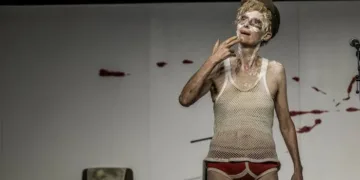
Noir usually hides guilt in alleys and cigarette smoke. Crash Land relocates that moral haze to open fields, cheap beer, flip phones, and camcorder static. Its chiaroscuro lives in behavior: tenderness against aggression, mourning against performance, loyalty against the private hunger to leave. There are no shadow-striped detectives here, unless one counts Sander in his oddball wardrobe, which would be generous to detectives.
The comedy is physical, juvenile, and often proudly idiotic. Nut shots, unsafe stunts, reckless dares, and botched filmmaking plans supply the surface rhythm. The pacing snaps between hangout looseness and sudden emotional pressure, keeping the viewer in a strange psychological state: laughing at danger, then realizing the film has been quietly measuring the cost. Sound design helps that shift. The slap of bodies, the roughness of recorded tape, and the awkward silences after grief intrudes make the audience feel how limited the boys’ emotional vocabulary has become.
Performances Caught Between Bravado and Fear
Parker gives Crash Land its bruised humanity. Clay’s face often seems a few seconds behind his feelings, as if grief has reached him before he can name it. That delay is powerful. He is sweet, confused, restless, and quietly terrified of discovering that loving his friends may require leaving some version of them behind.
LaBelle’s Lance is a comic engine with a cracked casing. His intensity can make a scene spark, especially when his confidence runs far ahead of his competence. Yet the performance avoids turning Lance into a simple loudmouth. His refusal to grow up carries the pressure of loss, class frustration, and fear disguised as certainty. Wolfhard’s Sander adds a twitchy, eccentric rhythm, giving the group an outsider within its own outsider circle.
Quinn’s Jemma could have been written as a familiar catalyst for male maturity, and the romance does flirt with expected coming-of-age patterns. Her performance keeps the character alert and self-possessed. She sees the boys clearly without treating them like a rescue mission.
Some narrative beats are familiar, especially as the film shifts from anarchic stunt comedy into softer emotional terrain. The Clay and Jemma thread risks neatness. Still, Bryk’s affection for these characters gives the film its charge. Crash Land understands that immaturity can be ridiculous and painful in the same breath. Sometimes the bravest thing a young man can do is admit that the stunt hurt.
Crash Land is a Canadian comedy film that held its world premiere at the South by Southwest Film and TV Festival on March 13, 2026. The plot tracks a group of small-town backyard stunt performers who decide to make a real movie to honor their late friend. Audiences can view the movie through its distributor, Elevation Pictures, at select independent film events and upcoming theatrical or streaming platforms as it expands its release.
Full Credits
Title: Crash Land
Distributor: Elevation Pictures
Release date: March 13, 2026
Running time: 90 minutes
Director: Dempsey Bryk
Writers: Dempsey Bryk
Producers and Executive Producers: Billy Bryk, Finn Wolfhard, Julian Geneen, Dempsey Bryk, Charles Cohen, Matthew Miller, Matt Johnson, Sam Sutcliffe, Jasmin Karibzhanova, Dias Toibazarov, Gabriel LaBelle, Brian Alkerton
Cast: Gabriel LaBelle, Finn Wolfhard, Billy Bryk, Noah Parker, Abby Quinn
Director of Photography (Cinematographer): Kristofer Bonnell
Editors: Hanna Park
Composer: Spencer Creaghan
The Review
Crash Land
Crash Land turns crude stunt comedy into a tender study of grief, masculinity, and friendship. Its familiar coming-of-age beats and slightly tidy romantic thread hold it back, yet Dempsey Bryk’s raw direction, sharp ensemble, and camcorder texture give the film bruised honesty. The jokes are often juvenile by design, sometimes beautifully so. Beneath the nut shots and reckless dares sits a sincere portrait of boys learning that pain needs a language.
PROS
- Raw, intimate visual style
- Strong ensemble performances
- Sharp balance of crude comedy and grief
- Noah Parker gives the film emotional weight
- Small-town setting feels authentic
- Film-within-a-film concept works well
CONS
- Some familiar coming-of-age beats
- Romance thread can feel a little tidy
- Crude humor may test some viewers
- A few tonal shifts land unevenly