




























Michael Gallagher’s The Leader approaches the Heaven’s Gate tragedy with a grim patience that keeps the focus on people rather than spectacle. The film dramatizes the rise of Marshall “Herff” Applewhite and Bonnie Lu Nettles, tracing how a private hunger for meaning becomes a public machine of obedience.
It is a historical drama shaped by true-crime dread, but its real interest lies in the mechanics of belief: how loneliness can be converted into loyalty, how shame can be dressed up as doctrine, and how spiritual language can make surrender feel like salvation.
The story stretches from Applewhite and Nettles’ first meeting in a Texas hospital through the formation of Heaven’s Gate, the UFO-Christian sect that began in the 1970s and ended in 1997, when thirty-nine members died in Rancho Santa Fe, California. They believed they were leaving their “human vehicles” for a higher existence tied to the Hale-Bopp comet.
Gallagher treats that belief system as strange, frightening, and deeply sad. The film never mocks the followers. It studies the ache that brought them there.
Applewhite, Nettles, and the Design of Doctrine
The film’s most powerful material comes from the bond between Applewhite and Nettles, played with unnerving precision by Tim Blake Nelson and Vera Farmiga. Gallagher frames them as two broken people who find purpose in each other, then build a theology that turns their private wounds into communal law. Applewhite carries religious guilt, sexual repression, self-loathing, and untreated instability. Nettles appears restless inside ordinary life, drawn toward spiritual command with the confidence of someone who needs belief to feel chosen.
Their teachings about celibacy, androgyny, and the “human vehicle” are presented as emotional design choices, almost like rules in a severe narrative game where every mechanic exists to erase the self. The matching haircuts, shapeless clothing, and rigid codes become a control scheme for the body. Desire is treated as a bug to be patched out. Identity becomes something to overwrite.
Nelson makes Applewhite horrifying because he never plays him as a simple monster. His wide stare, preacher gestures, and strange vocal certainty create a man who can dominate a room, then collapse inward when no one is watching. He needs followers to stabilize his own fiction. Farmiga gives Nettles a colder, sharper force. Her Bonnie understands devotion as both faith and tool. Their chemistry gives the film its electric charge: intimate, peculiar, poisonous.
The Followers and the Price of Belonging
The Leader works best when it pauses to ask why anyone would join Heaven’s Gate in the first place. The answer is rarely stupidity. Gallagher shows people drawn by need: loneliness, shame, sexual fear, grief, alienation, and the desire for structure. Applewhite and Nettles offer comfort first. Then come the manuals, the rules, the severed family ties, the surrendered names, the punishments, and the slow replacement of personal judgment with group obedience.
This is where the film’s storytelling resembles the best narrative-driven games about systems and consequence. Every small concession becomes part of a larger trap. A follower cuts off contact with family, then accepts a rule about clothing, then polices desire, then reframes suffering as proof of spiritual progress. The horror comes from progression. Nobody starts at the ending.
Jim Parsons gives the film its most aching supporting performance as Warren, a believer whose rigidity comes from fear rather than cruelty. He clings to Heaven’s Gate because its discipline seems to offer relief from himself. Simon Rex’s David and Grace Caroline Currey’s Michelle bring out the cracks in the system, especially once attraction and punishment expose the cruelty beneath the promise of transcendence.
The limitation is scope. Some followers blur together, and a few emotional arcs repeat the same pattern without enough individual texture.
A Docudrama With Horror in Its Frame
Gallagher directs The Leader with a methodical, research-heavy style that often feels close to docudrama. The VHS textures, video testimonials, direct-to-camera addresses, and tight close-ups give the film a chilling archival quality. Applewhite’s recorded persona becomes a kind of boss encounter that keeps returning: same stare, same certainty, same terrifying calm.
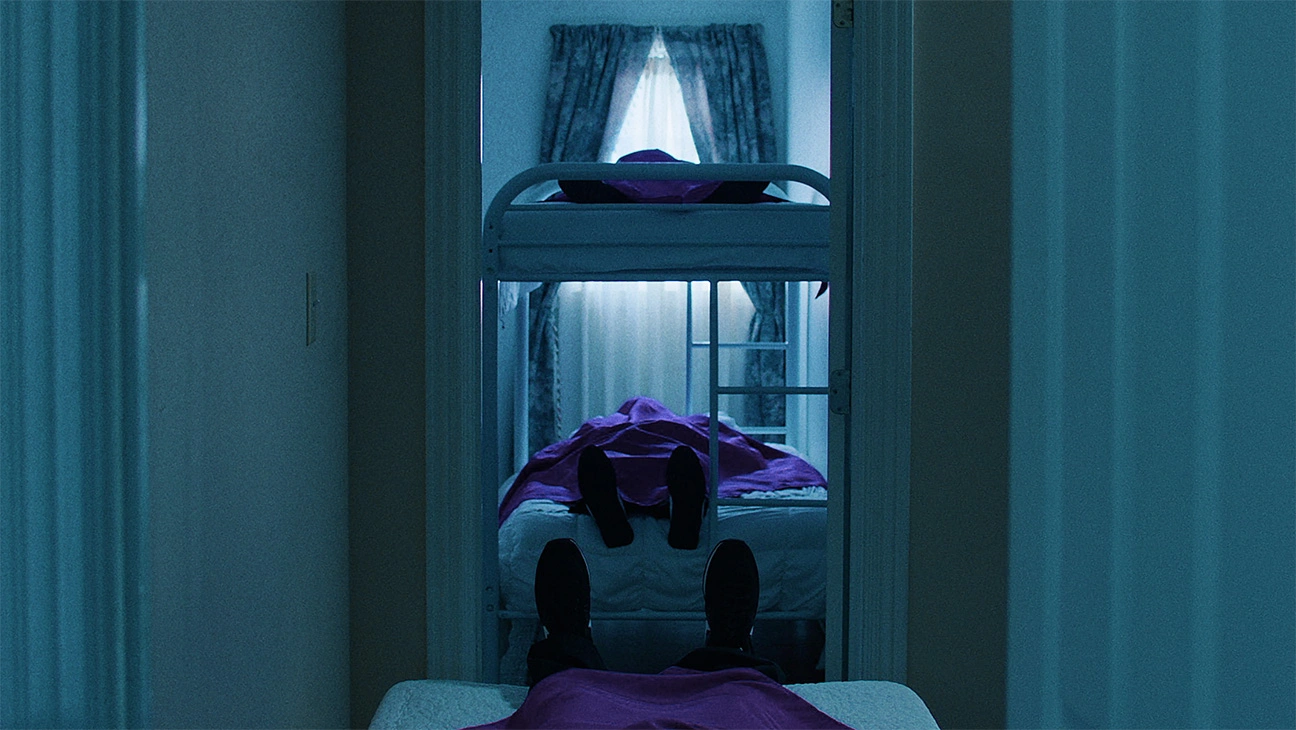
The visual approach is restrained rather than flashy. Period detail, muted interiors, and sinister lighting capture the atmosphere of 1970s spiritual experimentation, a time when fringe belief could disguise itself as liberation. The score deepens the unease, sometimes pushing the film toward psychological horror. That choice fits. Heaven’s Gate may have used the language of cosmic escape, but Gallagher keeps dragging the viewer back to rooms, bodies, rules, and fear.
The structure is less seamless. The nonlinear shape gives the film room to cover Applewhite and Nettles’ rise, Bonnie’s illness, and the group’s collapse, yet the reporter framing device can slow the momentum. Certain scenes land with devastating force, while others explain what the performances already communicate.
Still, the film’s strength is clear. The Leader turns an infamous tragedy into a study of manipulation, yearning, and belief, carried by performances that keep its dread painfully human.
The Leader is an American historical true-crime drama thriller that celebrated its world premiere at the Tribeca Festival on June 5, 2026, screening inside the Spotlight Narrative category. Written and directed by Michael Gallagher, the film explores the origins and tragic trajectory of the infamous Heaven’s Gate UFO cult. The storyline centers on the bizarre relationship between Marshall Applewhite and Bonnie Lu Nettles, portrayed by Tim Blake Nelson and Vera Farmiga, who constructed a complex doctrine mixing elements of science fiction, Christianity, and extraterrestrial ascension. The narrative follows their path from recruiting dedicated followers in the 1970s to the devastating 1997 event where thirty-nine members committed mass suicide in California. Currently playing as part of its film festival circuit run, distribution details regarding a wide theatrical release or domestic streaming home will be available following the conclusion of the festival.
Where to Watch The Leader (2026) Online
Full Credits
Title: The Leader
Distributor: Cinemand Films, Balcony 9 Productions
Release date: June 5, 2026
Running time: 104 minutes
Director: Michael Gallagher
Writers: Michael Gallagher
Producers and Executive Producers: Jana Gallagher, Michael Wormser, Joel David Moore, Matt Murphie, Cassian Elwes, Evan Silverberg
Cast: Vera Farmiga, Tim Blake Nelson, Jim Parsons, Michael C. Hall, Grace Caroline Currey, Simon Rex, J.B Yowell, Don McManus, Kelly Lynn Reiter, William Mapother, Matthew Glave
Director of Photography (Cinematographer): Ben Mullen
Editors: Joel Jay Blacker
Composer: Joseph Bishara
The Review
The Leader
The Leader is a chilling, performance-driven true-crime drama that treats Heaven’s Gate with restraint, dread, and emotional seriousness. Michael Gallagher’s film is strongest when studying how shame, loneliness, and spiritual hunger become tools of control. Tim Blake Nelson and Vera Farmiga give the story its poisonous charge, while Jim Parsons brings real sorrow to the followers’ side of the tragedy. Some pacing issues and thin supporting arcs hold it back, but its human focus makes the horror linger.
PROS
- Tim Blake Nelson gives a disturbing, layered performance.
- Vera Farmiga brings force and quiet menace to Bonnie Lu Nettles.
- Jim Parsons adds emotional weight as Warren.
- The film avoids cheap sensationalism.
- Strong use of VHS texture, close-ups, and period atmosphere.
- Thoughtful focus on vulnerability, belief, and manipulation.
CONS
- Some follower arcs feel underdeveloped.
- The framing device slows the momentum.
- A few scenes repeat similar emotional beats.
- The film’s broad timeline limits deeper character exploration.