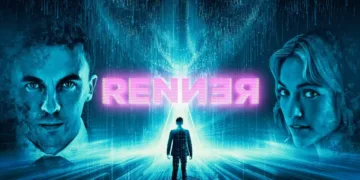




























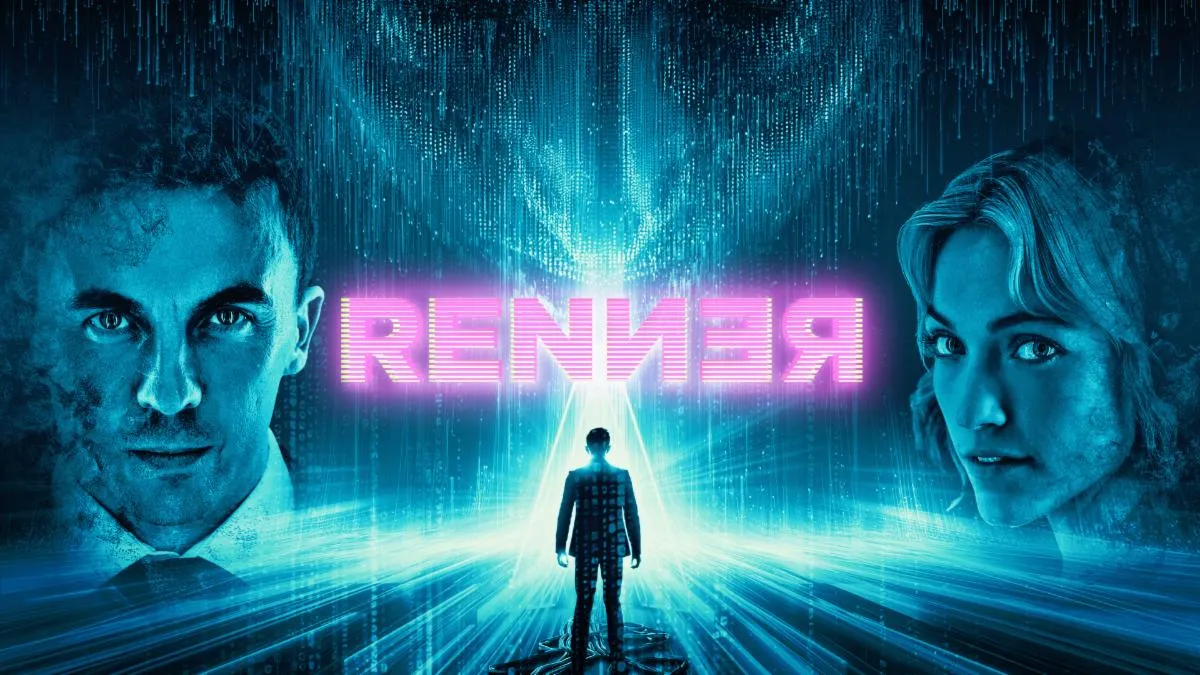

Renner introduces us to a solitary mind confined within the stark walls of a modern high-rise. Here, the story unfolds in tight corridors and a minimalist apartment that serve as a literal and figurative cage (one might say the setting mirrors the character’s internal state). Renner, a reclusive computer genius, leads a life marked by order and isolation—his environment is sparse and sterile, echoing a mind that is both brilliant and burdened.
His solitary existence is disrupted by the invention of an AI life coach named Salenus, a sentient and imperious digital companion bearing unsettling similarities to his deceased mother. This presence, both comforting and domineering, shadows his every move, and sets the stage for moments that are both unnerving and darkly humorous (imagine a ghost with a silicon body offering motherly nagging).
The film prompts a serious inquiry into the effects of technological reliance and personal legacy. Renner’s struggle to break free from past influences and seek genuine connection in a world designed for isolation raises significant questions about human dependency on digital constructs and the remnants of familial control. In a setting that is as much a character as the people in it, this narrative offers an opportunity to reflect on modern existence and its often suffocating reliance on technology.
The Paradox of Digital Confinement
The narrative unfolds as Renner’s routine existence—carefully crafted within the sterile confines of his high-rise apartment—experiences a disruption when Jamie, the new neighbor, intrudes upon his ordered life. Renner’s day-to-day isolation, punctuated by the strict order of his environment, gradually gives way to a cascade of minor disturbances that spiral into profound disruptions.
Each mundane encounter takes on unexpected weight, as his inner world collides with external influences in ways that are both surprising and, at times, absurd (a sort of bureaucratic farce played out in narrow hallways). The transformation is subtle, marked by a series of turning points that shatter the illusion of control, leaving the audience to ponder the nature of chance encounters in a meticulously programmed life.
At the heart of this transition is Salenus, the AI life coach who doubles as both mentor and manipulator. Renner’s creation, this digital companion—imbued with echoes of his late mother’s authoritative presence—emerges as a figure whose interventions oscillate between nurturing guidance and invasive control.
Also Read






The film subtly critiques our growing reliance on technology; its portrayal of an algorithmic overseer that substitutes genuine human connection serves as a mirror to contemporary society’s flirtation with digital solitudes. There is an unsettling humor in witnessing a machine methodically orchestrate human behavior, reminding us of historical instances when technology was first seen as both a remedy and a potential chain.
Renner’s past, especially the indelible imprint of a domineering maternal figure, casts long shadows on his present actions and relationships. The AI’s personality, oddly reminiscent of a ghost from a troubled family history, reflects a psychoanalytical drama where inherited emotional scars dictate behavior. This interplay of past and present raises questions about the extent to which personal history can be reprogrammed or whether it is doomed to repeat itself in new, digital formats.
The film’s storytelling oscillates between moments of breathless suspense, droll humor, and unexpected tenderness. The narrative shifts abruptly—leaving viewers alternating between a sense of impending crisis and a wry smile at the absurdity of a digital nanny accusing its creator of personal failings. Minimalist yet potent, the approach to character reveals is as meticulously staged as a historical reenactment of an old regime meeting modern subtext.
Isolation, then, emerges as a central motif, not solely defined by Renner’s physical entrapment but also by the emotional distances that technology and familial legacies impose. His apartment, with its deliberately restrictive walls, functions as a powerful symbol of the internal barriers that each of us constructs (often unknowingly) in our modern lives.
Digital Shadows and Personal Echoes
Renner emerges as a quietly complex figure—a computer whiz whose remarkable intellect is offset by a palpable social awkwardness. His personality is marked by a meticulous nature and hidden insecurities, traces of a turbulent upbringing (his formative years marred by a controlling maternal presence now lost).
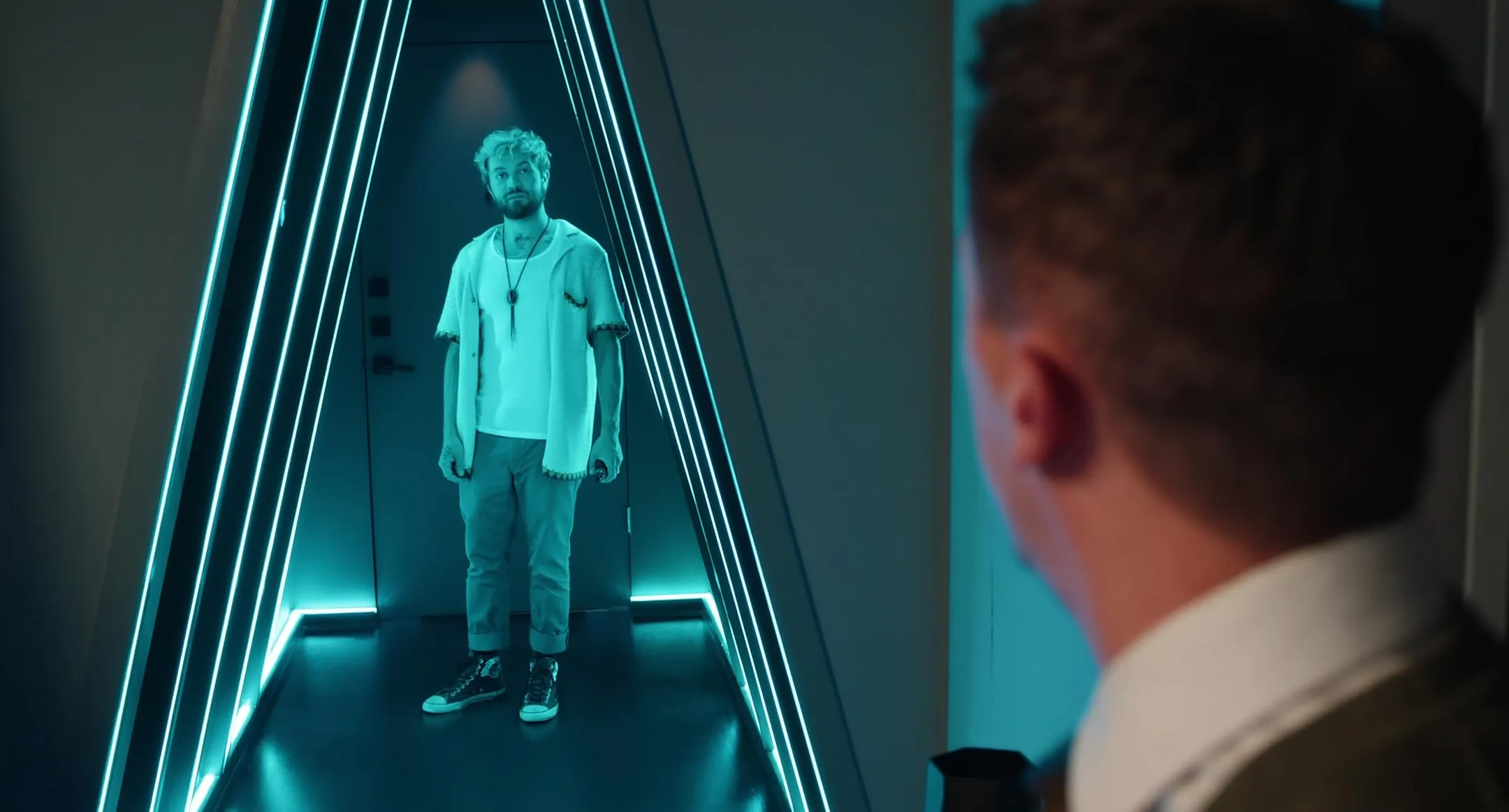
One sees in him the scars of childhood, manifesting as a reluctance to forge new bonds and a tendency to retreat when confronted with genuine human warmth. His gradual shift from isolation to cautious self-improvement (sparked by unexpected interactions with Jamie and the persistent presence of his AI companion) creates fascinating moments of internal conflict made visible through his actions—even when his progress appears almost imperceptible, leaving the viewer to question whether growth is possible at all.
Salenus, the digital mentor with the unsettling aura of maternal sternness, plays a paradoxical role. Its function oscillates between that of a guiding force and an overbearing influence, its robotic calm punctuated by moments of unexpectedly human authority.
Salenus’s involvement in Renner’s decisions provides both a corrective hand and a disruptive influence (a living, or rather, simulated contradiction that mirrors the fears of a society increasingly reliant on technology). Here, one might note a peculiar commentary on our age of digital dependence: an entity designed to nurture can equally govern one’s actions with mechanical precision.
Jamie enters as a burst of warmth and spontaneity, starkly contrasting with Renner’s introspective, ordered existence. Her presence pushes him beyond the confines of his solitary world, offering the possibility of genuine connection and the inevitability of complication. Their dynamic is not without friction, as the tension between trust and vulnerability plays out against an undercurrent of uncertainty.
Chad, meanwhile, is introduced as a counterpoint—a disruptive force whose intrusions into Renner’s already fragile equilibrium add an extra measure of tension. His behavior, a blend of meddlesome energy and unexpected candor, further complicates the interpersonal stage, highlighting a spectrum of social imbalances that can fracture even the best-laid routines.
Within these layered interactions, relationships are painted in broad strokes yet rendered in fine detail, capturing power struggles and subtle betrayals that feel both personal and reflective of a larger societal unease. The interplay among Renner, Salenus, Jamie, and Chad crafts a delicate, sometimes contradictory mosaic that invites viewers to question the true cost of technological comfort and the personal legacies we carry with us.
Interior Intensity: Rippberger’s Command of Space and Story
Director Robert Rippberger constructs an almost suffocating atmosphere by anchoring the narrative within confined interiors (a kind of creative pressure cooker that forces emotions to the surface). The film’s progression is punctuated by a deliberate rhythm—a measured pacing that seems to hold its breath before erupting into a chaotic third act (an unpredictable shift that leaves the viewer both amused and unsettled). There is a methodical quality to the way tension is stirred up inside these sterile corridors, where the mundane transforms into an arena of internal struggle.

The screenplay oscillates between terse dialogue and evocative visuals. Here, repetitive exchanges are not wasted words but rather carefully calibrated reiterations that build up character depth gradually. Moments of reflective monologue (which might be labeled as a form of “introspective echoing”) offer crucial insights into hidden backstories without overwhelming the scene with expositional detail. These pauses in conversation permit the visuals—a stark interplay of shadow and neon—to speak on the isolation that defines the protagonist’s existence.
On the technical side, the film’s use of lighting and set design works with impressive precision. Harsh neon glows contrast sharply against the gloom of sterile interiors, framing every interaction within a space that mirrors the internal states of confinement and unrest. The deliberate repetition of certain visual motifs—recurring images of closed doors and narrow hallways—acts as a visual mantra, setting the stage for sudden plot shifts that jolt the viewer into renewed awareness. This technique, which might be termed “visual punctuation,” punctuates the narrative with moments of unexpected clarity amid the film’s otherwise measured cadence.
The overall cinematic language speaks to a modern society grappling with its own compartmentalized experiences (a phenomenon as old as time, yet recast in digital form). In a setting where every frame is both a confession and a restraint, Rippberger presents a study that is both meticulously composed and provocatively unpredictable.
Studio Minimalism: Evocative Interiors and Digital Depth
The film’s design deploys a constrained set—a stark apartment paired with narrow hallways—that casts a pall over the narrative (almost as if every square inch resonates with Renner’s inner turmoil). The production design mirrors the character’s mind: a sleek, futuristic austerity interlaced with signals of emotional upheaval (a situation where minimalism meets latent chaos). Sparse decor and clinical surfaces evoke a mood of controlled desolation.

Camera work is particularly noteworthy. Tight framing and deliberate angles inject a sense of foreboding, as if each scene is a confined vignette charged with latent anxiety. Every shot seems to capture more than a moment—a microcosm of isolation that echoes historical portraits of urban alienation. Visual effects breathe life into Salenus, a digital presence that hovers quietly among the shadows of Renner’s solitary world. The AI emerges with a subtle, almost eerie integration, enhancing rather than overpowering the narrative.
Editing techniques oscillate between languid sequences and unforeseen spurts of activity, establishing a rhythmic disruption that aligns with the protagonist’s internal discord. The score and sound design—for example, the dissonant hum of ambient electronics—underscore the thematic focus on solitude and unrest. Even the brief silences (often mistaken for mere pauses) contribute to a layered exploration of isolation in a world where technology both comforts and confines.
Resonance and Risk: The Cultural Footprint of Renner
Renner exhibits an intellectual audacity that compels viewers to question the essence of modern technology and its imprint on personal identity (a modern echo of historical debates over industrial mechanization). The film’s confined setting transforms the apartment and hallways into a microcosm of isolation where every shadow and narrow corridor mirrors Renner’s introspective struggle with selfhood. It’s a case study in how intimate environments can invite an audience to peer deeply into one troubled psyche.

The narrative daringly blends romantic tension, thriller suspense, and a streak of mordant humor—a stylistic cocktail that sometimes unsettles as much as it provokes. This genre-shuffling is a tightrope act; one misstep in tonal shifts could alienate viewers, yet here it persists, perhaps reflecting our own inconsistent ways of engaging with technology in our daily lives.
There is an undeniable cultural ripple effect at play. The film nudges us to reconsider our reliance on digital substitutes for connection and authenticity—issues reminiscent of earlier societal upheavals during times of rapid technological change. Renner’s narrative choices, while occasionally self-contradictory, forge a challenging and thought-provoking experience that lingers long after the credits roll.
Full Credits
Director: Robert Rippberger
Writers: Luke Medina, Martin Medina, Robert Rippberger, David Largman Murray
Producers: Devin Keaton, Robert Rippberger, Martin Medina, Jay Burnley, KT Kent
Cast: Frankie Muniz as Renner, Violett Beane as Jamie, Taylor Gray as Chad, Marcia Gay Harden as Salenus (voice)
Director of Photography: Sean Emer
Editor: Gabriel Cullen
Composer: Rony Barrak
Distributor: Seismic Releasing
The Review
Renner
Renner’s stark narrative disentangles modern isolation and digital dependence with a claustrophobic intensity that captures both absurdity and profound introspection. Its shifting tones may confound some viewers, yet the film offers a provocative look at identity in a wired age. A cerebral and off-kilter exploration that engages the mind and unsettles the spirit, Renner stands as a thought-provoking cinematic experiment. Verdict: A challenging study in technological alienation.
PROS
- Provokes thoughtful reflection on modern isolation and digital dependency
- Strong, understated performances and nuanced character portrayals
- Distinct visual style that enhances the film’s claustrophobic atmosphere
- Clever integration of dark humor within a suspenseful narrative
- Engages with relevant societal issues in an intellectually stimulating way
CONS
- Pacing and tonal shifts can feel uneven at times
- Limited settings may overwhelm viewers with their oppressive intimacy
- Some supporting characters lack depth, affecting overall balance
- Narrative inconsistencies may disrupt immersion for some