























There is a particular cruelty in the promise of perfection. For Milla, the protagonist of Lucky Kuswandi’s A Normal Woman, life is a pristine surface. She and her husband Jonathan are the aspirational faces of Eternity Life, a supplement brand that trades in the very fantasy that holds her captive.
They inhabit a world of clean lines and social graces, a life built on the brittle foundation of image. The first fissure in this facade appears not as a dramatic explosion but as a quiet, insidious suggestion: that her daughter, Angel, must be surgically altered to fit the family’s aesthetic. This proposition, an act of casual violence against her child’s form, becomes the catalyst.
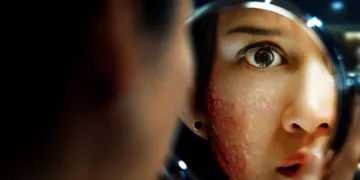
A strange malady takes hold, an uncontrollable itch, a rash that blooms across her skin. Milla’s body begins to speak a language her conscious mind cannot, initiating a terrifying pilgrimage into the integrity of her own sanity.
The Body as Battleground
The flesh will not be silenced. As Milla’s world constricts under the weight of expectation, her body becomes the site of a bloody rebellion, a canvas for the psychological torment she is forbidden from expressing. The film’s horror is not one of external monsters but of internal mutiny, a civil war waged on the cellular level.
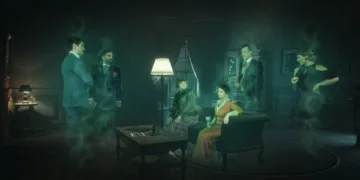
The frantic scratching is a desperate excavation, an attempt to claw through the layers of a false self to whatever truth lies beneath. Visions of a bloody, unknown child appear like ghostly delegates from a forgotten country, holding a claim to her that she cannot comprehend. She vomits glass, a visceral, physical rejection of the sharp, indigestible truths she has been forced to swallow daily.
This is the body as an unreliable text, screaming its anguish when the voice has been suppressed. It becomes the repository for every unspoken resentment, every swallowed humiliation. The gaslighting she endures is a second, more profound violence. Her husband’s calm, rational tone and his family’s feigned concern are instruments of existential erasure, designed to invalidate her perception of reality.
Also Read






They are not just ignoring her pain; they are denying its existence, a quiet psychic murder performed for the sake of social comfort. Her amnesia, a void where a childhood should be, is thus reframed. It is not a blank space but a sealed tomb, and her affliction is the body’s violent, clumsy attempt to dig up its own buried history without a map.
Orbits of Cruelty and Grace
To exist is to be seen by another, and in Milla’s life, most gazes are instruments of judgment, reinforcing the bars of her prison. Her mother-in-law, Liliana, is not merely a person but a force of nature, a high priestess of the social order who polices the surfaces upon which their world is built.

Her cruelty is a defense mechanism, a desperate warding off of the imperfection and truth that Milla’s condition threatens to expose. Hell, as a philosopher once noted, is other people. Yet the film offers a singular, defiant counterpoint in the form of Angel. Milla’s daughter becomes her sole witness, the one person whose belief acts as an anchor, preventing her mother’s complete dissolution into the madness others prescribe for her.
Angel’s unwavering loyalty is not a simple plot device; it is a flicker of grace in an expanding darkness, a testament to a connection that transcends the transactional cruelty surrounding them. Into this dynamic enters Erika, a figure from Milla’s forgotten past who embodies a different, more predatory mode of survival. Her opportunism, her attempt to usurp Milla’s life, is a dark mirror of Milla’s own constructed existence.
The narrative’s brief, jarring shift to her perspective provides a glimpse into the logic of a world where identity is a commodity to be seized. The film presents these female relationships as a constellation of forces—some that crush, some that anchor, and some that simply pass by, their intentions as murky as Milla’s own fractured memories.
A Freedom Paid in Scars
There is no monster to be slain, no ghost to be exorcised outside the self. The film’s final revelation is that the horror was always personal, the mystery collapsing inward until it rests on the fragile nature of identity. Milla’s entire life, she discovers, was a careful construction, an identity grafted onto her in the wake of a devastating trauma.

The archaeology of her soul is complete, and what she unearths is not the person she is, but the person she was prevented from becoming. Marissa Anita’s performance is a masterful study in quiet devastation; she does not act out the pain but allows it to inhabit the tension in her hands, the slump of her shoulders, the geography of her face.
She carries the weight of a life that is not her own. The film’s slow, deliberate pace feels less like a narrative choice and more like an experiential state, forcing the audience into Milla’s subjective time, where each moment of anxiety stretches into an eternity. It defies easy catharsis. Liberation is achieved not as a clean victory but as a shattering.
Milla may reclaim her history, but she is left standing in the wreckage of the life she once knew, facing the terrifying freedom of the void. The film leaves us with a difficult, resonant truth: that to find oneself, one must often lose the person they were forced to be, a process that leaves indelible scars. True identity is not a destination, but a painful, continuous negotiation with the past.
“A Normal Woman” is a psychological drama film directed by Lucky Kuswandi that premiered on Netflix on July 24, 2025.
Full Credits
Director: Lucky Kuswandi
Writers: Andri Cung, Lucky Kuswandi
Producers: Kevin Ryan Himawan
Cast: Marissa Anita, Dion Wiyoko, Gisella Anastasia, Mima Shafa, Widyawati, Kiki Narendra, Maya Hasan, Aida Nurmala, Fadi Alaydrus, Elkie Kwee, Melissa Karim, Alvin Adam, Hatta Rahandy, Alexa Jeslyn Hendrawan, Sari Koeswoyo, Feri Sumayku, Jasmine Laura Arendsen, Caitlyn Sevlin Gunawan
Director of Photography: Batara Goempar
Editors: Dinda Amanda
Composer: Abel Huray
The Review
A Normal Woman
A Normal Woman is a philosophically dense and emotionally resonant psychological thriller that foregoes cheap scares for a far more unsettling exploration of trauma, identity, and the violence of conformity. Anchored by a masterful and contained performance from Marissa Anita, the film uses the language of body horror to articulate a profound internal crisis. While its deliberate, slow-burn pacing may test some viewers, its haunting inquiry into the nature of the self and the painful cost of reclamation makes it a deeply compelling and thought-provoking watch.
PROS
- A powerful and nuanced lead performance by Marissa Anita.
- Intelligent use of body horror as a metaphor for psychological suffering.
- A thoughtful and challenging exploration of trauma, gaslighting, and identity.
- The strong, believable emotional core of the mother-daughter relationship.
CONS
- The deliberate, slow pacing can feel drawn out in certain sections.
- Some supporting character arcs, particularly Erika's, feel underdeveloped.
- The narrative's central cycle of suffering can feel repetitive before the final revelations.