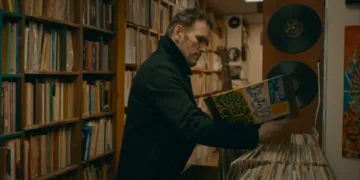





























The American romance with the open road is a story we tell ourselves constantly. It is a myth of freedom, of shedding a settled life for the promise of experience somewhere to the west. Director Ebs Burnough’s documentary, Kerouac’s Road: The Beat of a Nation, positions itself as an inquiry into the source code of that myth: Jack Kerouac’s 1957 novel, On the Road.
The film sets out to understand why this specific book maintains its powerful hold on the nation’s psyche, acting as a rite of passage for generations of restless souls. Burnough connects the post-war restlessness of the Beat Generation to the questions facing Americans today, asking what it means to hit the road now.
With passages from the novel read by Michael Imperioli providing a steady, rhythmic pulse, the documentary presents itself not as a simple biography but as a multi-layered investigation into a cultural artifact that refuses to fade away. It is an ambitious undertaking from the start.
A Patchwork of American Stories
The film’s narrative architecture is its most defining and challenging feature, constructed from three distinct threads that the film braids together with varying success. The first is a biographical sketch of Kerouac, assembled from archival news footage, grainy home movies, and valuable recollections from friends like the still-lively musician David Amram and the writer Joyce Johnson.
This thread offers tidy revelations that re-frame the author not as a purely American icon but as an outsider. We learn his first language was French, a product of his French-Canadian heritage, and that his formative years included a stint in the Merchant Marine during World War II. The second thread is a symposium of cultural analysis from a wide range of modern artists.
Josh Brolin speaks with the passion of a young man whose life was changed by the book, while author Jay McInerney offers a more academic view on the novel’s prose and its place in literary history. The third strand departs from the past entirely, following three contemporary road-trip narratives meant to act as modern echoes. This structural choice, layering history with analysis and current events, is a high-wire act for editor Paul Trewartha, who must find a coherent rhythm in what often feels like three different films competing for screen time.
Also Read






Appreciating a Flawed Classic
To its credit, the documentary’s complex structure makes space for a refreshingly critical examination of its subject. This is no simple tribute. The film celebrates the novel’s kinetic, jazz-infused energy while directly confronting its most significant failings, treating it not as scripture but as a product of its time.

The critique of the work’s embedded misogyny is sharp, with commentators, including Kerouac’s former girlfriend Joyce Johnson, noting that the female characters were often flat props in a male psychodrama, existing only in service of the men’s quests for kicks.
The analysis also widens its lens to include race and privilege. The film is smart to acknowledge the profound freedom afforded to a white man roaming the country in the late 1940s, a liberty not available to most. W. Kamau Bell memorably speculates on the very different, perhaps more profound, book that might have emerged had Kerouac hit the road with James Baldwin.
The documentary also touches on the destructive nature of the fame Kerouac achieved, with actor Matt Dillon observing how sudden celebrity can corrode the very authenticity a writer seeks to capture. This willingness to hold fondness and criticism in the same hand is the film’s greatest strength.
Modern Journeys, Mixed Results
The narrative decision to include the three modern journeys is the film’s biggest gamble, and its least successful. The intention is clear: to prove the timelessness of Kerouac’s restless spirit by showing it manifest in the lives of people today.
We follow Amir, a young Black man from Philadelphia whose trip south to college in Atlanta is framed as a modern migration. We see Diana, a retiree in a camper van seeking a final reconciliation with her estranged, elderly father. And we join Tino and Tenaj, an empty-nester couple documenting their new life in a van. The problem is not with their stories, which are individually affecting.
The issue is structural. These threads feel like sentimental detours that interrupt the film’s intellectual momentum. They break the flow of the more potent discourse about Kerouac, his art, and his complex legacy. Where the analysis of the book is sharp and specific, these segments feel generalized and emotionally diffuse, operating on a different narrative frequency. They feel less like an integral part of the film’s argument and more like a separate, smaller documentary that has been awkwardly inserted.
The Unfocused but Fascinating Ride
The result of this ambitious construction is a film that feels sprawling and, at times, profoundly unfocused. Its thematic map is crisscrossed with so many routes that it often loses its way. Yet for all its structural flaws, the documentary remains a worthwhile and often engaging piece of work.
There is a sense that its chaotic, multifaceted nature unintentionally mirrors the sensory-overload quality of Kerouac’s novel itself. The film is a cascade of voices, images, and ideas that do not always harmonize but are rarely dull. Its primary value is in its multifaceted approach and its refusal to provide a single, easy answer about the book or the complicated man who wrote it on a legendary scroll of paper.
It does not seek to be the definitive documentary on Jack Kerouac. Instead, it functions as an effective conversation starter, successfully reopening the debate around a foundational American text for a new generation. As one commentator notes, the book is not perfect, but decades later, we are all still talking about it. This film shows us why that conversation still matters.
Kerouac’s Road: The Beat of a Nation is a documentary that premiered at the Tribeca Film Festival in June 2025 and was released in theaters on August 1, 2025.
The Review
Kerouac's Road: The Beat of a Nation
Kerouac’s Road: The Beat of a Nation is an ambitious and intellectually engaging documentary that successfully reopens the conversation around a flawed American classic. While its sprawling, multi-part structure often feels unfocused and the modern-day narrative threads prove to be a distracting detour, the film's core analysis is sharp and insightful. It's a fascinating, if messy, ride that values critical inquiry over simple reverence, making it a worthwhile watch for anyone interested in the complex legacy of On the Road.
PROS
- Offers a critical and nuanced examination of both Kerouac and his novel.
- Features engaging archival footage and insightful commentary from a diverse group of contributors.
- Successfully avoids becoming a simple tribute, instead treating its subject with complexity.
CONS
- The narrative structure is unfocused and tries to cover too much ground.
- The three contemporary road trip stories feel sentimental and distract from the central analysis.
- The film's pacing is uneven due to the constant switching between its different threads.