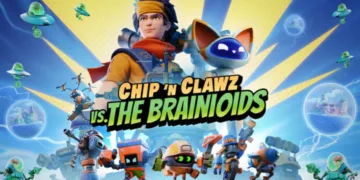



























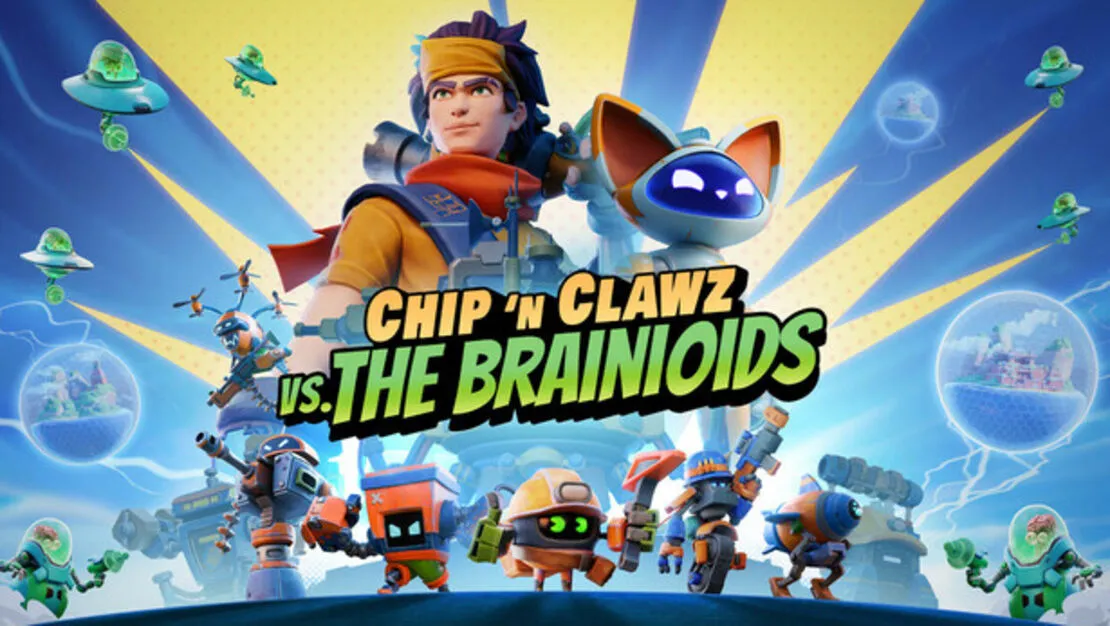

When you hear the name Julian Gollop, your mind probably jumps to the tense, tactical battlefields of X-COM. It’s a name synonymous with methodical, turn-based strategy where every decision carries immense weight. His new game, Chip ‘n Clawz vs. The Brainioids, is something else entirely. This title throws the grim realities of an alien invasion into a blender with the cheerful energy of a Saturday morning cartoon.
It tells a simple, goofy story of an inventor named Chip and his robot cat, Clawz, fighting to save Earth’s supply of a resource called Brainium from a horde of aliens called the Brainioids. The game is an energetic and surprising fusion of third-person action with real-time strategy and tower defense. It swaps methodical planning for chaotic, colorful skirmishes, presenting an experience that is immediately charming and accessible.
The General and The Soldier
Chip ‘n Clawz asks you to wear two hats at once, and it’s in this demanding dual role that the game finds its unique, if sometimes frantic, identity. From a distance, it operates as a streamlined real-time strategy game. The economic model is refreshingly simple, revolving around a single resource: the glowing crystals of Brainium. You construct mining outposts, and your automated miner bots diligently begin harvesting, freeing you from the complex resource chains that define many other RTS titles.
This Brainium is your lifeblood, spent on everything from defensive gun turrets to the barracks that produce your robotic army. The units themselves fit into neat archetypes. Hardy Boxer bots march forward to engage in melee, agile Shooter bots provide covering fire from a distance, and flying drones harass enemies from the air. Later, you gain access to powerful Artillery structures that can bombard enemy bases from afar.
The “Commander Mode” allows you to pull the camera back for a traditional top-down view. From here you can quickly place buildings and assign rally points, directing your entire robotic force to a single location. It’s a functional system, though it lacks the granular control of its more serious peers; you cannot assign complex patrol paths or create specific control groups. Your command is a blunt instrument, a way to point your army in the right direction before you dive into the fray yourself.
The moment you leave Commander Mode, the game becomes a hands-on third-person action title. You are on the ground, a single unit in the army you just commanded. The combat is direct and simple. A single button handles your melee attack, which can be strung together into a basic combo, while another fires your ranged weapon, which operates on a limited ammo supply you must replenish. The two heroes offer genuinely different approaches to the battlefield.
Chip, the human inventor, zips around on a hoverbike, allowing him to flank enemy positions or rush back to defend a weak point. His key ability is “overdrive,” a temporary boost he can apply to any friendly building or unit. Overdriving a barracks at a critical moment can double its production speed, creating a tide-turning wave of reinforcements.
Clawz, the robotic cat, provides essential support. His jetpack offers vertical movement, letting him reach high ledges for collectibles or rain fire from above. His most crucial skill is his ability to repair damaged units and structures in the field, saving you the costly expense of rebuilding them from scratch.
The core experience of Chip ‘n Clawz is the constant, fluid transition between these two modes of play. One moment you are a general, assessing the flow of battle and allocating resources. The next, you are a soldier, weaving through enemy fire to help a group of your Shooters take down a formidable alien brute. This hybrid design recalls other ambitious genre blends like Brutal Legend or the much older Herzog Zwei.
When it works, it creates a thrilling sense of empowerment. You are not just an abstract commander; you are the heroic leader of your army. Yet, this constant context-switching is also the game’s greatest challenge. The heat of a battle can make it difficult to pull back and think strategically, while spending too much time in Commander Mode can leave your hero vulnerable. Finding the rhythm where you can effectively manage both your army and your own actions is the central skill the game asks you to develop.
An Eight-Hour Alien Scramble
The game’s campaign provides the main stage for its mechanical experiments, unfolding over an eight-hour adventure. The story is light and serves mostly as a cheerful backdrop for the action. The dialogue is filled with jokes and fourth-wall-breaking humor that aims for a younger audience, keeping the stakes enjoyably low. You are not saving humanity from extinction; you are stopping some greedy, goofy-looking aliens from stealing your planet’s shiniest rocks.
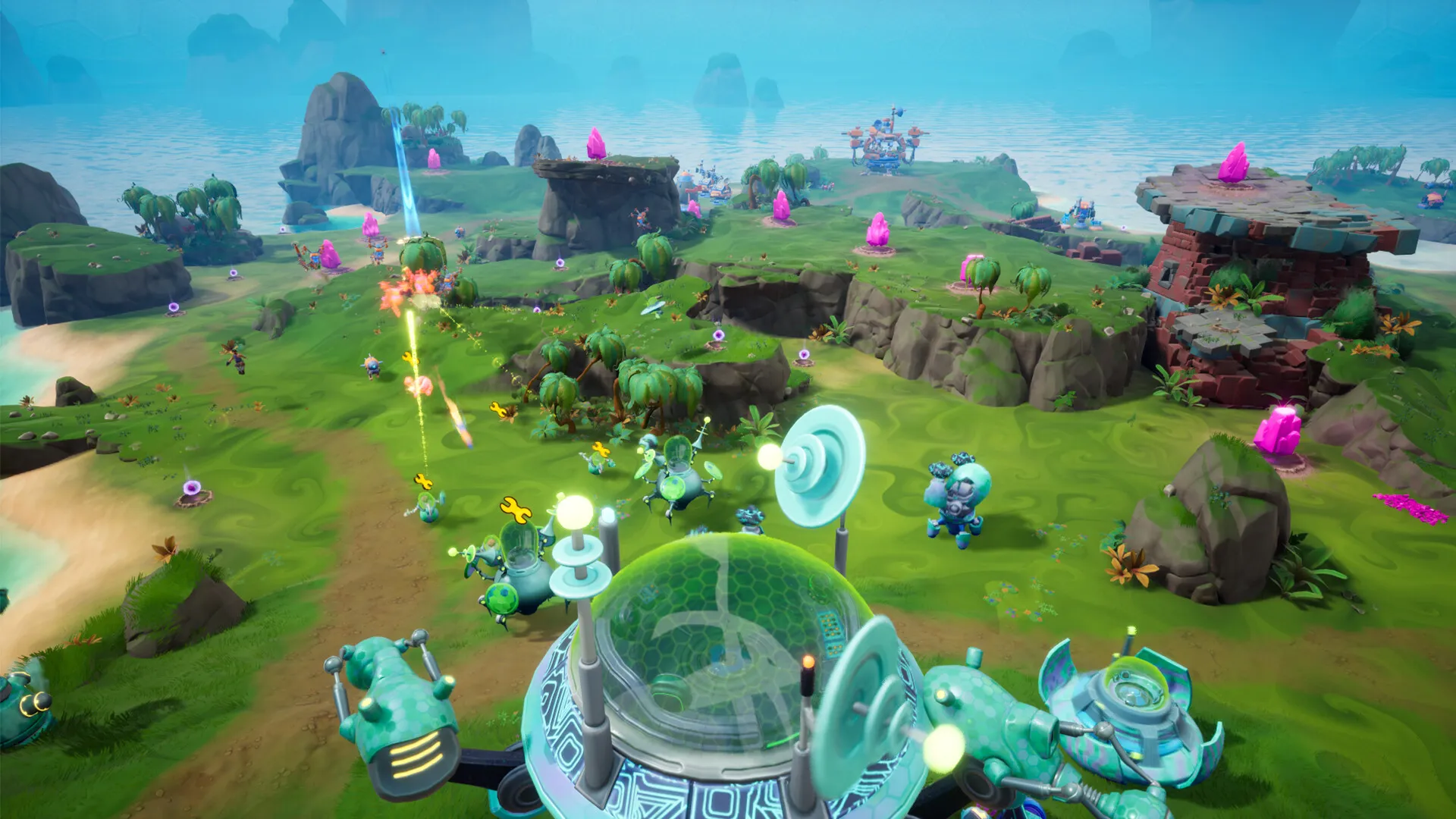
This lighthearted tone permeates the mission design, which typically involves a tug-of-war where you must destroy the enemy’s main base while protecting your own. The formula is occasionally broken up by escort missions or pure base-defense scenarios that test your ability to build effective fortifications.
A particularly interesting design choice is how the campaign handles progression. Instead of permanently unlocking units that carry over between missions, you often start each level with only your basic miners. You must then explore the map to find blueprints, which grant you access to your other unit types for that stage only.
This decision has a significant effect on pacing. It forces you to constantly re-evaluate your strategy based on which units you find first and prevents you from defaulting to a single powerful army composition. It can feel like a clever, rogue-lite-inspired twist that encourages improvisation. For some players, this reset may feel like an annoyance, making the beginning of each mission a repetitive scramble to rebuild your arsenal from scratch.
When the campaign introduces its large-scale boss battles, the game’s blend of action and strategy is put to the test. These encounters are multi-stage affairs that cannot be won through brute force. One fight might require you to have Clawz constantly repairing a set of key defensive towers that are the only things capable of damaging the boss, while you use Chip to zip around the arena, clearing out the smaller enemies that are trying to disable those towers.
These moments are highlights that demand you engage with the game’s full mechanical toolset. Replayability is encouraged through a series of optional objectives in each mission, along with a star-rating system. Earning a perfect five-star rating, however, requires you to complete the level on the highest difficulty. This may feel like artificial padding to players who prefer to experience the game on a standard difficulty first, effectively asking them to play through the campaign twice to see everything.
The primary weakness of the campaign is a gradual sense of repetition. The strategic layer is not quite deep enough to sustain its length, and many later missions can be won by identifying the strongest unit and simply overwhelming the AI with numbers. The simple third-person combat also lacks the depth to remain engaging on its own, making some of the longer missions feel like a grind.
Better with a Buddy
While the solo campaign is a perfectly enjoyable experience, Chip ‘n Clawz reveals its true potential when played with another person. The entire campaign is designed for drop-in, drop-out cooperative play, a feature that elevates the whole game. This co-op is available both online and, most impressively, via local split-screen. Bringing back couch co-op for a strategy game is a rare treat, and it makes this title an exceptional game to share with a friend.
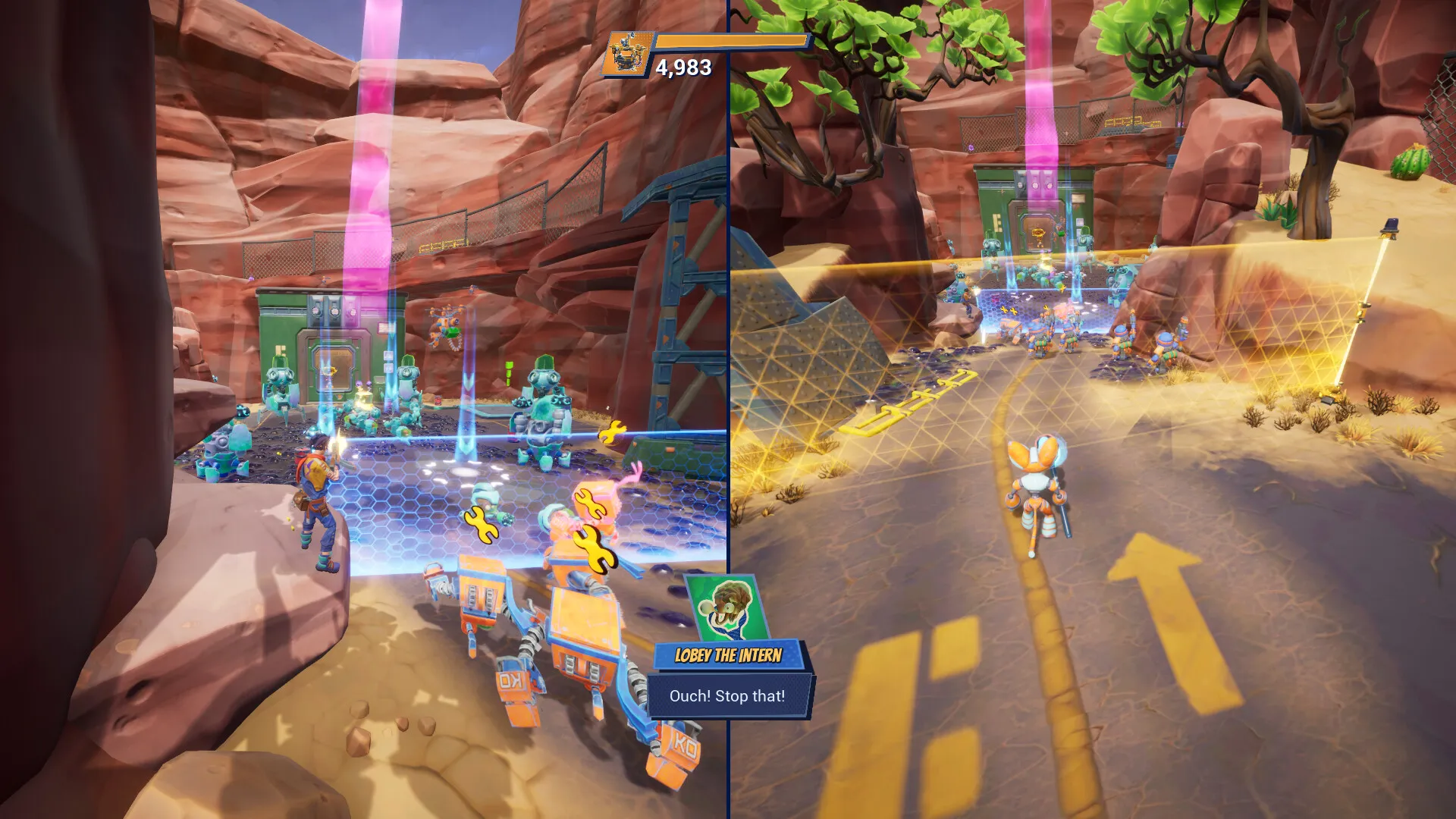
The experience is immediately more dynamic and manageable with a second player. A common strategy involves one player taking on the “macro” role, focusing on base building and resource management, while the other player leads the “micro” charge on the front lines, using their hero’s abilities to support the robot army directly.
This division of labor feels natural and makes executing complex plans much easier. The difficult boss fights become less about frantic multitasking and more about coordinated teamwork. Having Chip and Clawz on the field at the same time, combining their unique skills, feels like the intended way to play.
For those with a competitive streak, a Versus mode offers a chance to battle against other players. It supports both 1v1 and 2v2 matches, which are also playable online or in local split-screen. In a player-friendly move, all units and base upgrades from the campaign are unlocked from the start, so you can jump straight into the action without having to grind through the single-player story first. The PvP can be thrilling, as human opponents are far less predictable than the game’s AI.
Some balance issues were noted, with certain passive base modifications feeling significantly more powerful than others, leading to some very short, one-sided matches. An interesting design element in this mode is the “panic button.” A few minutes into a match, this option becomes available to both sides.
Activating it provides an immediate, massive injection of Brainium, but it also places your base on a short self-destruct timer. It’s a high-risk, high-reward mechanic designed to prevent matches from stagnating. It gives a losing player a final, desperate chance to mount a comeback, ensuring that competitive games end with a bang instead of a whimper.
Saturday Morning Charm
The game’s personality is its strongest asset, delivered through an art style that feels like a loving homage to the colorful 3D platformers of the PlayStation 2 era. The visuals are bright and bold, with stylized environments and character models that would look right at home in a game like Ratchet & Clank or Jak and Daxter.
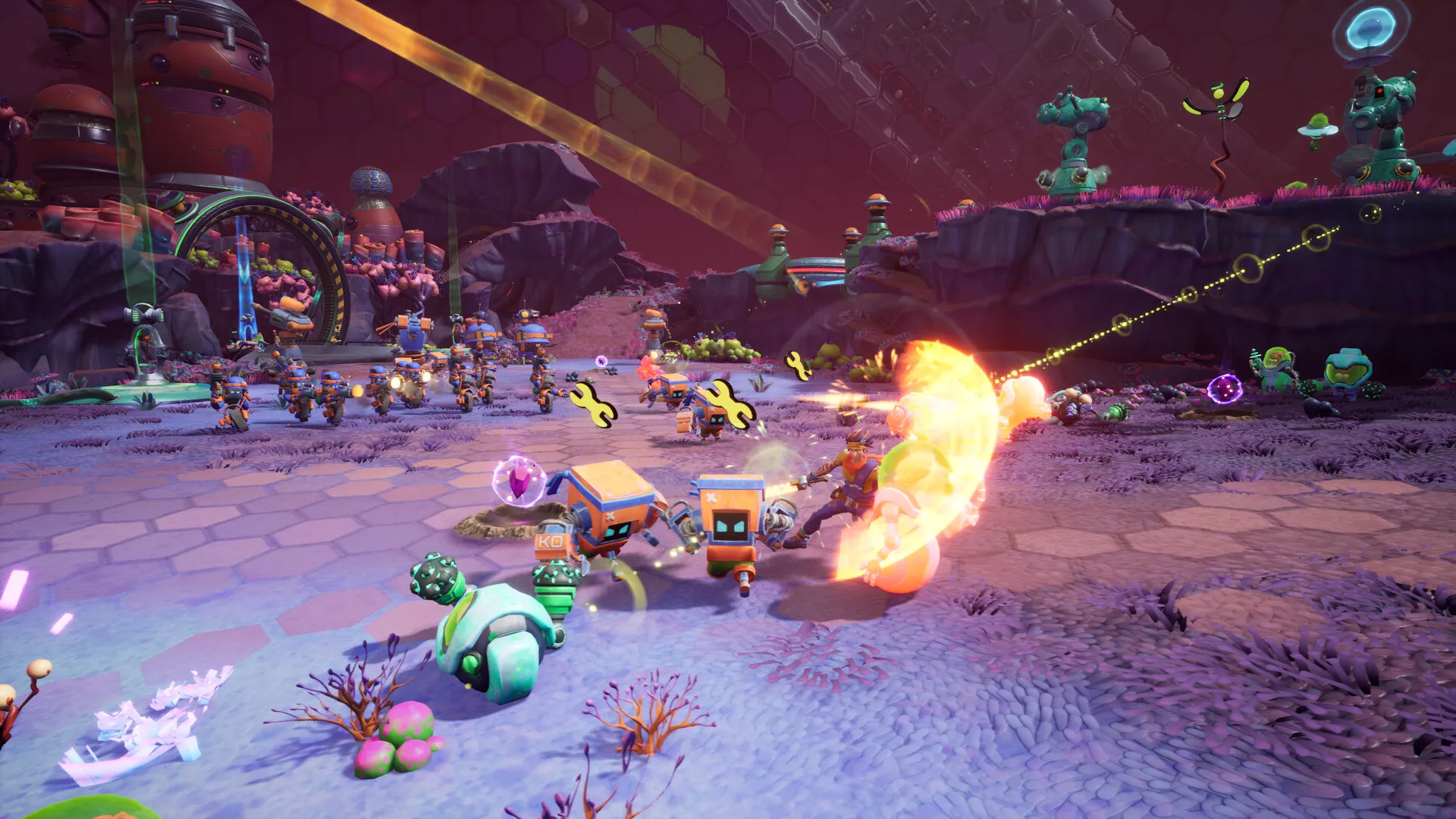
This aesthetic choice perfectly complements the lighthearted tone. The enemy Brainioids are a highlight, with a variety of wacky designs that range from small, skittering brains in jars to massive, lumbering war machines. They are more goofy than menacing, which keeps the atmosphere fun and inviting for players of all ages.
The audio design works hard to support this cheerful vibe. The voice acting is enthusiastic and well-delivered, bringing the cartoonish characters to life. The script is filled with self-aware humor that, while simple, generally lands its jokes and contributes to the game’s overall charm. The soundscape of a battle is functional, though it lacks the punch and clarity of more polished titles.
Attacks and explosions can sometimes blend into a general cacophony, making it difficult to pick out specific audio cues in the heat of the moment. The music is upbeat and fitting for the action, but it rarely stands out and is not particularly memorable. A minor annoyance comes from the repetition of voice lines, especially during long fights or when you repeatedly perform the same action, which can slightly wear down the game’s otherwise delightful presentation.
The Review
Chip ‘n Clawz vs. The Brainioids
Chip ‘n Clawz vs. The Brainioids is a wonderfully charming and inventive game that successfully merges action and strategy into a fun, accessible package. Its greatest strength is its fantastic cooperative play, which makes the entire campaign a joyous romp with a friend. While the experience is hampered by a lack of strategic depth and some repetitive mission design that holds it back from greatness, its personality and creative spirit make it an easy recommendation for anyone looking for a lighthearted and engaging adventure.
PROS
- Excellent and fun cooperative mode, including local split-screen.
- Charming, colorful art style and lighthearted personality.
- An interesting and accessible blend of third-person action and real-time strategy.
CONS
- Strategic gameplay lacks significant depth.
- Campaign pacing suffers from repetitive objectives.
- Third-person combat is mechanically simple and can become monotonous.