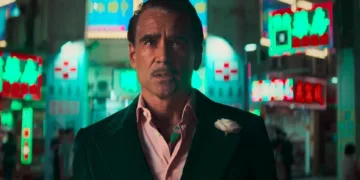



























The film begins not with a bang, but with a word. A single, guttural profanity breathed into the stale air of a Macau hotel suite by Lord Doyle, a man waking to the familiar terror of himself. This raw utterance is our entry point into a world already deep in consequence, a descent that started long before the cameras began to roll. Doyle, portrayed by Colin Farrell, is a specter haunting the casinos, a British con man whose fraudulent lordship is the last fraying thread of a collapsing identity.
He is a performance artist of ruin. His immediate crisis is mundane yet absolute: a massive hotel bill is due in three days, and he possesses nothing but the mounting weight of a past he cannot outrun. Edward Berger immediately submerges us in the frenetic, hallucinatory pulse of this life, set against the neon glare of Macau. The city is a purgatory of chance, its endless night a perfect mirror for a soul adrift in its own chaos.
The Hungry Ghost in Velvet
Colin Farrell does not simply play a man at his limit; he dissolves into the very physiology of desperation, making the body a landscape of spiritual decay. His performance is a study in entropy, etched into the perpetual sweat that slicks his skin and the ceaseless tremor that lives in his hands. He radiates an anxious energy that suggests a body on the verge of total system failure, an organism rejecting its own inhabitant.
When Doyle eats, it is a grotesque spectacle of consumption. He shovels food into his mouth with a rapaciousness that speaks less of physical hunger and more of a metaphysical void he is trying to fill by force. It is a demanding, vanity-free inhabitation of a character that marks a significant point in Farrell’s career, a willingness to portray the complete abjection of a human being.
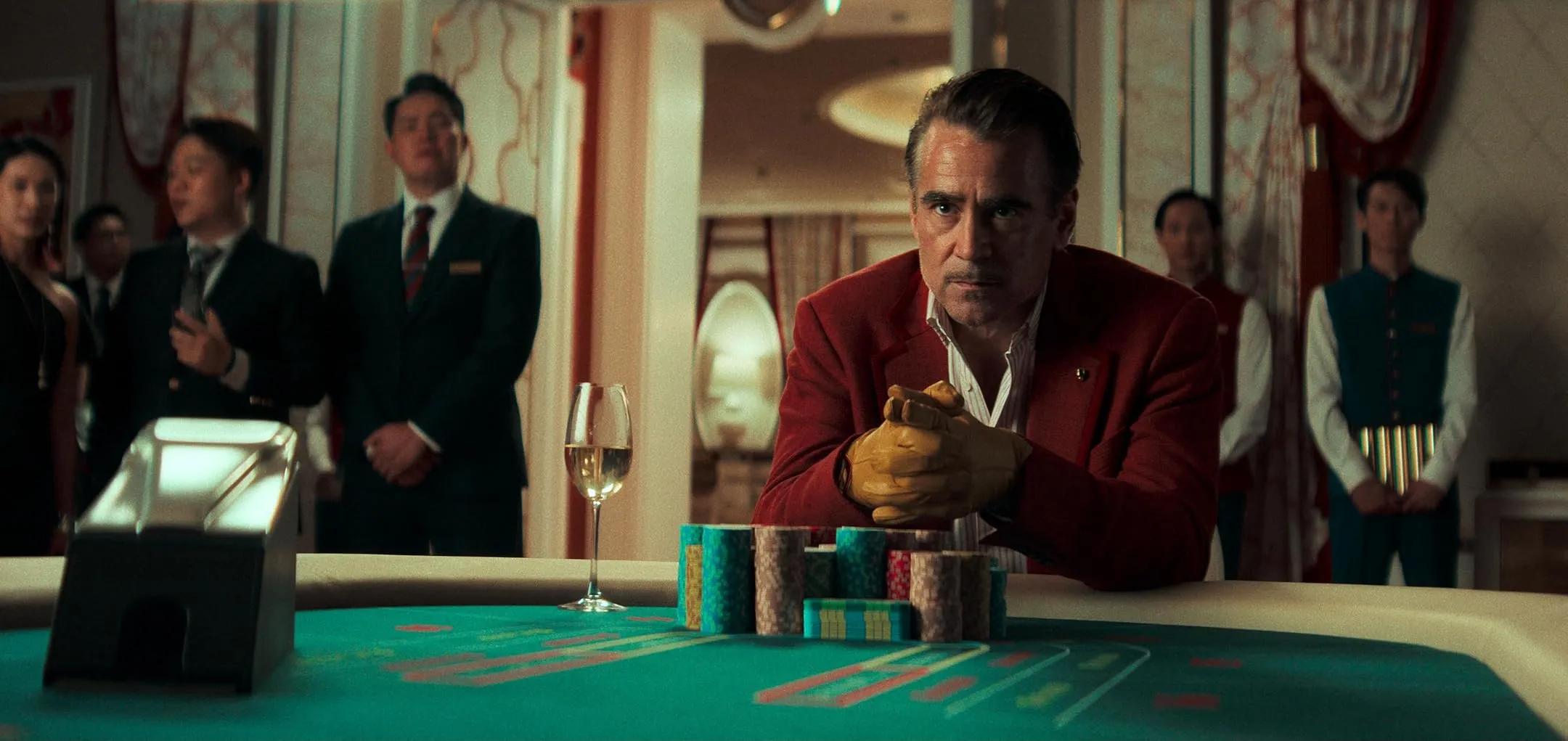
This physical collapse is the foundation for the flimsy architecture of his persona. The “Lord Doyle” identity is a terrible piece of theater, a role he performs with the exhaustion of an actor who has forgotten why he took the part. His conspicuous costumes, the bespoke velvet suits and squeaky yellow leather gloves, are not garments but the failing armor of a hollow man.
The locals call him a gwai lo, a foreign ghost, a name that is tragically accurate. He is a man who dresses to be seen because he feels fundamentally invisible, even to himself. His compulsion, then, is not for the thrill of winning or the acquisition of wealth. It is for the terror of losing everything, a constant flirtation with the annihilation he both fears and subconsciously seeks.
Also Read





The turn of a card provides a momentary stay against the crushing silence of his own being. He is the archetypal hungry ghost, driven by a mindless momentum that is governed by the cold, internal logic of addiction, a condition where the only cure is more of the poison.
An Electric Purgatory
The film’s aesthetic is a direct extension of its protagonist’s fractured psyche, a world built from the materials of his own damnation. Cinematographer James Friend paints Macau with a palette of intoxicating, almost radioactive light. Saturated reds, golds, and greens bleed from every frame, creating an environment that is beautiful in the way a fever dream is; its vibrancy is a symptom of a deep and pervasive sickness.

The camera itself is an uneasy, almost cruel participant in Doyle’s downfall. Wide, cavernous shots render him a solitary speck against the gargantuan, empty excess of the casinos, a visual statement of his cosmic insignificance.
Disorienting canted angles tilt the world off its axis, reflecting a reality that has lost its moral and physical foundation. Then, suddenly, the lens will push into an aggressive, invasive close-up, capturing every pore, every bead of sweat, offering a high-definition map of a man’s disintegration without his consent.
This visual assault is matched by Volker Bertelmann’s thundering, ever-present score. The music is not an accompaniment but an active agent of the film’s chaos, the externalized heartbeat of Doyle’s anxiety. It is the sound of a merciless god of chance rolling dice. It swells with his delusions of a winning streak and crashes with the brutal finality of his losses.
Through these powerful sensory choices, Macau transforms from a location into a philosophical space. It is a meticulously crafted purgatory of illusion and hollow promises, a peninsula where souls are weighed not by virtue but by credit lines. It is a place where a man might believe he can erase himself and begin anew, which makes it the perfect, glittering trap for a soul already running from its own emptiness.
Specters at the Table
Into Doyle’s solipsistic hell wander other figures, less fully formed characters and more catalysts or reflections of his own fragmented state. Dao Ming, the casino employee who extends him an unlikely line of credit, appears as a mysterious offer of grace in a world that has none. Played by Fala Chen with a quiet watchfulness, her motivation remains a central puzzle.
Is her pity for Doyle born from a genuine recognition of a fellow lost soul, a shared understanding of quiet desperation? Or is she another illusion in a city built on them, a projection of the salvation he craves? Their connection feels wispy and uncertain, their chemistry deliberately muted, which prevents the story from finding a simple emotional anchor. She functions more as a philosophical question than a romantic interest: can redemption be offered by another, or is it merely a mirage?
The past arrives in the sharp, observant form of Cynthia Blithe, Tilda Swinton’s private investigator. She is the embodiment of the consequences Doyle fled, a specter of accountability in a land of calculated anonymity. Their negotiations are a witty cat-and-mouse game, a brief theater of deflection for Doyle. Yet her presence, though captivating, feels functionally limited, a narrative necessity more than a deep exploration of his history. Other small figures add texture to this specific circle of hell.
“Grandma” (Deanie Ip), a crass and ruthlessly successful baccarat player, serves as a comic tormentor, a god of the game in miniature. The brief appearance of a fellow con man, Adrian Lippett (Alex Jennings), only confirms the profound, suffocating untrustworthiness of Doyle’s universe. These people are ghosts of a different sort, orbiting his decline.
A Beautiful, Hollow Bet
Edward Berger’s direction is a high-stakes gamble on style itself, suggesting that in a world devoid of inherent meaning, a powerful aesthetic is the only truth one can create. The film’s presentation is operatic, its energy frenetic, and its tone deliberately unsubtle.

This is a maximalist vision, a showy immersion in one man’s unraveling that dares the viewer to look away. The narrative blurs the line between objective reality and Doyle’s hallucinations, most notably through the recurring, untethered image of a man plummeting from a skyscraper. We are left to question the substance of what we see, a technique that mirrors Doyle’s own loose grip on his world and forces us to confront the unreliability of perception.
Rowan Joffe’s screenplay structures the story in suffocating cycles of winning and losing, a rhythm meant to mimic the hamster wheel of addiction. While thematically fitting, this repetition is a risky choice, threatening to numb the audience and make each new low and fleeting high feel progressively less impactful. The central question of the film is whether its impressive, dazzling style can justify a story that feels, at times, emotionally thin.
Does the relentless focus on the surface, on the visual and sonic representation of chaos, come at the expense of deeper human insight? The film certainly explores the destructive nature of compulsion and the hollow core of extreme wealth. It gestures toward the possibility of redemption without ever promising it.
It remains uncertain, however, if it offers a profound look at the soul’s sickness or serves as a stunningly executed technical exercise in rendering despair beautiful. Berger places his bet on a visceral, stylistic experience, and the film’s ultimate success depends on whether the viewer finds its beautiful surfaces to be a mirror of a deep emptiness or just an empty, albeit gorgeous, decoration.
The movie Ballad of a Small Player had its world premiere at the Telluride Film Festival on August 29, 2025. It will be released in select U.S. theaters on October 15, 2025, and will become available to stream on Netflix starting October 29, 2025.
Full Credits
Director: Edward Berger
Writers: Rowan Joffe, Lawrence Osborne
Producers and Executive Producers: Mike Goodridge, Edward Berger, Matthew James Wilkinson, Mark Nolting, Jeanne Tremsal, Luke Rivett, Rowan Joffe, Lawrence Osborne, Ellie Gibbons
Cast: Colin Farrell, Fala Chen, Tilda Swinton, Deanie Ip, Alex Jennings
Director of Photography (Cinematographer): James Friend
Editors: Nick Emerson
Composer: Volker Bertelmann
The Review
Ballad of a Small Player
A hypnotic and visually stunning descent into addiction, Ballad of a Small Player is anchored by an unflinching, career-best performance from Colin Farrell. Edward Berger’s maximalist style creates a fever dream of profound despair. Yet, for all its aesthetic brilliance, the film risks feeling as hollow as its protagonist’s soul; it is a beautiful document of ruin that observes more than it illuminates the human condition.
PROS
- A towering, physically committed lead performance from Colin Farrell.
- Stunning, atmospheric cinematography that turns Macau into a character.
- A powerful and immersive musical score that heightens the psychological tension.
- Confident, stylish direction with a clear and ambitious vision.
CONS
- The narrative can feel emotionally hollow beneath the dazzling style.
- Underdeveloped supporting characters, particularly the romantic interest.
- A repetitive plot structure that may feel numbing to some viewers.
- The intense focus on aesthetics occasionally lessens the story's human insight.