































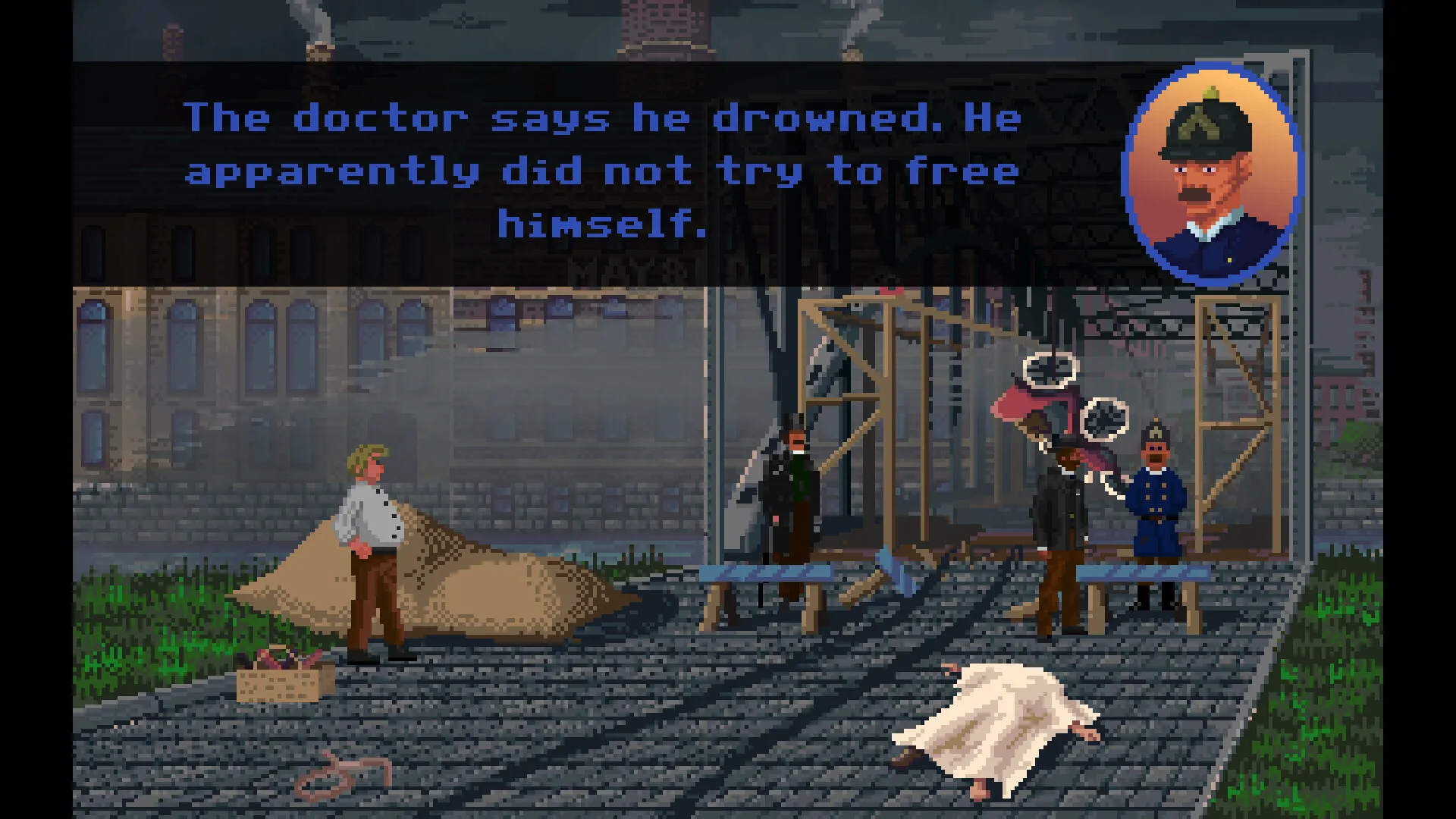
The year 1899 finds Leipzig, Germany, as a city of steam and intellect, a center of industry where new technologies clash with old ways. An automobile, still a novelty and a menace to some, has crashed through the gate of an unfinished bridge.
This is the world of Casebook 1899 – The Leipzig Murders, a point-and-click detective game that places players in the shoes of Detective Inspector Joseph Kreiser. The game immediately establishes a tone rooted in the anxieties of the fin de siècle, where the promises of progress are shadowed by new forms of violence.
As Kreiser, the player is tasked with making sense of four different cases, each a small story reflecting the societal tensions of a recently unified Germany stepping into the 20th century. The game is less about a single grand conspiracy and more an examination of the everyday crimes that reveal the character of a city in transition.
Constructing Truth from Fragments
The gameplay of Casebook 1899 mirrors a specific European tradition of rational deduction found in the works of authors like Agatha Christie. The process is methodical, favoring the slow accumulation of evidence over dramatic intuition. Players explore locations with the mouse, collecting items and clues that populate Detective Kreiser’s notebook.
This journal becomes the game’s central mechanic. It is an archive of facts waiting to be connected, a textual representation of the crime scene that the player must organize and interpret. This system moves beyond simple evidence collection; it posits that the truth is not found but constructed. The player must actively link related pieces of information to forge new lines of inquiry, a mechanic that externalizes the internal process of logical reasoning.
Also Read






For instance, discovering a severed brake cable on the crashed automobile is one fact. Later, finding a pair of scissors at the driver’s house is another. By linking these two items in the notebook, the player generates a deduction: the crash was sabotage, not an accident. This mechanical act of drawing a line between two disparate facts is a powerful representation of the “aha!” moment, the spark of insight that defines the detective genre. It transforms the player from a passive observer into an active participant in the creation of meaning.
This approach creates a fascinating synergy between the game’s narrative and its systems. The player is not just guiding Detective Kreiser; they are performing his cognitive labor. This contrasts sharply with more linear detective games, such as the Ace Attorney series, where the path to the truth is a narrow, pre-defined corridor of logic. In those games, the player’s role is to find the correct key for a series of locks.
Here, the player is given a box of unassembled parts and asked to build the lock itself. The system also shares a philosophical kinship with games like Return of the Obra Dinn, which also demand that the player synthesize information without guidance. However, Casebook 1899 roots its deductions in dialogue and character motivation, aligning it more closely with literary crime fiction.
The process feels akin to historiography, where a historian pieces together a coherent narrative from fragmented and often contradictory archival sources. Each clue is a primary source document, and the player is the historian writing the definitive account of what transpired. Dialogue functions as another layer of this archival research. Witness testimonies are subjective, colored by personal bias, fear, or deceit.
The player must collect these verbal statements and weigh them against the physical evidence, looking for inconsistencies that betray a lie. This process elevates the game beyond a simple puzzle box. It becomes an exploration of epistemology, asking how we can know something for certain when all information is filtered through imperfect sources. The game’s willingness to allow the player to be wrong is the ultimate expression of this philosophy.
You can arrest an innocent person based on a plausible but incorrect interpretation of the facts, and the story adapts to this failure. This choice suggests a modern, almost postmodern, understanding of justice. The “solution” is simply the most convincing narrative constructed from the available evidence, and the game allows your flawed narrative to become the case’s official history.
An Authentic Echo
The game’s presentation is a deliberate exercise in cultural specificity, rejecting a generic, placeless aesthetic for one deeply rooted in its time and location. The pixel art functions as a form of digital impressionism, capturing the feel of the era without striving for the photorealism that dominates much of the contemporary games industry.
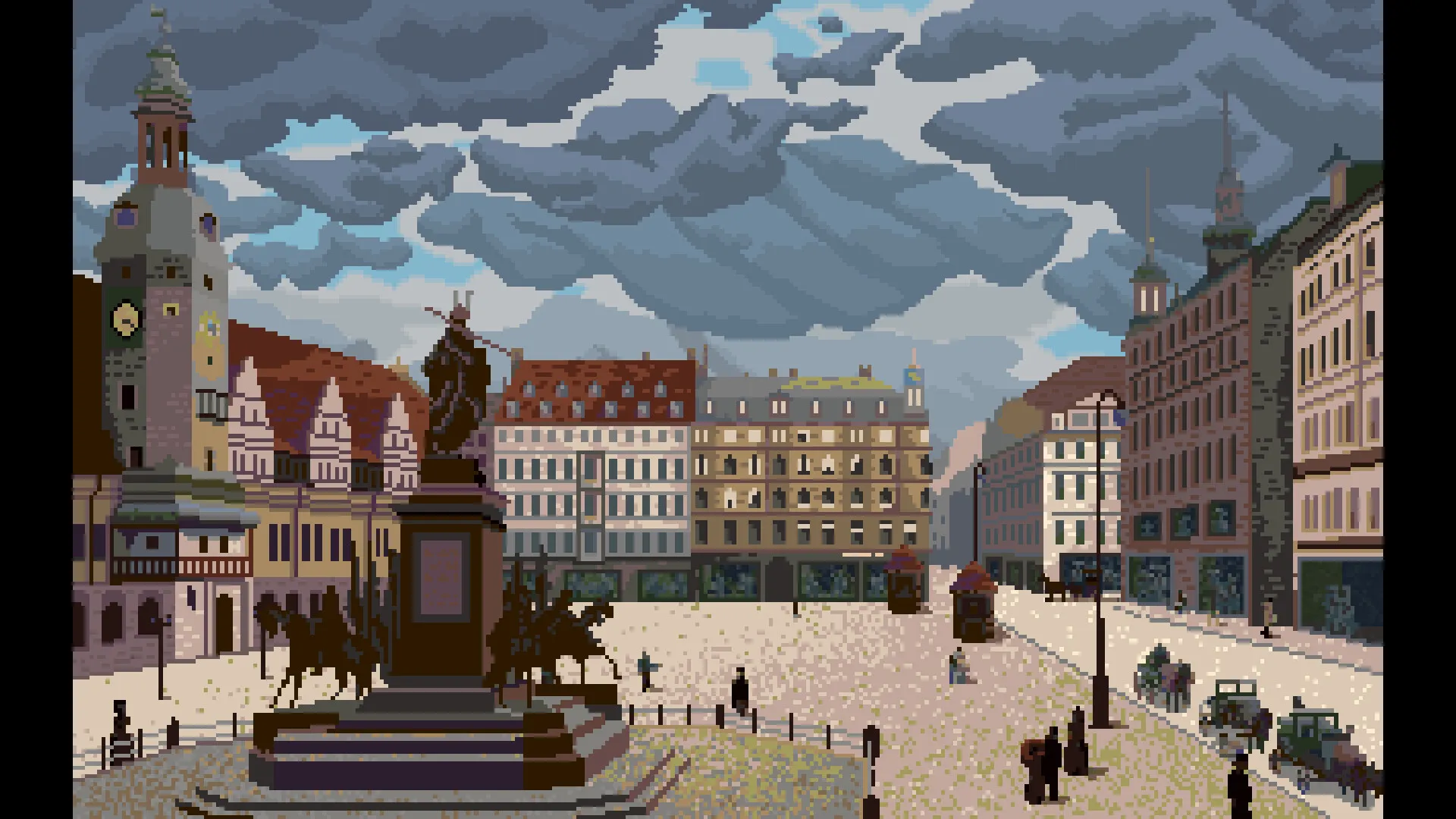
This stylistic choice is not merely nostalgia; it is a conscious rejection of the idea that graphical fidelity equals immersion. Instead, the art invites the player’s imagination to fill in the details, a process that fosters a deeper cognitive engagement similar to reading a novel. The blocky, expressive sprites and painterly backgrounds evoke the quality of early newspaper photography or the lithographs of the period, giving the industrial landscapes of Leipzig a textured, historic feel. Within these scenes, the artists embed a wealth of cultural information.
The architecture distinguishes the working-class districts from the homes of the bourgeoisie; the clothing and interior decor speak volumes about the social standing and aspirations of the characters the player interviews. The constant presence of smokestacks and new construction visually reinforces the theme of a society caught between an agrarian past and an industrial future.
This visual storytelling is supported by a subtle and effective soundscape. The music is often sparse, allowing the ambient sounds of the city to create a sense of place. The clip-clop of a horse-drawn cart on cobblestone, the distant hum of a factory, the murmur of patrons in a beer hall—these sounds build a world that feels lived-in and real.
When the score does swell, it uses instrumentation that feels appropriate to the late Romantic era, underscoring moments of dramatic revelation without becoming intrusive. The most significant aesthetic choice, however, is the commitment to full German voice acting. In a global market where English is often the default language, this is a powerful statement. By eschewing an English dub, the developer forces a non-German-speaking player into the position of an outsider, reliant on subtitles to understand the proceedings.
This decision preserves the specific cadence and texture of the language, making the dialogue an integral part of the game’s world-building. It is a choice that privileges artistic integrity over maximum commercial accessibility. The experience becomes comparable to watching a film from the New German Cinema; the sound of the language itself is part of the work’s identity.
This act of translation, both linguistic and cultural, asks more of the player and offers a richer, more authentic reward. It is a form of cultural resistance to the homogenizing tendencies of global entertainment, insisting that some stories are best told in their native tongue.
An Anthology of Urban Crime
Casebook 1899 adopts an episodic structure, with four separate cases forming the complete narrative. This design choice aligns the game with the long tradition of serialized crime fiction, particularly the short stories of Sherlock Holmes that first appeared in magazines. Each case is a self-contained mystery that introduces a new corner of Leipzig society and a new moral puzzle.

This anthology format allows the game to explore a range of themes without being burdened by a single, sprawling plot. One case might explore the tensions of class conflict in a factory setting, while another might examine a domestic dispute within a wealthy family. Detective Kreiser serves as the connective tissue, his investigation providing a lens through which the player observes the city’s social fabric.
This structure also benefits the game’s pacing, ensuring that no single investigation overstays its welcome and keeping the experience feeling fresh. Each case presents a new tableau of characters and a new set of logical challenges, functioning like a collection of short films united by a common protagonist and setting.
The game’s design philosophy is built on a foundation of respect for the player’s intelligence. It refuses to provide easy answers or clear signposts, a choice that defines its particular brand of difficulty. Real detective work involves uncertainty and the possibility of following a false lead, and the game simulates this experience by not holding the player’s hand.
This is most apparent in the function of Public Prosecutor Gustav Möbius, who accompanies Kreiser. He is not a simple hint button. His advice is often abstract, prompting the player to think differently about the evidence rather than telling them what to do next. His most practical function is to confirm when a location has been thoroughly scoured for clues, a subtle mechanic that prevents aimless wandering without solving the case for the player.
This design creates a profound sense of accomplishment when a deduction is correctly made and a case is successfully closed. It is the fantasy of being a working detective, complete with moments of frustration and confusion, rather than the power fantasy of being an infallible super-sleuth. This approach has consequences for the game as an interactive system.
The possibility of failure invites replay, not just to see the “correct” outcome, but to explore alternative investigative paths and test different hypotheses. Each playthrough becomes a unique authoring of events, with the player’s final conclusion standing as their definitive version of the truth.
This makes Casebook 1899 an experience for a patient and thoughtful player, someone who finds satisfaction in the process of inquiry itself. It is a game for the cross-media enthusiast who might enjoy a dense historical novel or a subtitled European crime drama as much as an interactive experience.
The Review
Casebook 1899 - The Leipzig Murders
Casebook 1899 is a thoughtful and culturally rich detective adventure. Its greatest success is the synergy between its methodical deduction gameplay and its authentic historical German setting. The game trusts the player to interpret evidence and construct the truth, a process made more immersive by the excellent pixel art and German-only voice acting. While its deliberate pacing and lack of guidance will not be for everyone, it is a deeply rewarding experience for patient players who value intellectual challenge and atmospheric storytelling.
PROS
- Intelligent deduction mechanic that empowers the player.
- Authentic and richly detailed historical setting.
- Meaningful player agency with consequences for failure.
- Episodic structure keeps the pacing tight.
- Culturally specific presentation enhances immersion.
CONS
- Minimal hand-holding can be frustrating.
- The hint system is intentionally vague.
- Deliberate pace may feel slow to some.