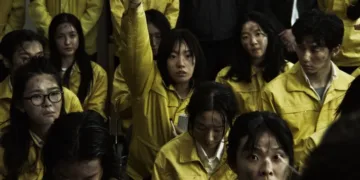




























A voice recalls a world that has forgotten its own reflection. It speaks of a time when the ocean was blue, before a blood-red sky began to weep black rain. This is the poisoned genesis of Syeyoung Park’s The Fin, a film that breathes a melancholic, post-apocalyptic air. We are introduced to a unified Korea, a nation bound not by progress but by the walls of a new paranoia. An ecological cataclysm has scarred the earth, and in its wake, humanity has fractured.
The society is split between citizens and the Omegas, a people mutated by the toxic sea, now bearing the fin-like appendages that mark them as outcasts. The state has weaponized biology, crafting a narrative where the Omega’s touch is contamination and their scream is a death sentence.
They are phantoms, exploited for the dangerous work of cleansing the very oceans that remade them. Beneath the surface of this ordered oppression, personal histories stir, promising a confrontation with the ghosts of this carefully constructed reality.
A Trinity of Fractured Wills
The film’s soul is found not in its grand dystopian architecture but in the quiet, desperate spaces between three conflicted people. Their convergence forms a meditation on the fractured self. We meet Mia, a vessel for a past she has meticulously tried to bury.

An Omega living under a cloak of seamless humanity, her psychology is a chilling mirror of the state’s own propaganda; she harbors a deep resentment for her own kind, a self-hatred born from the belief that her Omega father abandoned her. She tends to a clandestine indoor fishing shop, a strange, beautiful sanctuary that sells bottled nostalgia for a clean world.
This shop is her curated reality, a fragile bubble protecting her from the hostile city and her own biology. The arrival of a severed fin, a relic from the life she fled, acts as a physical summons back to the self she tried to kill. Her story is a quiet study in alienation.
Opposite Mia is Sujin, an agent of the regime and our initial guide through its ideology. She is a believer in the clear lines drawn between citizen and monster, her certainty a product of relentless indoctrination. Her arc is the slow, painful unraveling of that certainty. It is more than disillusionment; it is the collapse of a moral framework.
We watch her experience a profound cognitive dissonance as the state’s sterile doctrines clash with the messy, undeniable suffering of individuals. The bedrock of her worldview cracks, leaving her adrift in a sea of moral ambiguity.
The catalyst for this turmoil is an unnamed Omega, a figure who embodies defiance. He is not merely a messenger but a keeper of memory, a testament to a community that refuses to be erased. His journey into the city is a pilgrimage, an act of profound faith in the bonds of kinship, performed in the heart of enemy territory. His solemn purpose forces the collision of Mia’s hidden self and Sujin’s questioning one, creating a tense exploration of loyalty, identity, and the courage required to face a disowned truth.
The Architecture of Otherness
The Fin is a quiet, devastating meditation on the timeless, terrible mechanism of creating an “Other.” The film patiently dissects how a society, gripped by a foundational fear, builds its very identity on the exclusion and dehumanization of a designated scapegoat. Fear is not a byproduct of this system; it is both its primary fuel and its most refined product.

The state does not simply manage paranoia, it manufactures it, distributing it like a ration. The “Omega” becomes an empty vessel, a biological canvas onto which the culture projects its deepest anxieties about decay, impurity, mortality, and its own complicity in a ruined world.
Park’s choice to set the story in a reunified Korea is a stroke of bitter philosophical irony. The old geopolitical scar has seemingly healed, yet this healing has only revealed a deeper, more elemental wound within the social body.
The physical wall of the DMZ is gone, replaced by countless invisible walls of prejudice and a new, inescapable segregation branded onto the body itself. Political unification proves hollow without a corresponding moral cohesion. The new form of nationalism is predicated on a biological purity that requires a constant enemy.
This social decay is inextricably linked to the environmental catastrophe that preceded it. The poisoned ocean is the literal and metaphorical source of the film’s conflict. The Omegas are the children of this poison, their mutated bodies a living testament to humanity’s trespass against nature. Society’s violent rejection of them is a frantic, collective attempt to disavow its own original sin. They are a mirror reflecting the monstrosity of their creators, and for that, they cannot be forgiven.
A Patina of Despair
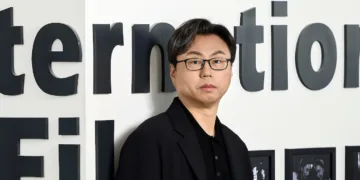
Director Park Syeyoung, who also serves as the film’s cinematographer, paints his world with a palette of decay and fragile, fleeting hope. The camera’s gaze is patient, almost funereal, at times feeling observational to the point of voyeurism. It mirrors the state’s pervasive surveillance but replaces its cold judgment with a profound, sorrowful empathy.

This patient gaze allows the oppressive atmosphere to seep through the screen, immersing the viewer in the world’s quiet dread. The visuals are given a grainy, worn texture, as if the film stock itself has been weathered by the toxic air, making the world feel tactile and scarred. Color becomes a language of emotional states.
The outside world suffocates under a sickly, permanent twilight of orange and red, the sky a constant, weeping wound. This oppressive haze is broken by the strange, melancholic blues and yellows of the fishing shop, an artificial haven of remembered beauty.
The sparse, piano-driven score punctuates the silence more than it fills it, leaving ample room for the unsettling soundscape of the city. The film’s deliberate, slow pace is essential, forcing the viewer into a state of contemplation, to feel the suffocating weight of time in this stagnant, hopeless world. This carefully crafted aesthetic makes a late-film choice all the more jarring.
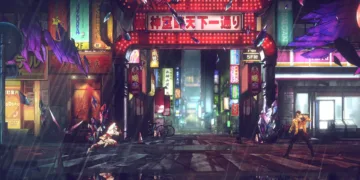
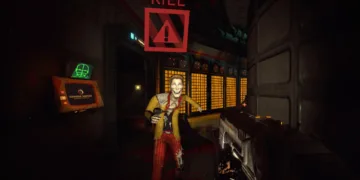
In a brief propaganda sequence, the uncanny warp and morphing of human figures reveal the use of generative AI. The slick, weightless quality of these images ruptures the film’s aesthetic fabric, clashing with the tactile sorrow of the surrounding scenes. It is a ghost from our world’s machine leaking into theirs, a moment of soulless artifice that, in its dissonance, adds a final, complex layer of unintentional commentary.
The Fin premiered in Locarno, Switzerland on August 9, 2025. It is a South Korean, Qatari, and German production, and the movie is in the Korean language. It was produced by Gold Rush Pictures. The film has been described as a compelling sci-fi drama about mutated outcasts in a seemingly unified Korea.
Full Credits
Director: Syeyoung Park
Cast: Yeji Yeon, Pureum Kim, Goh-woo, Youngdoo Jeong, Joowon Meng.
The Review
The Fin
A slow, sorrowful immersion into a world poisoned by its own fears. The Fin is a visually hypnotic and philosophically dense parable that lingers long after the credits. While its narrative familiarity is a minor anchor, its profound atmospheric dread and trenchant critique of human division make it a haunting, essential piece of dystopian cinema. It is a beautiful, brutal reflection on the monsters we create and the humanity we discard.
PROS
- Haunting, atmospheric cinematography with a distinct and memorable visual style.
- Deeply resonant and relevant allegorical themes exploring fear, exploitation, and social control.
- Philosophically dense and emotionally compelling narrative with complex character psychology.
- Strong, patient direction that creates a cohesive and melancholic tone.
CONS
- Some core narrative elements may feel overly familiar to fans of the dystopian genre.
- The use of generative AI for a sequence feels jarring and thematically dissonant with the film's organic texture.
- Its deliberate, slow pacing might not appeal to all viewers.