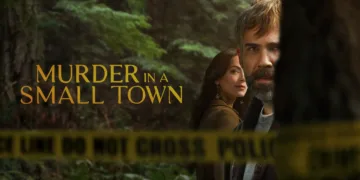

























The small-town mystery genre operates on a fundamental contradiction: the promise of peace against the reality of human nature. It presents communities like Gibsons, British Columbia as idyllic refuges, places where the noise of the city gives way to coastal calm, only to reveal that the same darkness thrives there, just in quieter corridors.
Murder in a Small Town builds its foundation on this very idea. Police Chief Karl Alberg, a man intentionally escaping urban violence, finds himself policing a town that generates a surprising amount of it. As the second season begins, he and his partner Cassandra Lee, newly minted as a town councilwoman, represent the town’s central tension. They are two people attempting to build a stable, peaceful life atop ground that is perpetually, violently unsteady.
The Anatomy of a Frying Pan Murder
The season’s opening case uses a classic procedural structure, beginning with a recognizable domestic crisis before methodically dismantling it to reveal a more complex machine of criminality beneath. The inciting event is stark: Denise Walker, pushed to a breaking point by her husband Garrett, defends herself with a cast-iron frying pan. What follows is a study in panic.
Her decision, encouraged by her sister Marita, to hide the body is a catastrophic miscalculation born of fear. Their attempts to stage a scene—wrapping the body in a rug, driving the car into the woods—are portrayed not as clever machinations but as the frantic, flawed work of amateurs. The narrative doesn’t ask for our admiration of their cunning; it examines the poor choices people make when they believe they are out of options.
The investigation unfolds with a satisfying patience. Karl Alberg’s approach to police work remains the show’s quiet strength. He is an observer first, a detective second. His initial sweep of the Walker home reveals clues not through dramatic discovery but through noticing what is absent: a single pan from a matching wall-mounted set.
He smells the lingering chemical signature of bleach used to erase evidence. These details, small as they are, speak to his method of solving crimes by understanding the human behavior that surrounds them. Rossif Sutherland’s performance reinforces this, portraying Karl as a man who pieces together events through empathy as much as through forensics.
Also Read






The case pivots when Garrett’s body is found on his burnt-out boat. The medical examiner’s report is a narrative turning point, revealing that the frying pan blow was not fatal. Stab wounds and smoke inhalation were the true causes of death. This discovery widens the circle of suspicion and shifts the story’s focus from a domestic incident to a full-fledged murder. The script efficiently unwraps Garrett’s hidden life, showing him to be a gambler who had leveraged his boat for favors with a local biker gang.
He was a courier for his mistress, Susan Baylor, a woman with a clean facade and a history of financial crimes. The motive solidifies around a bag of cash Garrett skimmed for himself. He was not a simple victim of a domestic dispute; he was a minor but greedy player in a criminal enterprise who made a fatal error. The plot is well-constructed, yet its final moments feel compressed. The climactic roadside chase and capture of the conspirators happen with such speed that the resolution feels more obligatory than earned, a rapid tidying up of loose ends.
Politics Arrives in Gibsons
While the premiere resolves its first murder, it carefully constructs the season’s primary source of conflict, moving the show’s dramatic weight from the crime lab to the town hall. The instrument of this change is Mayor Christie Holman, brought to life with a precise and commanding energy by Marcia Gay Harden.

Harden portrays the Mayor not as a simple antagonist but as a practiced political operator. She is a physician by trade, a background that lends her an air of authority and pragmatism, yet her actions are guided by a clear and self-serving agenda. Her presence immediately introduces a level of strategic maneuvering that Gibsons has not seen before.
The central conflict she initiates is a classic political dilemma, framed as a choice between culture and security. Cassandra, acting on her mandate from the voters, is championing the development of a community arts center. Mayor Holman, citing fiscal responsibility, sees the project as a wasteful vanity. This disagreement is the battlefield, but the Mayor’s strategy is far more sophisticated than a simple council vote. She identifies Karl’s primary professional weakness: his police force is critically understaffed and unable to properly serve an expanding jurisdiction.
She offers him exactly what he needs, a fully funded expansion with six new officers. The offer is a poisoned chalice. In exchange, Karl must become her political tool and convince Cassandra to kill the arts center project. This plot point is a clever mechanism. It elevates the series beyond a case-of-the-week format and creates an overarching problem that cannot be solved with handcuffs and an arrest warrant. It forces Karl and Cassandra into a position where their professional responsibilities are in direct, structural opposition.
A Relationship Tested by Strategy, Not Secrets
In a television landscape often reliant on romantic friction, the show’s handling of this new pressure on Karl and Cassandra is its most mature narrative decision. The writers resist the temptation to use Mayor Holman’s offer as a wedge of secrecy between the two. The miscommunication trope, a device that can feel tired and artificial, is pointedly avoided.

Karl goes to Cassandra almost immediately, laying out the Mayor’s proposal and its corrosive condition. This act of transparency defines their relationship as a partnership, one strong enough to withstand external manipulation. Sutherland and Kristin Kreuk sell this dynamic with a quiet, comfortable chemistry that makes their unity believable. Their performances suggest a history and trust that allows for such honesty.
Their subsequent conversation frames the season’s relational arc. They acknowledge the difficult position they are in and agree to face it as a team, promising that political maneuvering will not damage their personal foundation. The story positions them not against each other, but together against the problem. This is a significant choice, shifting the dramatic focus from internal doubt to the challenge of maintaining a private bond in a public arena.
It suggests the season is interested in a more nuanced exploration of a committed relationship. The potential for genuine conflict remains potent. What happens when Karl’s professional need for more officers becomes desperate? At what point do their opposing public duties create a strain that their private understanding cannot fully contain? The show has established a strong foundation, but it has also laid the groundwork for a meaningful test of that foundation as the political stakes get higher.
An Evolving, and Shrinking, Police Force
Beyond the central characters, the world of the Gibsons police department is in a state of flux. The premiere exhibits a curious bit of narrative housekeeping with the unannounced disappearances of Corporal Edwina Yen and Constable Andy Kendrick.

These were established supporting characters in the first season, and their absence without any in-story explanation is a minor but noticeable flaw. It disrupts the sense of a consistent, lived-in workplace, making the supporting cast feel somewhat disposable. Good world-building requires that even minor characters have narrative permanence.
To fill the gap, the show introduces Corporal Laila Jackson, an officer who previously worked with Karl in Minneapolis. Bethany Brown fits into the ensemble easily, but her character’s primary function in the premiere is to ask questions that provide exposition for the audience. The more promising development comes from Sergeant Sid Sokolowski. The series gives actor Aaron Douglas a substantial subplot, revealing that Sid’s teenage daughter is struggling with alcohol.
The story hints at a hereditary battle with addiction that has affected Sid’s family, a theme with more weight than the show typically handles. This storyline provides a valuable opportunity to deepen a reliable supporting player, giving him a personal crisis that will undoubtedly affect his work and his friendship with Karl.
This personal drama also neatly reinforces the main plot. With Sid needing to take time off for his family, Karl’s department is stretched even thinner. This detail transforms his need for more officers from an abstract political goal into an immediate, operational necessity, skillfully connecting the season’s disparate narrative threads.
Murder in a Small Town is a Canadian crime drama based on the Alberg and Cassandra Mysteries by L. R. Wright. The second season premiered on September 23, 2025, on FOX in the United States and Global in Canada. Episodes can be watched on Hulu the day after they air on FOX.
Full Credits
Director: Milan Cheylov, Leslie Hope, Amanda Tapping
Writers: Ian Weir, Sherry White, Leonard Dick, Jennifer Kennedy, Jennica Harper
Producers and Executive Producers: Ian Weir, Milan Cheylov, Nick Orchard, Morris Ruskin, Sharon Wisnia, Jon Cotton, Todd Giroux, Crystal Remmey, Tina Pehme, Kim Roberts, Jeff Wachtel, Rossif Sutherland, Kristin Kreuk
Cast: Rossif Sutherland, Kristin Kreuk, Marcia Gay Harden, Aaron Douglas, Mya Lowe, Dakota Guppy, Joshua Close, Bethany Brown, Marci T. House, Noah Reid
Director of Photography (Cinematographer): Mark Berlet
Editors: Cameron Sadler, Jason Chu
Composer: James Jandrisch
The Review
Murder In A Small Town Season 2
The second season premiere of Murder in a Small Town successfully broadens its narrative by introducing a sophisticated political storyline that places new pressures on its characters. The show’s greatest asset is its commitment to a mature central relationship, which it uses as an anchor against the procedural plot and new civic conflicts. While the pacing of the weekly case feels hurried at its end and some character disappearances are jarring, the episode builds a strong framework for a more layered and satisfying season, proving the series has ambitions beyond its cozy mystery setup.
PROS
- The introduction of a season-long political arc provides a strong, central conflict.
- A mature and refreshingly direct approach to the main characters' romantic relationship.
- The weekly mystery is thoughtfully constructed, escalating from a simple incident to a complex crime.
- Begins to add welcome depth to key supporting characters.
CONS
- The resolution of the premiere’s main criminal case feels abrupt and rushed.
- The unexplained absence of established characters from the first season is a distracting oversight.
- Some elements of the investigation depend on familiar genre conventions.