






















A good documentary often finds its footing in a central, guiding question. Canceled: The Paula Deen Story begins with a declaration of purpose, not from its director, but from its subject’s son, Bobby Deen, who insists making the film is a terrible idea. This initial moment of dissent is the most honest thing in the entire production. It frames the entire project as an act of persuasion, a story being told against the better judgment of one of its key participants.
This immediate fracture within the Deen family unit becomes the film’s unintentional thesis. It is not a straightforward look back at the 2013 scandal that dismantled a culinary empire; it is an exploration of a family’s fractured attempt to control a public narrative that has long since escaped their grasp.
The film then rewinds, re-establishing Paula Deen’s reign as a Food Network icon before diving into the deposition that changed everything. But that opening scene of conflict lingers, forcing the viewer to question every subsequent interview and archival clip. Is this a search for truth, or a family’s desperate, perhaps misguided, public relations campaign?
Crafting a Counter-Narrative
The film’s primary technique is the careful construction of a sympathetic protagonist. It doesn’t just tell her story; it builds a case. Director Billy Corben uses a wealth of archival footage from Deen’s old shows, creating a potent nostalgic contrast between the joyful, butter-slathered past and the tense, somber interviews of the present.

The biographical details of her early struggles with agoraphobia and her humble beginnings in a home catering business are presented as foundational character evidence. When the narrative finally arrives at the 2013 scandal, it handles the details like a defense attorney. The film makes a crucial distinction: Deen admitted under oath to past usage of a racial slur; she was not caught using it in a tirade. This framing is everything. It shifts the focus from the act itself to the perceived injustice of the reaction.
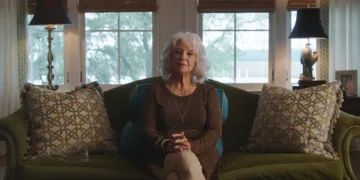
This perspective is reinforced through new interviews where Deen and her son Jamie cast the media as the villain. The inclusion of Bobby’s reluctance is a calculated narrative device. It works as a tool to disarm the audience, offering a veneer of objectivity. By showing internal disagreement, the film suggests it is not a monolithic piece of propaganda, making its otherwise one-sided arguments appear more balanced than they are.
Lost in the Conversation
When the documentary attempts to broaden its focus to a larger commentary on “cancel culture,” its structure becomes unstable. The pacing falters as it struggles to weave the personal drama of the Deen family into a coherent social critique.
The film raises valid points by drawing comparisons to figures like Mel Gibson and Duane “Dog” Chapman, whose careers weathered similar storms with far less damage, but it never investigates why these outcomes were different. The film’s narrative has significant holes. It fails to properly contextualize the nature of Deen’s “cancelation,” omitting any serious discussion of her appearance on Dancing With the Stars or the fact that many of her restaurants remained successful for years. This curated version of her professional life is essential to maintaining her status as a victim.
The most lucid analysis comes from food historian Michael Twitty, who speaks with clarity about accountability versus cancelation. His segments are so sharp and insightful they feel as if they belong to a different, more rigorous film. His commentary is like a compelling side quest in a video game that is far more engaging than the main plot, but the film never finds a way to integrate his ideas into its central narrative.
A Story Half-Told
Ultimately, the film serves as a platform for justification, not a tool for investigation. Corben, a director known for the journalistic edge in films like Cocaine Cowboys, remains curiously passive here. He allows the Deen family to control the terms of the conversation, rarely pushing back or challenging their rationalizations.
The documentary systematically works to undermine Deen’s critics, painting them as opportunistic or misguided without giving their perspectives equal weight. The emotional experience for the viewer is one of dissatisfaction. By avoiding any real confrontation with its subject, the film denies the audience any sense of catharsis or profound discovery. It feels less like a documentary and more like a carefully managed therapy session, designed to make its subject feel vindicated.
Canceled: The Paula Deen Story aims to add nuance to a public figure’s downfall, but it does so by presenting a curated and incomplete version of the story. It raises questions about justice and public shaming but demonstrates little interest in the complicated, messy work of finding the answers. It chooses personal absolution over honest reflection, leaving its most important story untold.
Canceled: The Paula Deen Story premiered at the Toronto International Film Festival on September 6, 2025. The documentary is a case study on celebrity culture, race, and media, exploring the rise and fall of the celebrity chef. As of now, it does not have a wide-release date, as where it airs down the road depends on which company acquires it, such as Netflix, Hulu, or HBO.
Full Credits
Director: Billy Corben
Cast: Paula Deen, Bobby Deen, Jamie Deen, Gordon Elliott, Michael W. Twitty
The Review
Canceled: The Paula Deen Story
Canceled: The Paula Deen Story presents itself as a re-examination of a public figure's downfall but functions as a carefully managed defense. The film sidesteps genuine introspection in favor of constructing a sympathetic, one-sided narrative. While it effectively raises questions about media frenzies and disproportionate consequences, it shows little interest in the more difficult work of exploring accountability. The result is a missed opportunity, a film that chooses the comfort of justification over the complexities of truth.
PROS
- Features sharp, insightful commentary from food historian Michael Twitty.
- The internal family conflict, especially Bobby Deen's skepticism, provides moments of authentic drama.
- Effectively uses archival footage to establish the scale of Deen's former celebrity.
CONS
- Presents an overwhelmingly one-sided argument that lacks journalistic balance.
- The direction feels passive, failing to challenge its subject's narrative.
- Possesses an unfocused structure that muddles its critique of "cancel culture."
- Ignores key facts that would complicate its victim-centric story.