
















The Hollywood Hills exist as much in the global imagination as they do in physical space. They represent a pinnacle of American aspiration, a landscape of glass houses and precarious fortunes built on an untamed environment. This is a place of profound isolation, where security gates and canyon roads create private kingdoms.
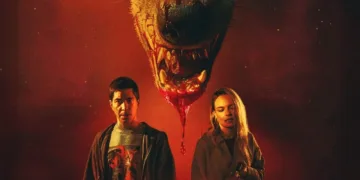
Civilization here feels like a performance, a thin veneer stretched over chaparral and wildlife. Coyotes uses this culturally charged setting not as a backdrop, but as a character. It imagines an assault on this symbol of insulated success. The story begins when natural disasters, a windstorm and wildfires, dismantle the infrastructure of this privileged world. The chaos peels back the veneer, forcing the wild landscape to reclaim its territory with violent intent.
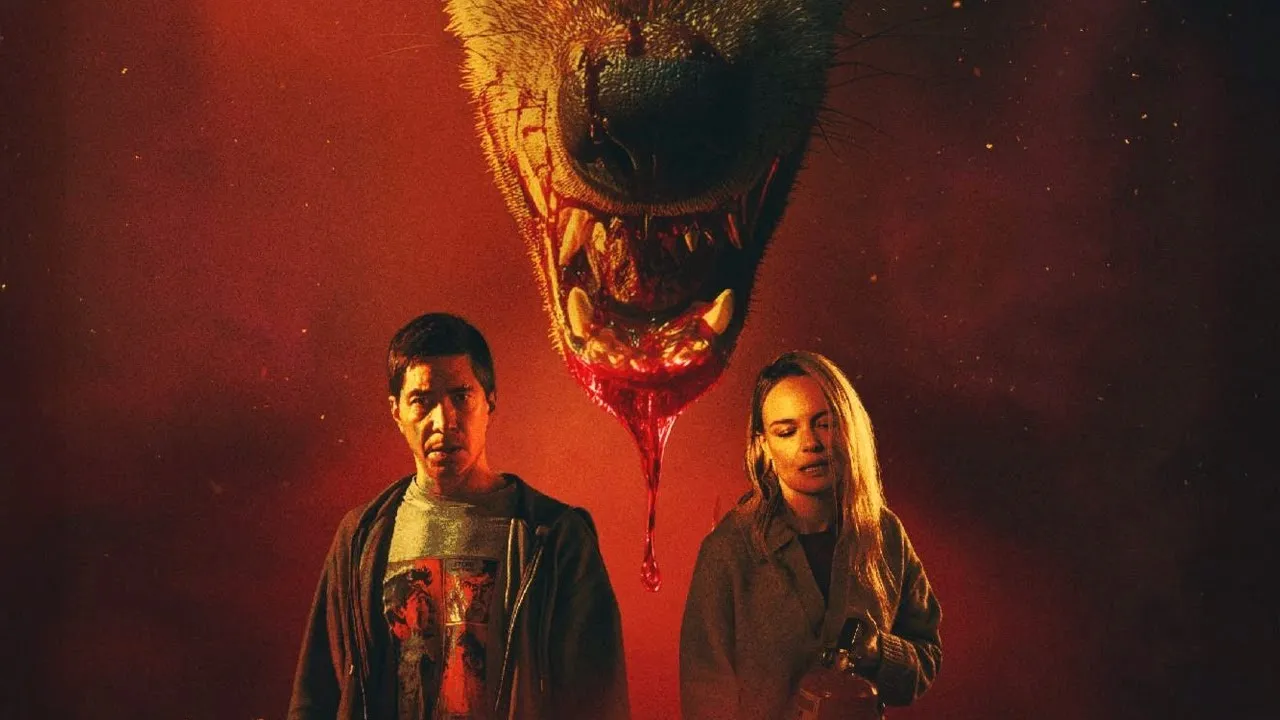
The Stewart family finds their architectural marvel of a home transformed into a cage, besieged by a force that does not recognize property lines or social status. Their struggle is against a pack of abnormally aggressive coyotes, a home-invasion plot where the invaders are nature’s dispossessed, returning to challenge the human occupants.
The Family Under Siege
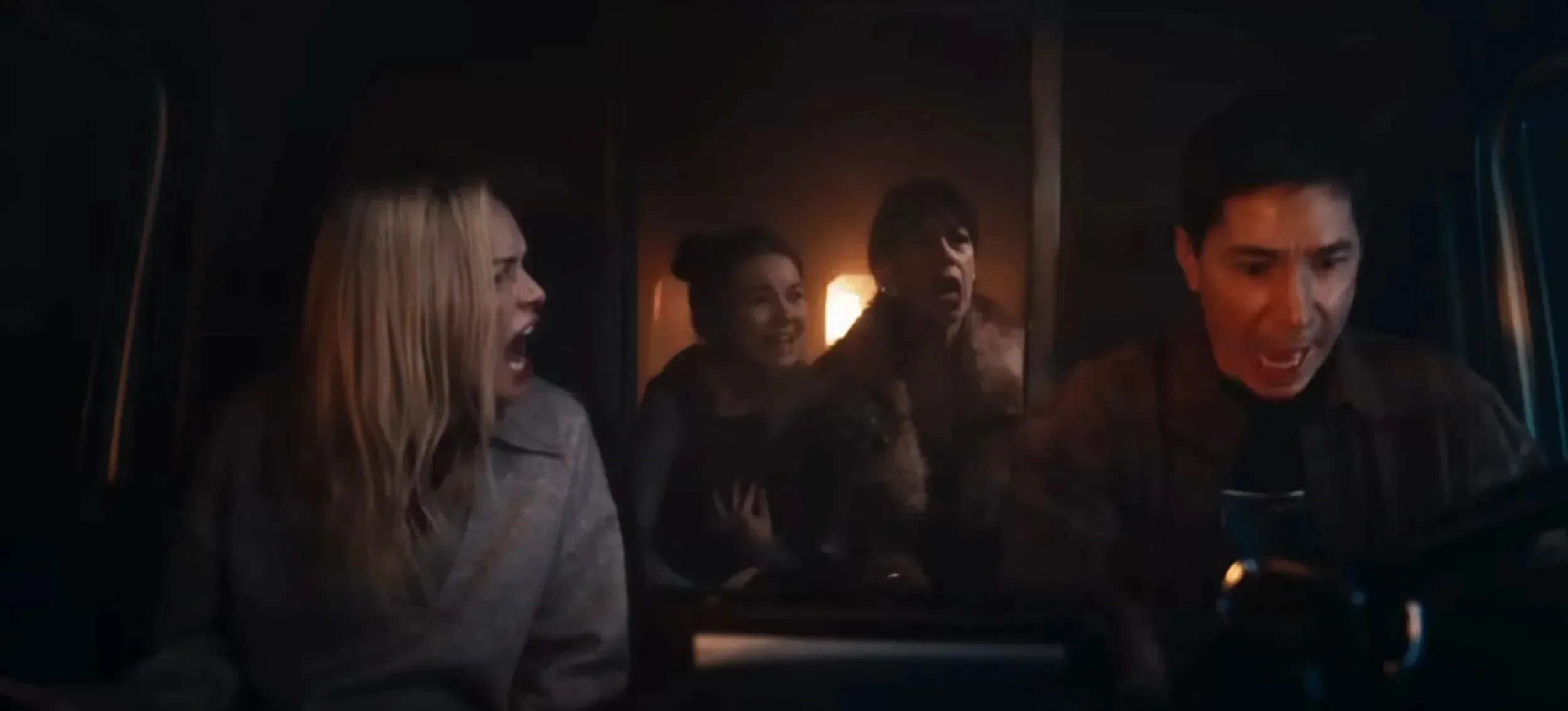
The film populates this collapsing world with distinctly American archetypes. Scott, the graphic novelist father, is a study in modern professional anxiety. His work has created a chasm between him and his family, leaving him ill-equipped for a crisis that requires primal action over intellectual labor. Justin Long’s performance expertly captures this sense of inadequacy.
His talent for physical comedy turns Scott’s attempts at heroism into a series of pathetic, funny failures. Every pained expression communicates a man realizing his civilized skills are useless. In contrast, Liv emerges as the pragmatic center of the family. She is the more capable and heroic figure, whose clear-headedness grounds their struggle.
Kate Bosworth portrays this competence without theatrics, and her natural chemistry with Long lends an authentic weight to their marital dynamic. They feel like a real couple whose long-simmering issues are forced into the open by extreme circumstances.
Their daughter Chloe, played by Mila Harris, functions as the emotional core, reminding the audience of the stakes. The moments of heartfelt connection between the three of them feel earned. The supporting cast expands this vision of American eccentricity. The neighbor Trip is a caricature of reckless indulgence, a man-child with access to drugs and weapons.
His date Julie, a conspiracy theorist sex worker, adds another layer of absurdity. These figures are not just comic relief; they are reflections of a society of isolated individuals whose strange lives collide only when the shared illusion of safety disintegrates.
A Beastly Blend
The film’s commitment to horror-comedy places it within a specific American cinematic tradition that often treats violence as spectacle. The tone prioritizes laughs derived from gore over sustained dread. It is a self-aware movie that understands the absurdity of its premise and invites the audience to enjoy the ridiculousness.

The carnage is intentionally over-the-top. Deaths are staged as elaborate, cartoonish gags, such as a grimly hilarious barbecue incident. This approach contrasts sharply with how other national cinemas might handle similar material.
A French extremity film, for example, would likely present such violence with an unflinching, visceral horror designed to disturb. A Japanese ghost story might find supernatural terror in nature’s revenge. Coyotes instead uses its violence to puncture tension, ensuring the experience remains entertaining rather than unsettling.
The antagonists themselves contribute to this tonal choice. The coyotes are not realistic animals; they are movie monsters, depicted as unnaturally large, vicious, and intelligent. The quality of the computer-generated effects is often unconvincing, which further distances the audience from any real sense of threat. The visible artificiality of the creatures reinforces the film’s campy, comedic feel.
The structure is lean and efficient. At a brisk 92 minutes, the plot never stagnates. The pacing is relentless, moving from one chaotic set piece to the next. The film is full of intense sequences, but it often pulls back from the brink of true mayhem, favoring controlled bursts of action over an overwhelming onslaught.
More Than a Monster Movie?
At its core, the film is a domestic drama staged within a disaster. The central conflict forces the Stewart family to rebuild their fractured bonds under the most extreme pressure. It is also a story that interrogates and subverts traditional concepts of masculinity. Scott’s journey is not one of straightforward heroic transformation. His frequent failures and his wife’s superior competence offer a more complex look at gender roles in a crisis. This is a recurring theme in contemporary Western cinema, reflecting evolving societal norms.

The narrative includes a thin environmental fable, attributing the coyotes’ aggression to human expansion and the resulting wildfires. A final reveal offers a specific motivation for the attacks, positioning the animals as victims lashing out rather than pure monsters. This gesture toward an ecological message feels somewhat tacked on, a way to add thematic weight without engaging in a serious critique.
The film’s most significant shortcoming is its missed opportunity for sharp social commentary. Set within the affluent and culturally specific world of the Hollywood Hills, it introduces characters ripe for satire but does little with them. The movie avoids a pointed critique of Los Angeles’s celebrity culture or its class divides, opting instead for a more generic and universally palatable story. This choice makes the film an easier product for the global market but leaves it feeling thematically shallow.
Craft and Execution
Director Colin Minihan manages the film’s tricky tonal balance with skill. He shifts between gory horror, broad comedy, and earnest family drama without letting one element overwhelm the others. The action is staged clearly, and the single-location setting is used effectively to build a sense of inescapable claustrophobia. The visual style, however, is less consistent.

The movie intermittently employs a comic book aesthetic, using graphic panels to frame scenes or introduce characters. This technique feels more like a superficial flourish than an integrated part of the film’s visual language.
It gestures toward a certain style without committing to it, a symptom of a broader trend where visual gimmicks are applied without narrative purpose. The quirky, high-energy score from Brittany Allen is more successful, perfectly complementing the film’s manic blend of danger and dark humor.
Final Assessment
Coyotes is a film built for audiences seeking an uncomplicated, gory, and amusing experience. It is a creature feature that fully delivers on its promise of animal-led mayhem infused with a comedic sensibility.
The movie succeeds as an entertaining entry in the horror-comedy subgenre, carried by strong performances from its leads, a relentlessly fast pace, and a confident mix of laughter and bloodshed. The unconvincing special effects will be a dealbreaker for viewers seeking genuine horror, but for those aligned with its campy spirit, the artificiality is simply part of the fun.
“Coyotes” is a horror comedy film that premiered at Fantastic Fest on September 20, 2025, and had a theatrical release on October 3, 2025. It is a limited theatrical release, which means it is shown in select movie theaters. You can check Fandango and Atom Tickets to see if it is playing in your area.
Full Credits
Director: Colin Minihan
Writers: Tad Daggerhart, Nick Simon, Daniel Meersand
Producers: Nathan Klingher, Ford Corbett, Joshuah Harris, Jib Polhemus
Cast: Justin Long, Kate Bosworth, Mila Harris, Katherine McNamara, Brittany Allen, Keir O’Donnell, Norbert Leo Butz, Kevin Glynn, Norma Nivia
Director of Photography (Cinematographer): Bradley Stuckel
Editors: Colin Minihan
Composer: Brittany Allen
The Review
Coyotes
Coyotes is a gleefully bloody and fast-paced creature feature, powered by the comedic timing of Justin Long and a self-aware script. It prioritizes ridiculous fun and cartoonish gore over genuine scares or sharp satire. While the shoddy CGI and undeveloped themes keep it from greatness, it’s a highly entertaining ride for those seeking a silly, high-energy horror-comedy that knows exactly what it is.
PROS
- Justin Long’s excellent comedic performance.
- Fast, relentless pacing that never gets dull.
- A successful and entertaining blend of horror and comedy.
- Strong on-screen chemistry between the lead actors.
CONS
- Unconvincing and often cheap-looking CGI for the animals.
- A missed opportunity for meaningful social satire of its Hollywood setting.
- Inconsistent and underdeveloped visual style.
- Some of the scare sequences become repetitive.