

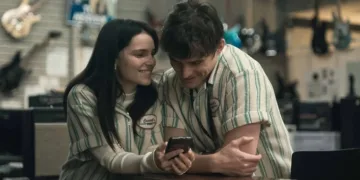




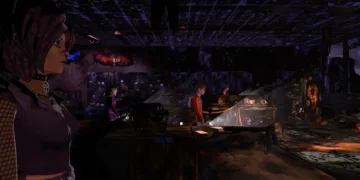







A woman’s life, dedicated to the careful craft of baking, is suddenly thrown into a state of profound imbalance. In Love, Danielle, the protagonist’s world is not defined by the sweet certainties of her bakery, but by a single, bitter piece of scientific knowledge. Danielle learns she carries the BRCA1 gene mutation, a microscopic arrangement of code that predicts a high probability of future cancer. The film immediately discards the familiar comfort of a linear life path.
Instead, it presents a choice born of modern medical capability: preemptively dismantle parts of her body to forestall a potential illness, thereby sacrificing her dream of bearing children, or live with the crushing weight of risk. This is a story about the emotional and psychological architecture of a “previvor,” a person forced to confront mortality before a disease has even taken root. The film explores this contemporary dilemma through a distinctly American indie lens, finding unexpected humor in moments of dread and examining the complex fallout on a marriage, family, and one’s very sense of self when the body becomes a site of future conflict.
A Performance of Radical Vulnerability
The emotional authenticity of Love, Danielle rests almost entirely on the shoulders of Devin Sidell, whose performance is less an act of imitation and more an act of translation. As a person who is herself BRCA1-positive and has undergone the same preventative surgeries her character contemplates, Sidell brings a rare and unimpeachable authority to the role.
Her portrayal of Danielle is stripped of melodrama, offering instead a textured study in quiet fortitude, sudden panic, and the dark, witty remarks used to keep despair at bay. This is not the typical cinematic depiction of illness, which often begins with a diagnosis and charts a path of physical decline. Instead, Sidell maps the internal geography of a “previvor,” a state of being defined by abstract risk and life-altering decisions made in a physical vacuum. Her performance makes this liminal state tangible, grounding the film’s high-stakes premise in a deeply human reality.
This commitment to truth extends into a filmmaking choice of profound bravery and artistic significance. Sidell incorporates raw, personal footage from her own medical journey, presenting her actual post-surgery body to the camera. These unsimulated images of scars and tissue expanders are not used for shock; they are integrated with a quiet matter-of-factness that challenges the viewer. This act of self-documentation aligns with a growing tradition of autobiographical art in an era that prizes radical transparency.
In many cinematic cultures, such bodily trauma might be communicated through metaphor or subtext. Here, the choice is to present the physical evidence directly, collapsing the space between the fictional narrative and the lived experience. It is an astonishing commitment that reclaims the body from a purely medical context and presents it as a testament to survival and choice, giving the film a weight that manufactured realism could never achieve.
Also Read






The Family Fracture: Support and Sabotage
While Danielle’s choice is hers alone, it is not made in a vacuum. Her world is populated by a network of relationships that alternately steady and destabilize her. The film presents her husband, Pat, as a rock-solid figure of support, a man willing to navigate the terrifying uncertainty alongside her. Their partnership is tested not by a lack of love, but by the difficult, delicate conversations about a future that has suddenly become conditional.

The presence of her sister, Amy, who is already in the throes of chemotherapy, provides a source of somber solidarity and a constant, visible reminder of the stakes. Adding another layer of poignant pain are Danielle’s close friends, who are joyfully expecting their first child just as Danielle confronts the potential loss of her own fertility. This community represents the bedrock of her present life, the very thing she is fighting to preserve.
This foundation of support is sharply contrasted by the unresolved fractures of her past, embodied by her dysfunctional parents. Her mother, Candie, a recovering alcoholic, remains emotionally distant, her life now oriented around her recovery network rather than her family. Her father, Bryce, a former television cowboy, deploys a relentless, performative optimism that denies the gravity of his daughter’s fear. His impulse is to entertain, not to console.
These figures are not simple antagonists; they are studies in emotional inadequacy, their failings representing the inherited trauma Danielle must parse alongside her genetic inheritance. The film visualizes this internal baggage through anesthesia-induced dream sequences, surreal flashes of a difficult childhood that intrude upon the sterile environment of the hospital.
This narrative technique, which connects present medical procedures to past psychological wounds, feels rooted in a Western therapeutic framework, suggesting that healing requires a direct confrontation with the ghosts of one’s upbringing.
Navigating Grief with Laughter
The film’s most surprising and effective tool is its use of humor. In a story centered on cancer risk and surgical trauma, the screenplay consistently finds moments of levity that feel both earned and necessary. Danielle’s quips about letting her husband choose the size of her new breasts, or the awkward comedy that arises from her Dungeons & Dragons sessions, serve a critical function.

This approach aligns with a specific sensibility in Anglo-American independent cinema, which often prefers to tackle tragedy with irony rather than pure pathos. Laughter is not a distraction from the gravity of the situation; it is a coping mechanism, a strategy for survival, and a way to assert control in a situation defined by its absence. This tonal balance makes the characters relatable and renders the film’s difficult subject matter accessible without diminishing its seriousness.
Ultimately, Love, Danielle functions as a powerful piece of narrative advocacy. It gives a voice and a face to the “previvor” community, a group whose experience is almost entirely absent from mainstream cinematic representation. The film educates its audience about genetic testing, preventative surgeries, and the complex emotional landscape of risk assessment, but it does so organically, weaving information into the fabric of a compelling human story.
It avoids the feeling of a medical lecture, instead sparking curiosity and empathy. By framing a specific medical identity within a universal story of choice, resilience, and the struggle to define oneself outside the shadow of family history, the film becomes an important cultural document. It demonstrates how personal storytelling can be a potent tool for public education, destigmatizing a frightening reality and offering a message of proactive courage.
Love, Danielle is an American dramedy feature film that centers on a woman who carries the BRCA gene mutation and must navigate the complexities of deciding whether to undergo preventive surgeries, such as a mastectomy and oophorectomy, to reduce her risk of developing cancer. The film is based on actual events and stars Devin Sidell, who is BRCA1-positive in real life. The film, directed by Marianna Palka, had its world premiere at the 2024 Heartland Film Festival in October 2024. It is scheduled for a North American digital and VOD release on October 3, 2025, through Freestyle Digital Releasing, and will be available on platforms like Prime Video and Apple TV.
Full Credits
Director: Marianna Palka
Writers: Steve Sears, Devin Sidell
Producers and Executive Producers: Joanna Kerns, Steve Morris, Amy Byer Shainman, Robin Conly, Steve Sears, Devin Sidell
Cast: Devin Sidell, Jaime King, Lesley Ann Warren, Michael Roark, Barry Bostwick, Ian Owens, Marianna Palka, Larry Clarke, Raymond Cruz, Kim Coles, Kelly Jenrette
Director of Photography (Cinematographer): Hana Kitasei
Editors: Alexandra Scratch
Composer: Michael Teoli
The Review
Love, Danielle
Love, Danielle is a courageous and deeply necessary film, anchored by Devin Sidell's astonishingly vulnerable performance. It transforms a specific medical reality into a universal story of choice, resilience, and the search for self in the face of uncertainty. By blending raw authenticity with disarming humor, the film avoids the pitfalls of melodrama, offering instead a powerful, honest, and unforgettable portrait of what it means to live as a "previvor." It's an essential piece of storytelling that educates as much as it moves.
PROS
- A profoundly authentic and brave lead performance rooted in real-life experience.
- Offers a rare and insightful exploration of the "previvor" experience with the BRCA gene mutation.
- Skillfully blends heartfelt drama with genuine, dark humor, making a heavy topic accessible.
- The use of real medical footage provides a level of raw, unflinching authenticity seldom seen in narrative film.
CONS
- The specific medical subject matter, while powerful, may feel narrowly focused for a broader audience.
- As a character-driven piece, its deliberate pacing might feel slow to viewers accustomed to more plot-intensive dramas.
- The inclusion of actual post-surgery footage, while effective, could be jarring or difficult for some viewers to watch.