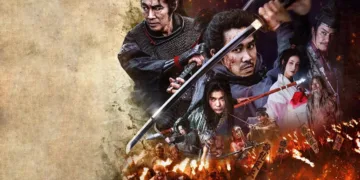



























He calls the boy “Frog.” The name is a casual joke, bestowed upon a young orphan moments after he is rescued from the roadside thugs of a corrupt monastery. It is an introduction that defines the ronin Hasuda Hyoe, a man whose easy charisma masks a deep-seated rage against the injustices of his time. This is 15th-century Japan, a landscape scarred by famine and plague, where the ruling shogunate has grown decadent and powerless, leaving the common people to be exploited by a predatory class of lords and money-lending monks.
Samurai Fury plants its story firmly in this broken world, reviving the classic jidai-geki, or period drama, with the grit and moral ambiguity of a Spaghetti Western. The film charts the course of an insurrection, beginning with one man’s personal code of honor and escalating into a full-throated rebellion. Hyoe’s journey is not just a fight for survival; it is an attempt to burn down a system that has failed its people, raising questions about the true cost of liberation and the nature of justice in a lawless age.
A Tale of Two Halves: From Personal Mission to Epic War
The film’s architecture is bisected, creating two distinct movements that feel almost like separate pictures. The first half operates on an intimate scale, concentrating on Hyoe’s burgeoning relationship with his new protégé, Saizo. Their bond is forged not in a formal dojo but on the road, through practical lessons in defiance.
Hyoe’s training extends beyond combat; he provides Saizo with a philosophical education in rebellion, demonstrated through audacious acts like trashing monk-run toll stations and defending villages from bandits. This section is a focused character study, examining how a revolutionary ideal is passed from one generation to the next. Then, the narrative undergoes a seismic shift. The camera pulls back to reveal that Hyoe’s seemingly random acts of kindness and violence are calculated moves in a much larger game.
His personal mission expands into a popular war as he gathers a disparate army of followers: fanboys, outcasts, and a hulking warrior who carries a giant club. The story transforms into a sprawling historical epic, its scope widening to encompass a meticulously planned assault on the capital of Kyoto. The goal is both symbolic and practical: to burn the IOUs and debt records that have served as instruments of oppression, thereby freeing the peasantry with a single, fiery act.
The Heart of the Conflict: Heroes, Villains, and Phantoms
At the center of the story is Hyoe, a figure given a surprising degree of warmth and humanity by actor Yo Oizumi. He portrays the hero not as an untouchable legend but as an accessible, even witty, man whose strategic brilliance is rooted in his connection to the people. This performance anchors the film’s key relationships. The mentor-student dynamic with Saizo provides the narrative with its initial emotional thrust, a bond that feels both authentic and necessary.
Also Read







It stands in stark contrast to the film’s central tragedy: Hyoe’s connection to Doken, the friend from his past who has chosen a different path as the shogun’s loyal enforcer. Their conflict is the story’s ideological core, a sorrowful examination of how two men from identical origins can become irreconcilable foes. While these central figures are given depth, the film struggles with its periphery.
As the rebellion swells, new characters are introduced who remain frustratingly thin. A hulking warrior named Emontaro and a silent female archer appear as powerful visual symbols of the uprising, yet they are denied any meaningful development or even dialogue. They exist as potent but hollow figures, phantoms of what could have been a richer, more populated world, their silence a missed opportunity to explore the full texture of the rebellion.
Spectacle and Style: The Blade’s Edge
The film’s aesthetic is a study in contrasts. It is shot with a painterly eye for the Japanese landscape, with authentic costumes and impressive sets that create a tangible sense of the Muromachi period. This visual beauty, however, is frequently home to brutal and gory action. The fight choreography is ambitious, showcasing a variety of weapons and styles, most notably Saizo’s fluid combat with a bo staff. Yet, the filmmaking often betrays the artistry of the performers.

The action sequences are marred by the intrusive habits of modern cinematic language: a perpetually unsteady camera, chaotic editing, and framing that is too tight to allow a clear view of the combat. The result is a sensory assault that substitutes visceral impact for spatial coherence, leaving the viewer with a feeling of the fight rather than a clear understanding of it.
A single, impressive long take of Saizo fighting on a rooftop serves as a frustrating glimpse of the clarity the film might have achieved. This visual approach is set to a score drenched in the style of a Spaghetti Western. The twangy guitars and atmospheric tones do more than add flavor; they reframe the samurai as a lone gunfighter, a deliberate choice that colors the entire thematic landscape of the film.
Samurai Fury is a Japanese historical action epic (Jidaigeki), originally released in Japan as Muromachi Outsiders (or Muromachi Burai). The film is set in 15th century Kyoto (1461), a time ravaged by famine and plague, where the corrupt shogunate is indifferent to the people’s suffering. The story follows Hasuda Hyoe, a rebellious ronin and vagrant, who decides to lead an uprising of outlaws and peasants against the ruling powers, setting him on a collision course with his former friend, Honekawa Doken, the shogunate’s head of security. Directed and written by Yu Irie, the movie premiered in Japan on January 17, 2025. It was released for Digital, Blu-ray, and 4K UHD in the United States by Well Go USA Entertainment starting on October 7, 2025.
Full Credits
The Review
Samurai Fury
Samurai Fury is a film of sharp contrasts. It succeeds as a character-driven story of mentorship and rivalry, carried by a charismatic lead and a strong emotional core. However, its ambition overreaches in the second half, where a sprawling epic plot and underdeveloped characters dilute the impact. While visually impressive, the chaotic action cinematography often obscures the spectacle it means to capture. It stands as a thoughtful, yet frustratingly flawed, revival of the samurai genre that is admirable in its intent but uneven in its execution.
PROS
- A charismatic and humane lead performance that anchors the film.
- Strong character-focused storytelling in its first half.
- Compelling central relationships, particularly the mentor-student and tragic rivalry dynamics.
- High-quality production design with authentic sets and costumes.
CONS
- A disjointed structure that feels like two different movies.
- Frantic and confusing cinematography during key action sequences.
- Underdeveloped supporting characters who are given little to no depth.
- The large-scale epic plot of the second half lacks the focus of the first.