























Mitski: The Land captures the artist’s 2024 tour for The Land Is Inhospitable and So Are We. Shot across three nights at the Fox Theatre in Atlanta, the film studies a performer defining the parameters of her stage world. Her current reach includes the viral rise of “My Love Mine All Mine,” a shift toward a wider audience beyond the indie listeners who first championed her.
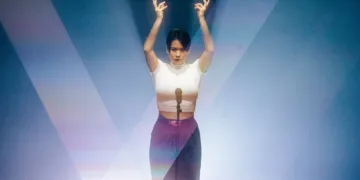
The film acknowledges that context from its opening passages by foregrounding her self-imposed isolation. Director Grant James and stage designer Andi Watson build a spare visual field. Mitski wears black slacks and a white top and stands alone at center stage. A seven-piece band delivers with precision from the margins. The staging makes a clear statement about authorship and focus. She occupies the frame with intent, collects the viewer’s attention, and constructs a contained universe for the night.
The Theatrical Body Language
The film grounds its storytelling in Mitski’s physical vocabulary. Working with choreographer Monica Mirabile, she performs movement that reads as narrative text. The choreography combines pantomime, theatrical gesture, and eccentric motion, with sudden air punches and Jazzercise-style kicks.
The approach rejects traditional dance vocabulary and turns her into a theatrical focal point rather than an accompanist to the band. She becomes the engine of drama. That commitment to physical narrative reshapes the concert into a staged work. Simple props, most notably two chairs, generate full scenes, including a window she mimes during “First Love/Late Spring.”
Lighting extends the idea: a single spotlight in “Heaven” creates intimate focus, while a caged pattern of lights for “I Don’t Like My Mind” compresses space and mood. Careful framing and controlled visual effects carry the stage pictures into a realm that invites the “gallery art” label. The authority of the performance, and its oddness, place her in the lineage of theatrical avant-pop artists.
Catalog Reimagined
Mitski: The Land reads as a career marker because it reconsiders the old to clarify the present. The setlist curates selections from across her catalog and assembles them into an emotional throughline. Rearranged treatments refresh fiercely felt older material.
Also Read







“Pink in the Night” and “Happy” feel re-earned, which offers a performing path for songs that had grown exhausting. A country-rock shape for “I Don’t Smoke” shifts the song’s emotional weather and creates a new vantage point. Transitions and medleys maintain the flow; “My Love Mine All Mine” leads directly into “Last Words of a Shooting Star” and keeps the arc intact.
Some widely known tracks do not appear, including “Your Best American Girl” and “Bug Like an Angel.” The omissions read as deliberate. The film documents an artist working at full command and preserves the climate of grand sensitivity and drama that runs through her writing.
The Island of Artistry
Craft decisions turn the concert into a striking piece of cinema. Sections in black and white, slow motion, and freeze frames channel the music’s emotional temperature into image. The choices serve the portrait of a persona. The film presents Mitski as an island figure, self-possessed, building an interior world on stage. The camera invites observation of that world; the invitation favors watching over collective participation. Many major concert films of this era emphasize the scale of stadium devotion and communal spectacle.

The Land focuses on solitude and disciplined art. Across its running time the images track loneliness, desperation, and shifting power, which clears away the reductive label of “sad girl music.” The work functions as documentation of a shift from indie breakout to a performer whose output invites serious historical attention.
The film’s structure favors legibility. The camera keeps lines clean, returns to repeated motifs, and respects the spatial grammar of the set. That clarity lets the storytelling through the body read without interference. Musical arrangements support that aim; they provide contour while leaving space for gesture to land. Song-to-song pacing avoids bloat, and the medley strategy sustains momentum while reframing familiar material.
Character emerges through action on stage. The solitary figure at center communicates self-possession and risk. The band at the periphery frames that character like a chorus in a play, present and vital while deferring to the protagonist. Costuming stays plain to remove distraction. The result makes intention visible.
Performance choices double as commentary on scale and fame. The viral success of “My Love Mine All Mine” widens the tent; the staging pulls the tent-pegs back to a more controlled radius. The film repeatedly shows what happens when an audience of many watches one person insist on a private logic. That tension feeds the drama.
The direction keeps faith with the concert’s rules. Light isolates or compresses. Framing favors negative space. Props convert into story devices. The two chairs become architecture: a window, a boundary, a partner, a bench. Those conversions create continuity with the lyrical content of the songs and keep the narrative spine intact.
Sound and image meet at the point of intention. Arrangements remake older tracks without blunting their emotional core. New emphases surface, which helps the artist carry material that once threatened to overwhelm her. The choice to leave out certain fan favorites operates like an editorial cut in a film; the absence focuses attention on the argument the show wants to make.
The film’s approach maps onto larger storytelling trends in concert cinema. Where spectacle often enlarges scale, this project refines attention. The camera and choreography argue for interiority as a legitimate mode for mass performance. That stance gives the document its shape and its distinction.
As a record of a tour, Mitski: The Land does the archival work with care. It captures the set’s visual language, the recalibrated arrangements, and the performer’s theatrical method. As a portrait, it clarifies how this artist currently tells stories on stage. The film preserves that method with precision and leaves a clear trail for future viewers who want to understand how this era sounded and looked.
Mitski: The Land is a concert film that captures the theatricality and intense emotional performance of singer-songwriter Mitski during her 2024 tour, supporting her album The Land Is Inhospitable and So Are We. Filmed over three nights at the Fox Theatre in Atlanta, the feature-length film brings her highly stylized choreography and minimalist stage design to the big screen. The film was released exclusively in cinemas worldwide on October 22nd, distributed by Trafalgar Releasing for a limited theatrical run.
Credits
Director: Grant James
Writers: Mitski (music and lyrics)
Producers and Executive Producers: Mitski, Moniker Films, Good Harbor Music, Working Class Films, Dead Oceans
Cast: Mitski
Composer: Mitski (songs)
The Review
Mitski: The Land
Mitski: The Land is a captivating document of artistic control and transformation. It foregrounds an intensely theatrical performance, using minimalist stagecraft and inventive choreography to deepen the emotional power of her songs. The film successfully recasts her catalog, confirming her status as a singular, commanding presence in contemporary music. This is an essential viewing for understanding her evolution from an indie favorite to a self-defined, monumental stage artist.
PROS
- Exceptional, theatrical choreography and movement.
- High-quality cinematic craftsmanship and artistic framing.
- Successful, emotionally resonant re-arrangements of older songs.
- Stark, highly effective minimalist stage and lighting design.
- Clear documentation of the artist's singular vision and confident persona.
CONS
- Setlist curation omits a few fan favorites (e.g., "Your Best American Girl").
- The emphasis on solitude may feel slightly distant for viewers expecting a traditional, communal concert film.