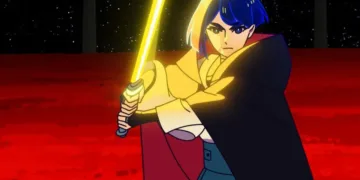












Star Wars: Visions Volume 3 arrives as the latest and most significant chapter of an animated anthology project that hands the galaxy’s creative keys to independent animation studios. These shorts remain non-canonical, which keeps the franchise open to visual and narrative experimentation even as the larger saga often favors continuity.
After a detour into international animation in Volume 2, this collection narrows its frame to Japanese studios. The lineup features Studio Trigger, Production I.G, and Kinema Citrus, joined by newer voices. The season models a kind of franchise de-centralization, a reminder of the energy that appears when a major IP invites genuine artistic play. That freedom keeps an aging brand from hardening into habit.
The Aesthetics of Neo-Kurosawa and Psycho-Jazz
The technical polish on display often astonishes. The quality of the animation stays exceptionally high, a consistency that holds even when a given script stumbles.
A single national focus does not flatten the look of the season. Each short stages its own formal argument about the visual language of Star Wars, which keeps the anthology from feeling like one texture repeated across nine films.
“The Duel: Payback” makes that argument with clarity. A stark black-and-white palette, pierced by sudden flashes of lightsaber and blaster color, points straight to Akira Kurosawa’s cinematic legacy. The approach goes past imitation. It reframes Star Wars as jidai-geki, a period-drama mode that supports a self-aware Neo-Kurosawa pastiche.
“BLACK” sits at the season’s far edge. This hand-drawn tone poem rides a relentless jazz score and builds a sensory experience that overwhelms plot. The film drops viewers into the fractured psyche of a Stormtrooper in battle. The piece invites the term “Psycho-Jazz Articulation,” a wink in the text to the way sound and image fuse into a single line of attack. The short serves as a counterpoint that argues for difficulty and opacity as living parts of art.
“The Bird of Paradise” continues the exploration of the inner life. The subject is a Jedi’s spiritual trial, rendered through vivid 3D CG. The trip unfolds as a psychedelic map of the self, with color and motion standing in for memory and will.
The Dialectic of Sequelitis and Archetypes
The season’s knotty choice is the introduction of three direct sequels to Volume 1: “The Duel: Payback,” “The Ninth Jedi: Child of Hope,” and “The Lost Ones.” Anthologies thrive on novelty, so continuity can tilt the frame toward a slate of pilots.

“The Duel: Payback” clears that hurdle. The short broadens the Ronin’s world, scales up the action, and sustains the visual rigor of its predecessor. The result feels like a deliberate, iterative step that earns its continuation.
“The Ninth Jedi: Child of Hope” plays a different structural game. The film lands in media res and reads as a setup for future serialization rather than a fully closed piece. The strategy tilts toward pragmatism and nods to corporate logic.
“The Lost Ones” dodges the pilot trap. The short returns to the Jedi F from The Village Bride and favors texture over incident. World and character receive the attention, which shows how continuity can add value when history and place sit at the center of the craft.
A set of familiar Star Wars archetypes ties the volume together. Jedi and Sith face off again and again, and orphaned or marginal heroes appear with companion droids at their sides. Comfort comes with that repetition, yet it can mute novelty. Entries like “The Smuggler” or “The Bounty Hunters” shake free when they plant those tropes in grounded, less mystical arenas that lean into grit and consequence.
I kept thinking about how I first learned to hear rhythm sections in jazz recordings. Once your ear locks onto the drum ride pattern, everything else reconfigures around it. These shorts work in a similar way. Lock onto the formal choice in each film and the theme emerges from the cut, the color, or the horn line beneath the image track.
The Creative Liberty Dividend
Volume 3 sustains the high artistic bar set by earlier entries. Across nine shorts, the anthology delivers a range of experiences that stay engaging and, at peak moments, feel inspired.
One structural note stands out. A single animation culture paired with recurring franchise archetypes creates a dense weave of echoes. Subtle similarities stack up across the lineup, which makes the volume play best as individual servings. Watch one, let it settle, then move to the next.
The enduring strength here is the creative liberty dividend. Non-canon status releases animators from lore management. That freedom fuels the volume’s sharpest choices, seen in the disciplined composition of “The Duel: Payback” and the raw, sensory charge of “BLACK.”
This third release secures Visions as an essential platform. The anthology continues to highlight fresh storytelling talent and supplies a steady current of artistic energy to a universe that often prefers caution.
Star Wars: Visions Volume 3 is the latest installment of the animated anthology series. It consists of nine distinct short films created by various acclaimed Japanese animation studios. The non-canonical nature of the series grants creators freedom to explore diverse stories, visual styles, and themes within the Star Wars universe, reimagining Jedi, Sith, bounty hunters, and smugglers. The entire volume premiered on October 29, 2025, and is available for streaming exclusively on Disney+. The series is rated TV-PG.
Credits
Title: Star Wars: Visions Volume 3
Distributor: Disney+
Release date: October 29, 2025
Rating: TV-PG
Running time: 13–22 minutes (for each of the nine episodes)
Director: Takanobu Mizuno, Hiroyasu Kobayashi, Naoyoshi Shiotani, Junichi Yamamoto, Masaki Tachibana, Hitoshi Haga, Masahiko Otsuka, Tadahiro Yoshihira, Shinya Ohira
Writers: Naoyoshi Shiotani, Shinya Ohira
Producers and Executive Producers: James Waugh, Josh Rimes, Jacqui Lopez, Justin Leach, Flannery Huntley, Kanako Shirasaki
Cast: Stephanie Hsu, Freddie Highmore, Jodie Turner-Smith, George Takei, Steve Buscemi, Simu Liu, Anna Sawai, Judith Light, Brian Tee, Karen Fukuhara, Kimiko Glenn, Harvey Guillén, Andrew Kishino, Masi Oka, Patrick Seitz
Director of Photography (Cinematographer): Kentarō Waki (for “BLACK”), Various others (for individual episodes)
Composer: Keiji Inai, Towa Tei, Yugo Kanno, Taisei Iwasaki, Ludvig Forssell, Takashi Omama, Kevin Penkin, Michiru Oshima, Shuji Katayama, Sakura Fujiwara
The Review
Star Wars: Visions Volume 3
Star Wars: Visions Volume 3 is an essential anthology, proving the enduring value of artistic freedom within a major franchise. While a few episodes rely too heavily on familiar Jedi archetypes and sequel continuity, the visual triumphs are breathtaking. Standouts like "BLACK" and "The Duel: Payback" offer stunning, high-concept animation. This volume maintains the series' standard as a vital space for aesthetic experimentation and creative risk.
PROS
- Consistent high quality with extreme stylistic diversity (e.g., black-and-white Neo-Kurosawa, Psycho-Jazz experimental art).
- Delivers necessary aesthetic experimentation for the franchise via non-canon freedom.
- "The Duel: Payback" and "The Lost Ones" successfully expand character and world depth.
CONS
- Too many stories focus on familiar Jedi/Sith conflicts and orphan archetypes.
- Some sequel episodes feel less like complete shorts and more like "backdoor pilots."
- The similarities of certain themes suggest the season is best consumed individually.