































Ghosting: The Spirit of Christmas wastes no time establishing its high-concept hook and its emotional frame. Against a bright holiday backdrop, the film introduces Jess (Aisha Dee), a young woman in Los Angeles who drifts between jobs and hobbies and feels stuck in her own life. That pattern shifts after a remarkably successful first date with Ben (Kendrick Sampson), an artist who awakens a rare sense of commitment in her.
The burgeoning connection ends abruptly when Jess dies in a car accident on the way home. The story then pivots into fantasy: Jess returns as a literal ghost, making the title’s pun on modern dating unexpectedly literal as Ben assumes she simply stopped replying to his messages.
Suspended between worlds, she learns she has unfinished business on Earth that blocks her from moving forward. Her best friend, Kara (Kimiko Glenn), initially stands as the only living person who can see her, which sets the two of them on a mission to identify and resolve whatever keeps Jess tethered.
The Complications of the Ethereal Rulebook
Jess’s status as a ghost functions as the central narrative device, one that lets the film stage questions about life and death through romantic comedy rhythms. The title’s play on a dating term feeds early scenes of situational humor, yet the storytelling soon runs into the demands of its supernatural design. A key weakness lies in how Jess’s “ghosthood” operates. Her physical presence shifts from scene to scene.
She can settle on a bicycle seat but cannot grip the handlebars, and she can sit at a table yet needs Kara to open a door. These inconsistent mechanics demand constant suspension of disbelief and create a drag on the story’s internal logic. The script appears aware of this, dropping lines that gently mock the absurdity of the rules.
The confusion extends to the narrative’s solution for Jess’s ascension. Kara’s spiritual advisor first proposes that “one big love” will release her, which sets up the idea that finishing her nascent romance with Ben is the primary objective. The story structure later reveals that her true unfinished business does not lie in romantic love but in something more private and personal. The shift has emotional coherence, yet it exposes how the film struggles to align its otherworldly premise with the feelings it wants to explore.
Friendship as the Main Event
The film frames itself as a romance, while its storytelling weight sits in the friendship between Jess and Kara. Their codependent, symbiotic bond becomes the real dramatic motor and gives the film its most genuine emotion. Jess fears failure and keeps herself in motion without real progress, while Kara stalls her own career ambitions out of fear of change, keeping herself available for her friend.
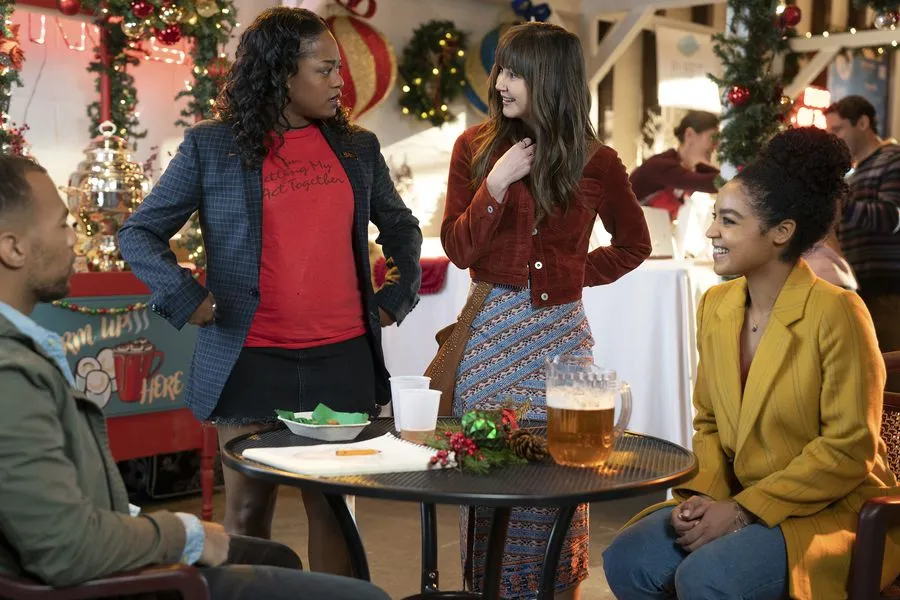
The interplay between Aisha Dee and Kimiko Glenn brings this dynamic to life, capturing both affection and the sting of their impending separation. Jess’s path to resolution rightly concentrates on recognizing and repairing this friendship, a shift in emphasis that reconfigures the standard romantic comedy template.
The romantic storylines serve this central relationship. The main romance between Jess and Ben, with Kendrick Sampson projecting easy charm, uses Jess’s liminal state to press on Ben’s emotional defenses that grew from his mother’s early death. Alongside this, the film sketches a secondary, appealing connection between Kara and Ben’s sister, Mae (Jazz Raycole), a psychology student.
Glenn and Raycole find quiet layers in these supporting roles, adding a touch of emotional realism that steadies the more outlandish ghost story elements. With both couples in play, the film opens space for different expressions of love and change.
Thematic Resonance and Context
The film settles into a lively tone that mixes quick-fire comedy with a steady warmth toward its characters. Pacing remains controlled, allowing the story to move toward its emotional peaks without lingering too long on the blunt fact of Jess’s death. She reaches acceptance with relative speed, which lets the narrative train its attention on the living and on the meaning of her life, sidestepping the finality of her loss.
Within the landscape of screen storytelling, the film sits comfortably alongside other high-concept holiday tales and openly tips its hat to classic models such as It’s a Wonderful Life. The piece operates primarily as a character study that happens to unfold at Christmas, with holiday tradition shaping the film most clearly in the closing stretch.
Festive decorations surround the characters, while the Christmas themes only draw together once the narrative shifts toward self-examination, personal growth, and the value of love that is not romantic. The story closes on a message about accepting change and facing inner fears. It delivers a gentle holiday experience that reframes the idea of “big love” and gives friendship the final word.
Ghosting: The Spirit of Christmas is a Christmas fantasy romantic comedy television film that premiered on Freeform on December 4, 2019. The story follows Jess, who dies tragically in a car accident right after a perfect first date with Ben. She returns as a literal ghost and, with the help of her best friend Kara, attempts to find the “unfinished business” that is keeping her anchored to the earthly plane before she can ascend to the afterlife. It blends supernatural absurdity with genuine heartfelt themes of friendship and love, and is available for viewing on various streaming platforms that carry Freeform content, such as Netflix in some regions.
Credits
Title: Ghosting: The Spirit of Christmas
Distributor: Freeform, Is or Isn’t Entertainment, Midwest Livestock
Release date: December 4, 2019
Rating: TV-14
Running time: 87 minutes
Director: Theresa Bennett
Writers: Laura Donney
Producers and Executive Producers: Tracey Jeffrey, Dan Bucatinsky, Lisa Kudrow, Tony Phelan, Joan Rater
Cast: Aisha Dee, Kimiko Glenn, Kendrick Sampson, Jazz Raycole, Missi Pyle, LisaGay Hamilton
Director of Photography (Cinematographer): Amy Belling
Editors: David Cordon
Composer: Brian H. Kim
The Review
Ghosting: The Spirit of Christmas
Ghosting: The Spirit of Christmas succeeds by prioritizing genuine emotional stakes over the mechanics of its high-concept fantasy. While the logic surrounding Jess’s ghost state is inconsistently drawn, the film’s narrative commitment to the powerful, codependent friendship between Jess and Kara gives it a beating heart. The performances anchor the story, delivering humor and warmth that resonate deeply. This is a clever, well-paced holiday entry that finds its true purpose in celebrating platonic love and confronting the difficult necessity of change.
PROS
- The relationship between Jess and Kara provides the film’s deepest emotional core, effectively subverting the standard romantic comedy structure.
- The central and secondary pairings are anchored by convincing and engaging performances, especially from Aisha Dee, Kimiko Glenn, and Jazz Raycole.
- The narrative is well-paced and maintains an effective balance of dry comedy and sincerity, preventing the death theme from becoming overly dramatic.
- The film delivers a heartfelt message about accepting change and valuing platonic bonds.
CONS
- The mechanics and rules of Jess's ghost state (her tangibility) are frequently confusing and illogical, requiring significant suspension of disbelief.
- The Christmas setting feels secondary to the character drama until the final third of the film.







