








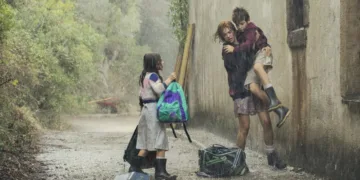


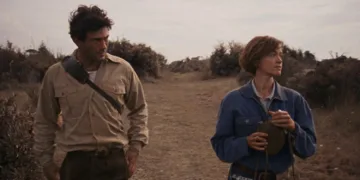







John Minton’s feature debut Game coils rural dread and social critique into a tense slice of British cinema that sticks in the mind. The project arrives with clear pedigree: it is the first feature from Geoff Barrow’s (Portishead) Invada Films, with Barrow also credited as producer and composer. Minton shares screenplay credit with Marc Bessant, Rob Williams and Barrow. Set in the early 1990s, the film uses acid house and rave culture as the noisy surface over a much nastier survival tale.
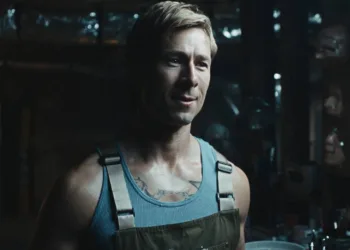
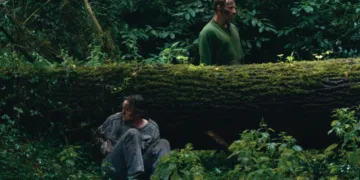
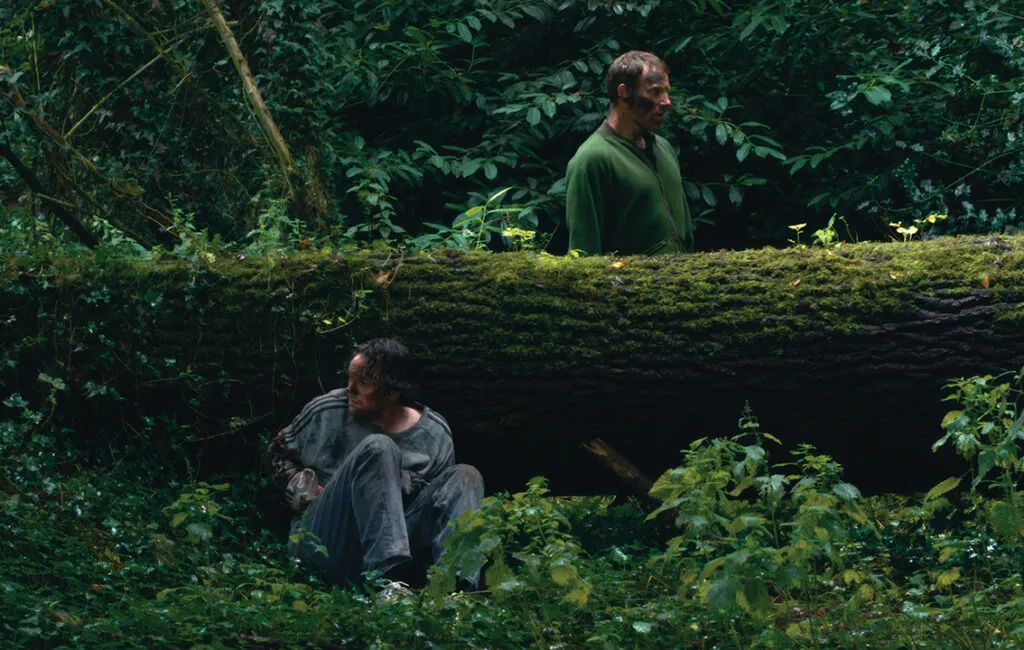
The story opens on David (Marc Bessant), hanging upside down in his wrecked car in a secluded English forest after fleeing a rave. His situation attracts the attention of the Poacher (Jason Williamson of Sleaford Mods), a territorial figure who treats this patch of woodland as his own domain. From this meeting, the film drops the audience into a dark, absurdist mood that plays the hedonism of the town visitor against an older, unforgiving landscape and the resentful man who guards it. The experience grows from this collision of worlds.
Two Men, One Literal Trap
Game builds much of its pressure by keeping almost the entire running time around David’s overturned car. The single-location setup works like a formal constraint used with careful control. David’s physical entrapment functions as a clear extension of his moral failures. The story moves forward through an intense, dialogue-led battle between the two men.
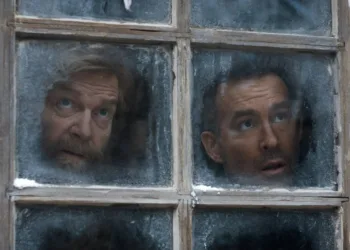
The Poacher withholds help and instead delivers a stream of embittered, class-conscious argument, turning David’s crisis into a chance to vent his hatred of “townies.” Jason Williamson plays him with real menace. Viewers familiar with his work in Sleaford Mods will recognise the same cantankerous energy, repurposed here into a portrait of rural resentment that sees David as a pampered intruder.
Marc Bessant answers with a performance built on strain and limitation, his body pinned in place while his panic increases. As a co-writer, he carries David’s slide into moral collapse and terror with conviction. Their confrontation produces a persistent psychological claustrophobia, presenting both men as mirrors for a wider selfish streak in British society. They stand as Nineties archetypes who feel lost and morally stained.
Style and Thematic Resonance
Minton’s work behind the camera, shaped by his background in music videos, feels assured and visually punchy. Ross James’ close-quarters cinematography heightens the tension through tight framing on faces and the enclosing forest. Repeated attention to insects, damp leaves and richly coloured flora turns the woods into something predatory, an active adversary.
The film patiently reveals its thematic concerns. The title Game carries twin meanings of hunted prey and ruthless contest. David’s earlier opportunistic theft and the Poacher’s cold refusal to help echo each other, forming a loop of self-interest. Instead of soft remembrance, the Nineties appear here as a bad trip of “anti-nostalgia,” a harsh, dog-eat-dog vision lurking behind talk of a “Second Summer of Love.”
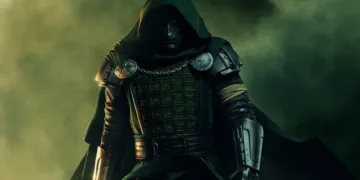
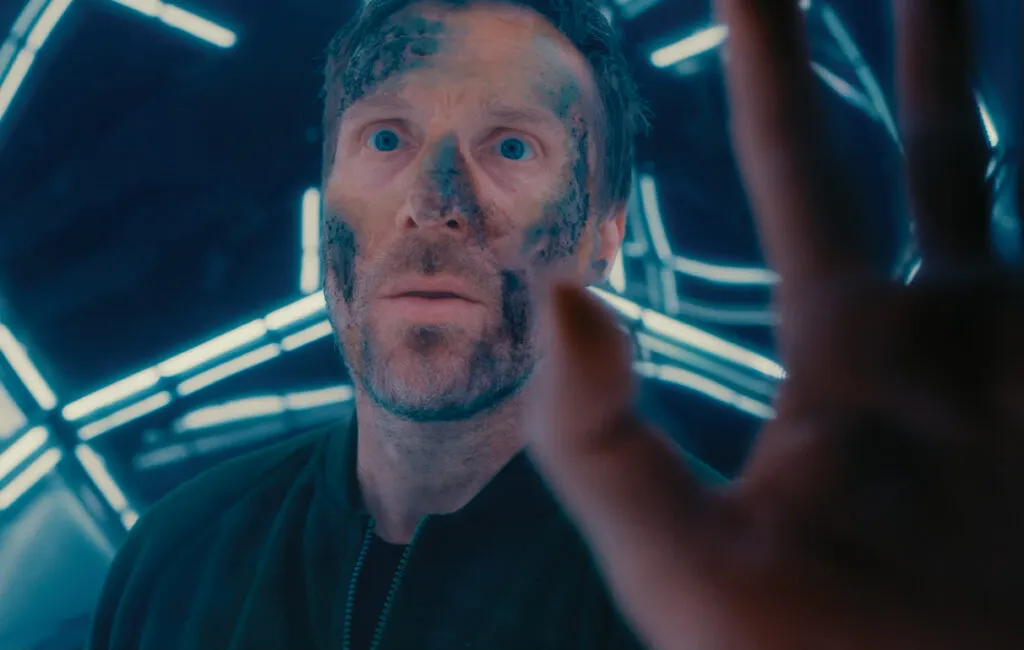
The film punctures the central standoff with impressionistic flashbacks to David’s chaotic life and later with vivid, lysergic imagery. In these passages, the forest twists into a warped battleground, a hallucinated space that tracks David’s fraying state of mind.
The Score and the Absurdist Chase
The sound design is as significant as the imagery in summoning primal unease. George Ramsden and Martin Pavey amplify the natural noise of the forest, which deepens the sense of isolation around the crash site. Geoff Barrow’s score carries equal weight, folding the pulsing energy of 90s electronica and rave beats into a steady unease.
The music locks onto David’s predicament and heightens the feeling of danger. In the final act, the film changes tempo. Slow, charged exchanges give way to a wildly strange sequence that tips the story into dark action. A flamboyant organ rendition of Ravel’s Boléro drives the chase, an extravagant musical choice that plays against the limping, desperate struggle we see on screen.
This peak underlines the film’s distinctive voice. Game moves like a stretched-out, self-assured music video, with an energy that recalls early British indie cinema such as Shallow Grave. The result is a strange, satisfying, existential car crash of a film that holds attention and keeps its bleak humour intact.
Game is a tense, atmospheric thriller set in 1993 amid the tail end of the British rave scene. The film follows David, an injured raver and thief, who crashes his car deep in the woods and finds himself trapped in a fight for survival when he is discovered by a local poacher. It marks the feature directorial debut of John Minton and is the first film from Invada Films, the new production company founded by Geoff Barrow (Portishead), who also co-wrote and produced the project. The film stars Marc Bessant and Sleaford Mods frontman Jason Williamson in their first leading roles. The UK and Ireland theatrical release is scheduled for November 21, 2025.
Credits
Title: Game
Distributor: Verve Pictures
Release date: 21 November 2025
Rating: BBFC 15
Running time: 82 minutes
Director: John Minton
Writers: John Minton, Geoff Barrow, Marc Bessant, Rob Williams
Producers and Executive Producers: Geoff Barrow, John Minton (Co-Producer)
Cast: Marc Bessant, Jason Williamson
Editors: John Minton
Composer: Geoff Barrow, Ben Salisbury, Jamie Paton
The Review
Game
Game is a sharp, confident debut that uses a single, volatile confrontation to explore deep-seated class resentment and moral bankruptcy in 1990s Britain. Its strengths lie in the raw, committed performances of Bessant and Williamson, the claustrophobic cinematography, and Minton's assured blending of psychological thriller and dark farce. The film rewards patience with an absurdist climax and a powerful, unflattering look at societal failure. This unique British indie feature is a powerful watch.
PROS
- John Minton shows confident, distinctive direction, successfully transitioning from music videos.
- The intense, dialogue-driven confrontation between Marc Bessant and Jason Williamson creates riveting tension.
- Ross James’ claustrophobic cinematography and the effective use of nature and light create a unique, moody atmosphere.
- Geoff Barrow’s blend of pulsating 90s electronic music and unsettling forest sounds enhances the film’s psychological impact.
- The film provides a cynical, layered critique of class tension and personal morality in Nineties society.
CONS
- The initial scenes detailing David's struggle to free himself are sometimes slow.
- The brief flashbacks chronicling David’s life initially feel too thin to fully establish his character.
- The film's highly stylized nature can make it feel more like an elongated music video than a conventional drama.