

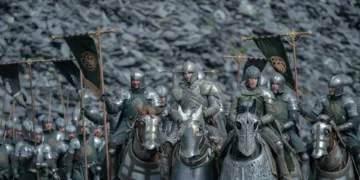






The first image refuses the cliché of a hushed, starry Bethlehem. It presents Judea in 4 BCE as a surveillance zone. Roads choked with soldiers, tax collection as a recurring visual motif, the frame crowded with bodies pushed to the margins by an imperial machine. The camera likes lateral movement here, tracking along patrols and caravans, building a sense of control that feels brittle rather than absolute. Every pan across Roman armor feels less like historical color and more like a visual reminder that this birth arrives in the shadow of a bureaucracy that can crush a village with paperwork and spears in equal measure.
Kevin Costner’s narration slips into this environment with an interesting dual function. On one level, it supplies dates, places, and a running commentary on what has been sentimentalized out of existence. On another, it behaves like the interior monologue of a noir investigator. He revisits his own childhood church play, those tinsel halos and cardboard stables, as if returning to a crime scene staged by nostalgia. The contrast between that memory and the onscreen Judea generates a quiet philosophical question: what does it mean that an event born in terror has been lacquered into seasonal comfort?
Visually, the production rejects soft focus and warm diffusion. The depth of field is often shallow, locking the viewer into the immediate stress of crowded streets and cramped interiors. The palette leans toward earth tones and exhausted flesh, with little relief. Frankincense is replaced by dust. The famous “silent night” looks more like an overcrowded refugee checkpoint where silence would be suspicious. By planting the Holy Family inside a geopolitical crisis, the film frames the Nativity as an act of survival within a machinery of domination, not an isolated tableau framed for stained glass.
Case File Bethlehem: Theology as Investigation
Structurally, the piece behaves less like devotional drama and more like a dossier. Dramatic scenes pause so Costner and a rotating set of historians, theologians, and clergy can enter, almost like a second camera angle on the same event. The effect mimics the rhythm of a true crime series. Scene, interruption, cross examination. The experts function as detectives reopening a cold case, sifting through familiar images and asking what, exactly, would have been architecturally plausible, politically credible, and logistically survivable.

The shift from wooden stable to rock-hewn cave exemplifies this forensic approach. The change is more than set dressing. A stable implies mild discomfort, a picturesque inconvenience that can sit on a mantel in miniature. A cave implies concealment, a need to disappear into the earth itself. The framing reinforces this difference. The camera pushes deeper into tight, low-ceilinged spaces, compressing bodies against rough stone, catching faces in half light. The birth becomes an event conducted under pressure, not under twinkling stars.
Also Read



The Magi receive similar treatment. The script moves their arrival forward in time, away from the night of the birth and into the more prosaic chaos of early childhood. Temporal compression gives way to temporal drag. The narrative no longer leaps from angelic announcement to royal visitation in a single, dreamlike sequence. It trudges, scene by scene, through the friction of real time, and the experts keep stepping in to remind us why. There is a quietly existential point embedded in this pedantry. Miracles, the special suggests, happen inside calendars, census schedules, and travel logistics. They have to survive the queue.
Costner’s delivery threads reverence through academic dryness. He cuts away from tenderness to discuss infant mortality rates and the lethal nature of ancient childbirth, like a professor inserting charts into a sermon. These statistics sit under the drama like a low drone. The viewer is constantly reminded that any baby surviving this world is a statistical outlier, before divinity even enters the conversation.
Holy Adolescents and a Crumbling King
Casting Mary and Joseph as visibly young, visibly frightened teenagers alters the usual devotional geometry. Their scenes are shot in close, crowded compositions, faces often occupying most of the frame, shoulders touching, eyes darting. They do not move like serene icons who anticipated this script. They move like kids who have been handed a fate they never auditioned for. Their relationship unfolds in shared glances, whispered arguments, and those small, exhausted touches that signal two people who have run out of good options.
The camera lingers on their uncertainty. It watches them quarrel, hesitate, misjudge. The performances keep their piety understated and their fear foregrounded. This choice introduces a philosophical tension: if divinity has chosen them, why does the experience look so much like ordinary panic? Free will and predestination collide in their hunched shoulders. They keep walking anyway. The film suggests that faith, in this landscape, resembles stubborn continuation more than serene acceptance.
Across the political divide, Anthony Barclay’s Herod occupies a very different visual grammar. He tends to be framed in slightly skewed angles and deeper shadows, a nod to classic noir villains whose inner rot leaks into the architecture. His physical frailty and mental instability read as two sides of the same failing system. He clings to a prophecy like a corrupt official clings to a leak-filled dossier, convinced that one rumor can topple him. His cruelty feels less majestic, more petty, rooted in personal insecurity rather than cosmic evil. The throne room becomes another shabby interrogation room, only with better drapery.
Gabriel, played by Saif Al Warith, arrives as a problem of tone that the production solves through restraint. No glowing wings, no deafening choir, just an uncomfortably calm presence stepping into a very mortal frame. The scenes read less like supernatural spectacle and more like a clandestine briefing. Light tightens around him, sound drops back, Mary and Joseph receive instructions that sound suspiciously like a classified relocation order. The divine appears as a quiet disruption of cause and effect, then steps aside, leaving the teenagers to deal with the human fallout.
Noir Shadows and a World Built for Crucifixion
Visually, the special leans into noir heritage with a confidence that borders on audacious. The lighting design favors hard sources and sharp contrasts, creating a persistent chiaroscuro that turns alleys, interiors, and even domestic spaces into moral battlegrounds. Characters slip in and out of pockets of illumination, faces half erased by darkness, edges of the frame heavy with opaque black. The sense that danger exists just beyond what the camera can see becomes a constant pressure on the viewer’s nerves.
Camera placement reinforces this pressure. The lens often sits low, gazing up at Roman soldiers and officials, giving their presence a distorted grandeur that feels both absurd and terrifying. In scenes with civilians, the camera moves closer to eye level, sometimes handheld, picking up the jitter of bodies trying to stay unnoticed. The alternation between rigid compositions for imperial power and more vulnerable, unstable framing for ordinary people tracks a clear ethical diagram: authority loves straight lines; survival lives in shaky ones.
Violence appears without ornamental distance. The aftermath of the Slaughter of the Innocents is treated with a clinical patience. The camera does not flinch. It studies bloodstained floors, discarded toys, the collapsed bodies of parents who cannot convert grief into eloquence. The sequences on crucifixion adopt a similar approach. No melodramatic music swell, just an unblinking gaze at a punishment designed for visibility and humiliation. The world here is optimized for public suffering.
Sound design heightens the psychological strain. Marching boots, shouted commands, and the rustle of a restless crowd sit high in the mix. Moments of quiet arrive rarely, and when they do, Costner’s narration or a distant infant cry slips in, refusing the audience any clean emotional release. The pacing mirrors this sensory strategy. Scenes of terror stretch, scenes of safety feel abruptly clipped. The viewer experiences hope in short takes, fear in long ones.
The production’s most striking achievement lies in how this aesthetic schema reorients the Christmas story. Light exists, but it is a precarious phenomenon, a small visual and ethical interruption inside a system built for crucifixion and census rolls. By the time the night is over, the relief the viewer feels has very little in common with holiday cheer. It looks closer to survivor’s relief, the dazed awareness that, against the odds, a single child and two exhausted teenagers have slipped through a machinery designed to erase them.
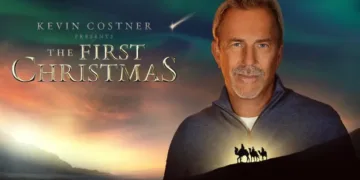
Kevin Costner Presents: The First Christmas is a hybrid documentary and scripted drama that premiered on the ABC network on December 9, 2025. Hosted and narrated by Kevin Costner, the special explores the historical and logistical realities surrounding the birth of Jesus Christ, utilizing a mix of expert interviews and dramatic reenactments. Following its broadcast debut, the production became available for streaming on Hulu and Disney+ starting December 10, 2025.
Full Credits
Title: Kevin Costner Presents: The First Christmas
Distributor: ABC, Hulu, Disney+
Release date: December 9, 2025
Rating: TV-14
Running time: 1h 25m
Director: David L. Cunningham
Producers and Executive Producers: Kevin Costner, Bridger Pierce, Marc Pierce
Cast: Kevin Costner, Gia Rose Patel, Ethan Thorne, Anthony Barclay, Saif Al-Warith, Mohamed Zouaoui, Kods Joundoul, Paulina Gálvez
Director of Photography (Cinematographer): Trevor Michael Brown, Andrew Bassett, Jeff Dougherty, Paul Marschall, Keaton Nye
The Review
Kevin Costner Presents: The First Christmas
This special succeeds by treating the Nativity as a historical cold case rather than a fairy tale. It trades comfortable nostalgia for a compelling, gritty texture that makes the ancient stakes feel urgent and real. The hybrid format occasionally disrupts the dramatic momentum, and the violence limits the audience to adults and older teens. Yet, the production offers a refreshing, grounded perspective that earns its emotional resonance through honesty rather than sentimentality. It is a sombre, fascinating watch for those willing to look past the tinsel.
PROS
- Effectively strips away myth to present a believable historical context.
- The noir-inspired lighting and location work create a tangible sense of danger.
- Gia Rose Patel and Ethan Thorne bring a necessary vulnerability to the central couple.
- The expert commentary adds valuable forensic insight into the era.
CONS
- The switch between drama and documentary can sometimes break the immersive spell.
- The depiction of Roman brutality makes it unsuitable for younger children.
- The relentless grimness might alienate viewers seeking traditional holiday warmth.