

















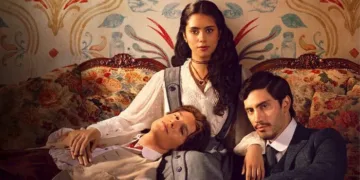











Emily Cooper pulls off a geographic sleight of hand, swapping the limestone poise of the Seine for the sun-scorched, centuries-stacked gravity of the Eternal City. This fifth run plays like a spiritual rebranding of her inner atlas. She takes charge of Agence Grateau’s Italian outpost, a career move that reads like a small personal empire extending its cheer into a culture with sharper instincts than the one she left.
The season’s tension sits between French professional lineage and an Italian present ruled by the Muratori cashmere dynasty. Paris’s rainy, intellectualized chic gives way to a Mediterranean heat that softens the hard edges of her former routines.
The show frames it as a tale of two cities, with Emily weighing life as a Parisian abroad against the pull of becoming Roman by habit. The promotion hints at her future as a corporate sovereign, yet she still drags unfinished emotional accounts behind her like carry-on luggage. The palette runs hot, the hair goes “cinematic bob,” and the past keeps hovering near the Colosseum like a tour guide who refuses to clock out.
The Muratori Shield and the Aristocracy of Absence
The Muratori family arrives with a particular strain of Old World gatekeeping, the kind that turns access into doctrine. Marcello and his mother, Antonia, protect their cashmere empire with the zeal of people who treat exclusivity as a sacred rite. Emily’s American, volume-forward marketing mindset hits that wall at speed.
The clash plays out as an argument between Western digital velocity and the slow, hand-tended soul the Italian countryside sells as identity. Marcello operates as a walking sign for the dispute: the heir who measures value through tradition, facing Emily, who measures it through revenue opportunity. The Muratori shield does not buckle for a viral hashtag.
Antonia Muratori stands as the matriarchal wall, devoted to preserving her late husband’s name as a living brand of mourning. Her resistance to expansion becomes the obstacle in Emily’s global mission, framed here as corporate spread dressed up as optimism. The theme widens into a social argument about local, high-trust cultures colliding with the flattening pressure of international commerce. Emily reads stalled growth as a personal provocation. Antonia reads growth as dilution, a slow thinning of what makes the Muratoris feel untouchable.
Minnie Driver enters as Princess Jane, played as a spacey socialite drifting through her own financial collapse with the breezy remove of someone unfamiliar with bank balances. She serves up a cynical, funny view of Roman aristocracy, functioning as a conduit for opportunistic networking. Jane claims connections “from Fiat to Fendi,” while privately carrying the kind of debt that can hide behind a title until the bill arrives with a smile.
Her presence turns the Rome office into theatre of the absurd: introductions to elite circles, available for a fee, delivered with the casual tone of ordering coffee. She also seems oddly aware of the camp level everyone is performing at, which makes her feel like the lone adult in a room full of beautifully dressed adolescents.
The season treats Roman landmarks like items to tick off an influencer’s shopping list. Truffle hunting in impractical heels becomes a neat visual metaphor for the series’ priorities: glamour first, physics later. Rome becomes an “authenticity” performance that plays like a theme park with better tailoring, and the show leans into that artificiality because escapism is the product. Culture arrives curated, scrubbed of grit, shaped into a tourism-ad sheen.
The Commodified Soul and the Architecture of the Pitch
The line between private self and professional asset has fully dissolved. In this universe, dinner becomes a pitch, a romantic walk becomes a site inspection, and a dance becomes a product demo. Emily’s suggestion that she rub hamburger meat on her hands to attract a designer’s dog lands as both inspired and faintly alarming (a marketing hack with the moral scent of raw beef). It captures the chaos of her operating system, where every unguarded moment becomes material for viral reach. The show calls it creativity; the vibe reads closer to emotional extraction with good lighting.
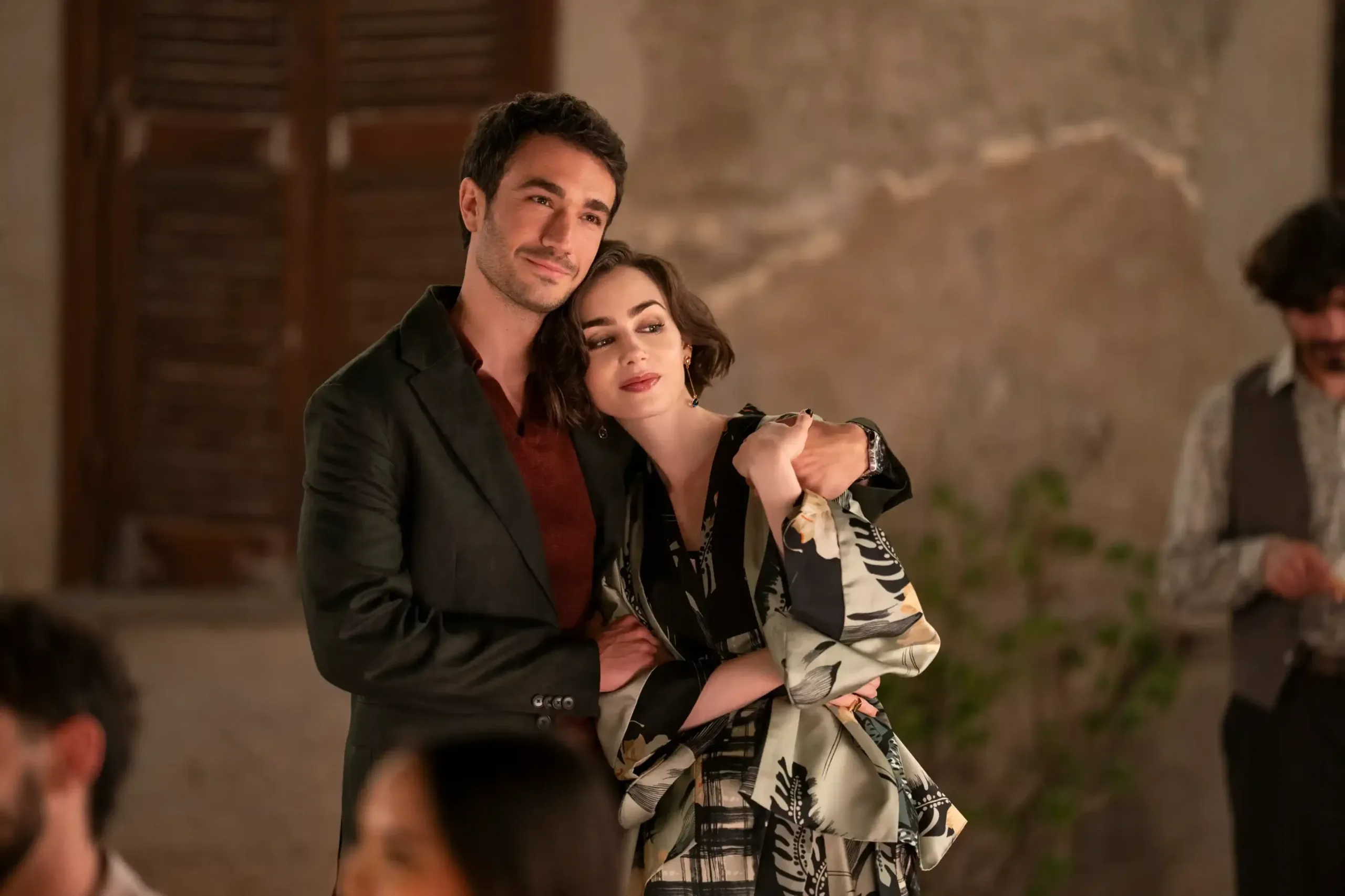
Sylvie Grateau tries to keep her famed composure intact while distracted by her Roman attachment to Giancarlo. She needs the Rome office to justify itself through immediate profit, yet she feels the pull of dolce vita leisure like gravity. Her conflict reflects the season’s larger problem: the challenge of maintaining a professional veneer in a setting that constantly asks for sensory surrender. Even Sylvie, patron saint of European cool, gets caught in the web of hustle. She finds inspiration in espresso, a flash of sensory marketing that pushes her toward pursuing the Bavassa company in Italy.
Luc and Julien supply the darker corporate comedy. Luc admits to cultivating a relationship with a Dolce & Gabbana representative, a confession that frames intimacy as a budget line and romance as procurement. Julien rebrands a homophobic water brand with the clinical calm of a mercenary, suggesting that at Agence Grateau morality counts as an optional add-on. Pleasure becomes business strategy, sold as aspiration, and the result feels glamorous in surface texture while hinting at something colder: a world where even affection functions like sponsorship inventory.
The show’s operating belief insists that your millionaire partner, your pop-star best friend, and your charming co-workers belong inside the social media campaigns that pay your rent. The work-life fusion leaves little space for a self that exists off-camera. Emily’s ideal end state looks like total border removal between living and selling. A Zoom meeting with Antoine and Alfie exposes the friction of distance and professional jealousy. Antoine’s petty behavior around the Bebe perfume spotlights the fragility of these entangled alliances. He wants someone to blame, and the series treats that as standard practice: campaigns fail, relationships crack at the same speed.
The Triangulation of Regret and the Ghost of the Chef
The “Team Marcello” phase begins with a honeymoon mood that plays undeniably sultry. Marcello points to a version of Emily that looks calmer, more sensual, a woman willing to shut off the analysis and jump into sensation (a rare idea in this universe of constant strategizing). The romance knots up because she also serves as his primary marketing consultant, folding desire back into work. Their chemistry keeps getting tested by the Muratori mandate. Emily repeats her familiar cycle: she meets a man, then she finds a way to monetize him.
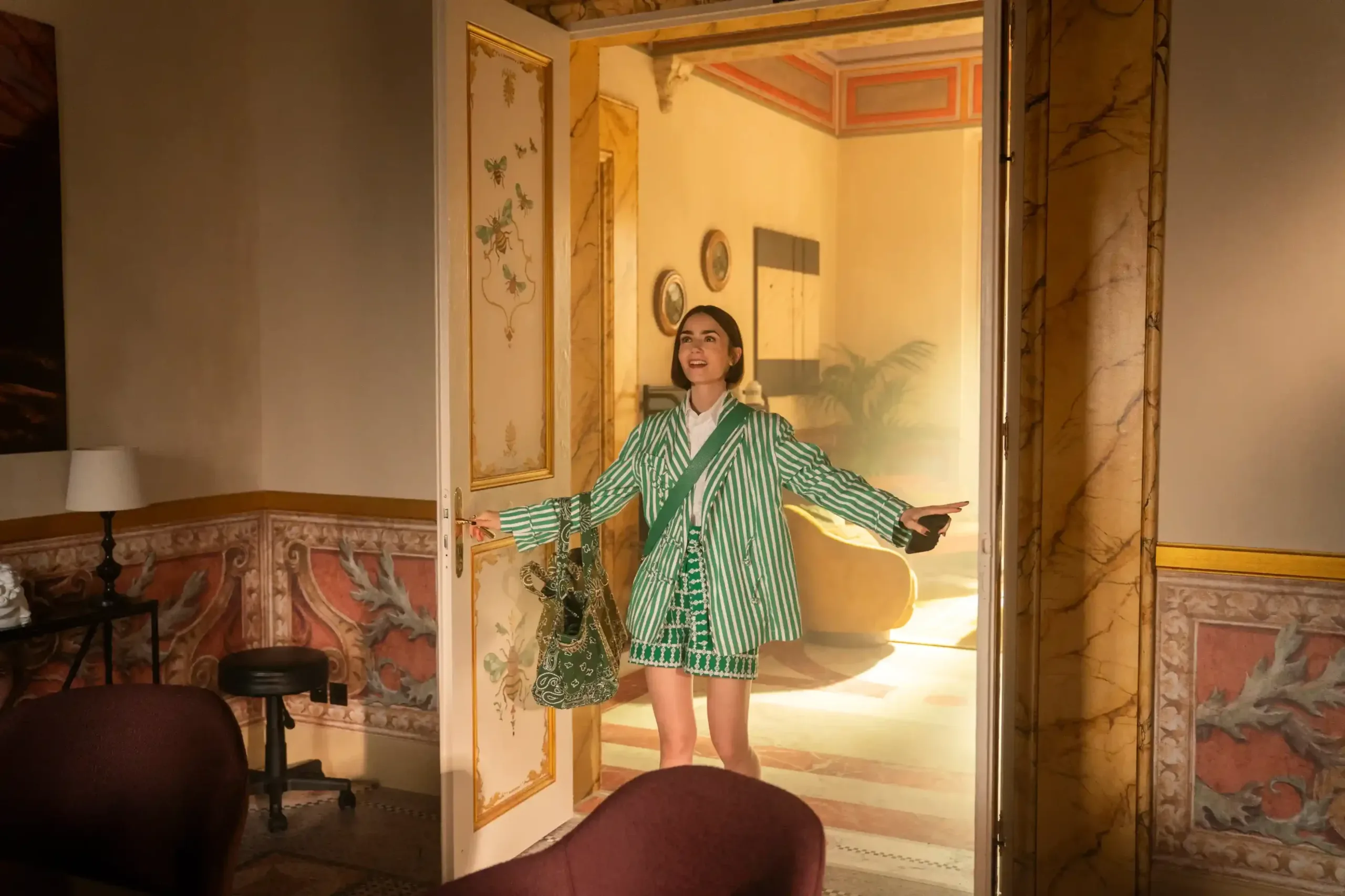
Gabriel hangs in the background like a spectral reminder of Parisian regret. His reduced screen time makes his absence louder. He recognizes, late, that his Michelin-star luck slipped away when Emily moved to Italy. Sylvie becomes an unexpected confidante, offering a moment of emotional honesty that feels unusually grounded for this show. She frames timing as the true deity of romance, and Gabriel absorbs the lesson with the tired expression of a man reading an overdue notice. He appears to be finding himself without a woman as the central anchor, a necessary character recalibration for someone long defined by proximity to Emily.
Back in Paris, the Mindy and Alfie subplot lands as a jarring pivot with the energy of narrative panic. Their pairing lacks the organic spark the show needs for believability, and the move feels like a forced fit designed to keep familiar faces orbiting the main story. “Girl code” gets tested, injecting tension into Mindy’s arc that reads more like plot maintenance than character growth. Mindy still functions as the show’s soul, yet her romance track this time plays like noise beside her musical rise. Her cover of Sabrina Carpenter’s “Espresso” hits as pure camp; some viewers will call it cringe, and the series seems ready to accept that trade because it worships surface-level pleasure.
The friction between Italian present and Parisian past operates like constant gravitational tug. Emily moves through a life built on the rubble of the prior one. A secret surfacing late tests her closest bonds and pushes her toward a choice between the stability of her Roman holiday and the unresolved chaos linked to Gabriel. The twist feels predictable, yet the show runs on that fuel: a circular narrative that promises evolution while delivering another round of beautiful people in beautiful places, selling each other the fantasy of change.
The Sartorial Dialectic and the Aesthetic of Escapism
Marylin Fitoussi uses clothing as a narrative instrument to track Emily’s displacement. The Rome wardrobe celebrates free-spirited sensuality: brighter, more romantic, tuned to the color of Roman sunsets. The Paris look sits in structured professionalism, with tailored suits and darker palettes doing quick visual work. Paris becomes the place where she works, Rome becomes the place where she lives. This wardrobe separation functions as the show’s sharpest storytelling move.

The cinematography doubles down on escapist appeal. Pasta and espresso montages tip into “food porn” so intense it becomes absurdist, and the camera lingers on designer handbags and tanned bodies with glossy devotion, ignoring any hint of real-life grit. The effect plays like ambient luxury viewing, a five-hour advertisement for a lifestyle fully commodified. The series works as a sedative, a fancy fever dream that encourages the viewer to shut off the brain and let the outfits do the thinking.
Mindy’s musical set pieces serve as the heartbeat of the pacing. Even buried under heavy production, they build the sonic scaffolding for transitions between cities. The characters’ magician’s-closet ability to produce runway quantities of outfits from tiny luggage stands as proof that realism has no authority here. Logistics take a back seat to looks. Glossy tourism remains the point.
Emily still reads as a formidable marketing engine, and she also comes across as increasingly self-centered. Each subplot bends back toward her gravity, giving her room to turn every problem into her own stage. She stays eternally bubbly and stubbornly determined, the cool girl who can pound hot dogs in couture with zero cognitive dissonance.
She becomes a Nosferatu in Jimmy Choos, feeding on the revenue streams around her while smiling for the camera. That plucky American perspective plays as the story’s real villain, spreading corporate sunshine across the globe like a cheerful infection. The series keeps offering pure escapism, a colorful, dramatic distraction that guarantees the glorious mess keeps spinning.
The fifth season of the hit dramedy premiered globally on Netflix on December 18, 2025. This installment follows Emily Cooper as she relocates to Rome to spearhead the opening of Agence Grateau’s new Italian office, shifting the series’ focus from the streets of Paris to the historic landmarks of Italy. All ten episodes were released simultaneously, allowing fans to immediately binge the latest developments in Emily’s chaotic professional life and her evolving romance with the Italian cashmere heir, Marcello. You can stream the entire season exclusively on Netflix.
Full Credits
Title: Emily in Paris Season 5
Distributor: Netflix
Release Date: December 18, 2025
Rating: TV-MA
Running Time: Approximately 31 to 38 minutes per episode (275 minutes total for the season)
Director: Andrew Fleming, Erin Ehrlich, Peter Lauer
Writers: Darren Star, Robin Schiff, Alison Brown, Joe Murphy, Grant Sloss
Producers and Executive Producers: Darren Star, Tony Hernandez, Lilly Burns, Andrew Fleming, Alison Brown, Lily Collins, Raphaël Benoliel, Stephen Joel Brown, Shihan Fey, Jake Fuller
Cast: Lily Collins, Philippine Leroy-Beaulieu, Ashley Park, Lucas Bravo, Samuel Arnold, Bruno Gouery, William Abadie, Lucien Laviscount, Eugenio Franceschini, Minnie Driver, Bryan Greenberg, Thalia Besson, Paul Forman, Arnaud Binard
Director of Photography (Cinematographer): Steven Fierberg, Seamus Tierney
Editors: Alex Minnick, Jesse Gordon, Laura Weinberg
Composer: James Newton Howard, Chris Alan Lee
The Review
Emily in Paris Season 5
Season 5 offers a high-gloss, albeit shallow, Roman holiday that doubles down on the show’s escapist DNA. While the shift in scenery provides fresh visual flair and the Muratori dynasty introduces a welcome friction, the narrative remains tethered to repetitive loops. It is a stylish triumph of production over substance, functioning more as a luxury commercial than a character study. For those seeking a mindless, aesthetic binge, it delivers exactly what is expected. However, for those craving emotional evolution or narrative depth, the series continues to prioritize the "look" over the "lesson."
PROS
- The transition to Rome and Venice offers stunning cinematography and a refreshing Mediterranean aesthetic.
- Her performance as Princess Jane brings a much-needed layer of eccentric, dry humor to the series.
- Marylin Fitoussi’s costume design expertly uses fashion to distinguish Emily’s Roman "vacation" persona from her Parisian professional self.
- With its brisk 30-minute episodes and low emotional stakes, it remains the ultimate "comfort food" watch.
CONS
- Emily continues to engage in the same professional and romantic mistakes, stunting her actual character growth.
- Several subplots, particularly Mindy and Alfie’s connection, feel forced and lack genuine chemistry.
- The show increasingly treats every personal interaction as a business opportunity, which can feel cynical.
- The "tale of two cities" conflict follows a highly formulaic path with few genuine surprises.