































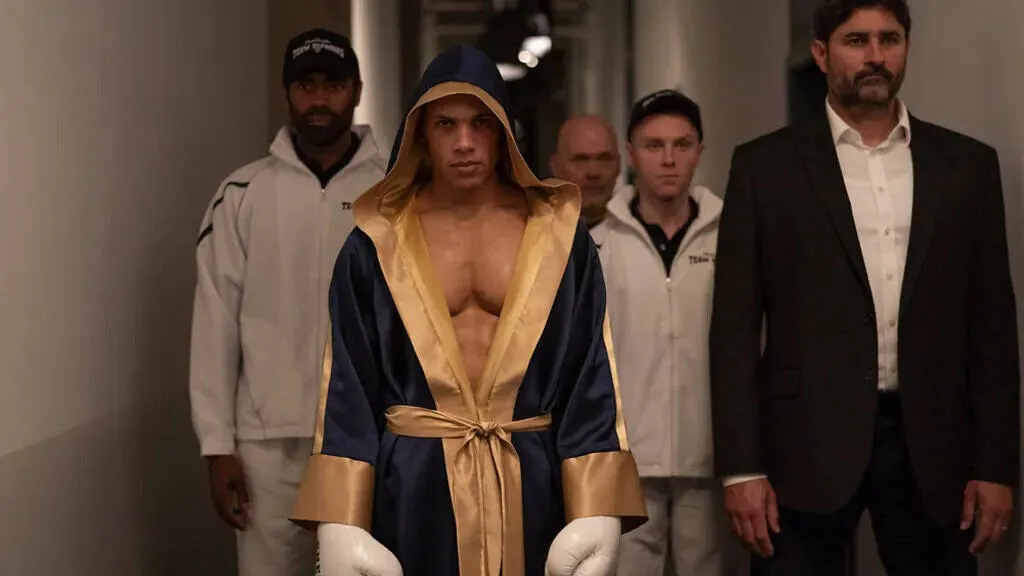
Christopher M. Anthony comes out swinging with Heavyweight, a boxing drama that keeps its distance from the ring. The story plays out in real time, boxed in by the sterile, sweaty confines of an arena dressing room. Jordan Bolger leads as “Diamond” Derek Douglas, a rising underdog who lands a world championship shot after other contenders pull out.
The script skips the familiar sports-movie ladder of training montages and triumphant physical ascents, choosing to crowd itself into the locker-room shadows. We spend ninety minutes before the first bell as the camera watches Derek’s final stretch of waiting, turning a fight-night premise into a close study of a man teetering at the edge. Outside, a crowd demands a show of strength.
Inside, Derek’s crisis gathers momentum. That focus on the moments before violence lets the film measure the mental toll of professional combat. Preparation becomes a matter of control, breath, and belief. The key question is simple and punishing: can Derek hold himself together long enough to make the walk.
Pressure Within the Dressing Room
The real-time structure turns the locker room into a pressure cooker, with each passing minute adding weight. Anthony builds tension through small narrative complications that steadily sand down Derek’s composure. The most intimate cut comes from Cain, a former sparring partner who has switched sides to the rival camp.
His presence in the hallway works like a psychological blade, since he carries close knowledge of Derek’s style and weak points. The sense of betrayal intensifies when Derek snaps and smashes a mirror with his fist. The resulting hand injury sparks a frantic thread in which the team scrambles to mislead officials and doctors long enough to keep the bout intact. The stakes sharpen fast: disqualification becomes an immediate threat before the fight even begins.
Jason Isaacs enters as Freddie, a promoter whose loud, money-first bluster brings chilly commercial logic into the room. He keeps reminding everyone, directly and indirectly, that Derek is a product moving through a high-stakes marketplace. That pressure reframes the underdog setup. Victory starts to look like an act of endurance against a rising tide of self-doubt, with the sport’s machinery grinding in the background.
Also Read






A Two-Man Thespian Bout
The film leans hard on the performances of Bolger and Nicolas Pinnock, who plays veteran trainer Adam. Bolger is sharp at presenting a fighter whose public shell starts to fracture. He uses controlled shifts in posture and movement to chart Derek’s decline, sliding from quiet dread into sudden flashes of fury.
Pinnock gives Adam a steady, grounded presence, and the film ties his professional standing tightly to Derek’s ability to function. The camera lingers on Adam’s face often enough that it becomes a gauge for the room’s rising panic.
Their relationship drives the story forward. They spar through conversation, moving between raw frustration and urgent attempts at reassurance. The bond reads as dependent and practical at the same time: Adam needs Derek to perform, and Derek needs Adam to keep the floor from dropping out.
The job, in these moments, becomes psychological triage as much as training. Osy Ikhile adds texture as Cain, bringing more than a simple villain shape to the role. His exchanges with Derek carry the sting of old rivalries, and the film uses that tension to expose vulnerability beneath the boxing world’s hard-man banter.
The Rhythm of the Countdown
The craft behind Heavyweight keeps the single-location design from going stale. The camera stays restless and fluid, circling and prowling around characters in ways that mirror their agitation. A soundtrack of heavy synths and rolling drums backs that movement, echoing a racing heartbeat. The sound and image work together to stress the clock, turning the approaching bout into a looming presence that keeps tightening its grip.
The dialogue stays sharp, using heated arguments to feed backstory in a way that feels charged rather than staged. A few beats can feel nudged into place to sustain momentum, yet the pacing stays tight enough to hold the viewer inside the moment-to-moment anxiety.
By leaving the fight itself offscreen, Anthony keeps attention on character pressure rather than physical spectacle. The drama stays trained on the human cost of the sport and the punishing mental preparation demanded at an elite level. It lands as a genre curveball aimed at viewers drawn to the psychological reality behind the athlete.
Directed by Christopher M. Anthony, Heavyweight is a real-time sports drama that premiered as the opening night selection of the Raindance Film Festival in June 2025. Set almost entirely within a single locker room, the story follows underdog boxer Derek Douglas as he prepares for a world championship match on short notice. The film was released in United States theaters on December 16, 2025, through Willa, and recently hit UK cinemas on January 23, 2026.
Full Credits
Title: Heavyweight
Distributor: Willa (US), Blue Fox Entertainment (International)
Release date: June 19, 2025 (World Premiere), December 16, 2025 (US), January 23, 2026 (UK)
Running time: 98 minutes
Director: Christopher M. Anthony
Writers: Christopher M. Anthony
Producers and Executive Producers: David P. Davis, Mark Goldberg, Michael S. Murphy, Philip G. Anthony, Jamie Carmichael, Phil Hunt, Compton Ross
Cast: Jordan Bolger, Nicholas Pinnock, Jason Isaacs, Sienna Guillory, Osy Ikhile, Blake Harrison, Sibtain Aslam, Barry Aird
Director of Photography (Cinematographer): Stil Williams
Editors: Pani Scott
Composer: David M. Saunders
The Review
Heavyweight
Heavyweight is a gripping exercise in tension that succeeds by stripping away the spectacle of the ring to focus on the psyche of the athlete. By trapping the audience in a real-time countdown, Christopher M. Anthony transforms a familiar underdog story into a claustrophobic psychological thriller. The power of the film lies in the raw, interdependent performances of Bolger and Pinnock, which elevate the locker room drama above its occasional melodramatic leans. It is a focused, high-stakes character study that proves the most brutal fights happen long before the first bell.
PROS
- Exceptional lead performances from Jordan Bolger and Nicolas Pinnock.
- Masterful use of a single location to create a "pressure cooker" atmosphere.
- A refreshing subversion of the boxing genre that prioritizes mental health over physical action.
- Sharp, fluid camerawork and a rhythmic soundtrack that drive the pacing.
CONS
- Certain plot points, like the hand injury, feel slightly forced to maintain momentum.
- Heavy reliance on verbal backstory can occasionally dampen the immediate tension.