































The volcanic soil of the Azores becomes a living medium for the dead weight this film carries. In Honeymoon Joon, Lilian T. Mehrel treats the landscape like a speaking part: lush, green, watchful, and quietly claustrophobic, the kind of beauty that can soothe and suffocate in the same breath. Even the title performs a small act of translation, stitching the Western “honeymoon” to the Persian endearment “joon,” a hybrid phrase that signals celebration pressed up against mourning.
Lela, a therapist of Persian-Kurdish descent living in the United Kingdom, arrives on the islands with her American daughter, June, for the first anniversary of June’s father’s death. His youthful stories of the archipelago have already written the place into family mythology, turning it into a destination that carries emotional instructions. From the opening, the film tunes itself to an awkward, intimate frequency between mother and daughter.
Sharing a hotel suite, June reaches for a pocket of privacy and physical relief, a small attempt at bodily autonomy. Lela enters mid-act to voice a plain complaint about her digestive system, and the moment curdles into something more revealing than embarrassing. The clash between June’s need for distance and Lela’s reflex for closeness establishes their pattern. They occupy a room designed for lovers, tethered by logistics and loss, moving through a paradise that does not feel inhabitable yet.
The Architecture of Displacement
The friction between Lela and June becomes a study in the way grief can estrange relatives while keeping them in constant contact. Lela’s professional identity as a therapist reads like muscle memory: she approaches pain as a place to live in, furnished with rituals, conversations, and the expectation of shared participation.
She wants grief to be communal, visible, spoken, and held in the body. Physical touch becomes her language of care and control. She adjusts June’s clothing, asks her to cover bare shoulders, and carries a protective vigilance that suggests an older, more conservative cultural formation still shaping her gestures.
June embodies a different displacement, one tied to motion and refusal. She has walked away from a prestigious medical residency after a stellar academic path, and she carries herself with restless energy that keeps searching for an exit. The Azores register for her as an escape hatch rather than a pilgrimage site. She wants air, speed, distraction, and the kind of forgetfulness that can pass for freedom during an anniversary.
Their generational and cultural divide sharpens through Lela’s attention to political news. She follows the “Woman, Life, Freedom” protests in Iran with palpable heaviness, mourning a homeland she has not visited in decades. That awareness sits beside her attempts to govern her daughter’s appearance and choices, and the film lets the tension stand without softening it into a neat moral lesson. Lela can carry solidarity and control in the same hands, the same way she carries grief and propriety in the same suitcase.
The conflict lands with particular force in tactile objects, the film’s quiet insistence that mourning often expresses itself through matter. Lela keeps a plastic bag containing her late husband’s final haircut, a literal fragment she intends to return to the sea. The detail is blunt, intimate, and a little shocking in its specificity.
June recoils from it, feeling the ritual’s weight as something that pins her in place. Mother and daughter divide along the question of what grief should look like: Lela clings to physical remnants and embodied customs; June reaches for the fleeting and the untouchable. Their shared days become a series of small maneuvers, retreats, and contained skirmishes, with silence doing the work that dialogue cannot.
Philosophical Detours and Ironic Encounters
The hotel itself supplies an almost cruel staging. Lela and June arrive as accidental guests at a resort running a honeymoon special, and the setting keeps pushing them into the orbit of young couples performing joy for themselves and for the room. Every meal and spa appointment becomes a reminder of what their trip cannot be. The environment turns their grief into a visible contrast against surrounding romance, and the film uses that proximity as pressure rather than decoration.
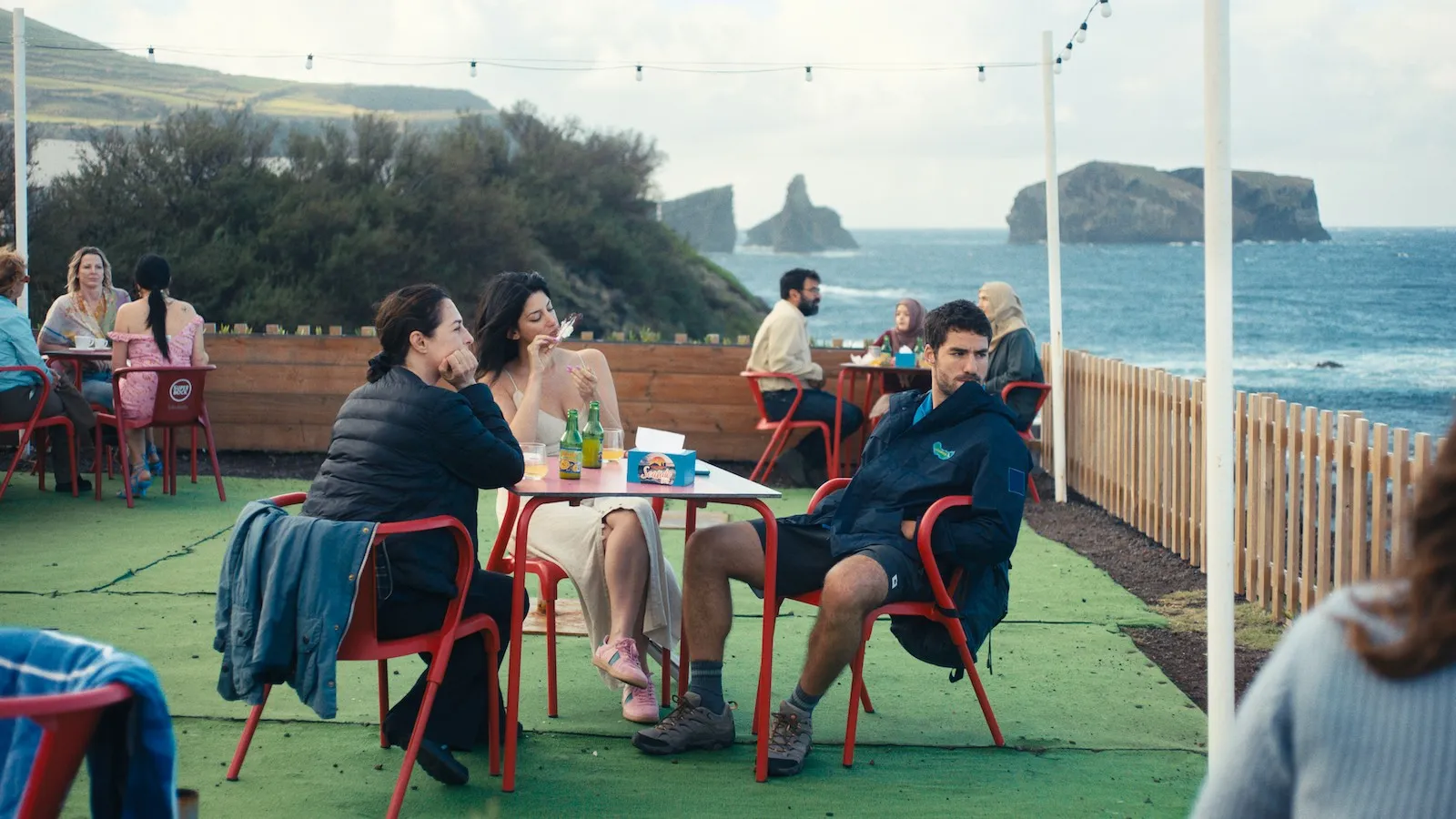
Their private tour guide, João, becomes a catalyst precisely because he offers each woman a different kind of attention. June flirts with him with desperate playfulness, aiming for a spark that might cut through the anniversary’s gravity. Lela responds to him through conversation that leans toward the philosophical and abstract, drawn to language that can frame loss without collapsing into confession.
João carries a quiet steadiness, guiding them through terrain while also functioning as a reflective surface for their needs. His line that every day is a new goodbye shifts the trip’s mood. The phrase lands like a small pivot point, turning the holiday scaffolding into a deeper reckoning with transience.
The film finds texture in situational humor, often turning June’s intensity into a source of mild, stinging comedy. There is an ongoing irony in the way staff attention and even João’s gaze seem pulled toward Lela’s poised, mature presence more than June’s overt attempts at romance. The expected dynamic flips. The reversal sharpens the film’s sense of social performance: desire, grief, and perceived authority circulate through the room in ways that embarrass the person trying hardest to be seen.
Physical humor appears in brief, unexpected beats that keep the film from hardening into a single tone. These moments do not cheapen the themes of death and displacement. They show how the mundane persists inside mourning, how the body keeps making demands even while the mind tries to build a shrine. The comedy sits inside the daily abrasion between mother and daughter, a reminder that grief does not erase irritation, awkwardness, or the occasional ridiculousness of being alive.
The Visual Texture of Recovery
The film’s visual language avoids postcard aesthetics. The camera uses the Azores’ contours as an external map for internal disquiet, shaping geography into an emotional instrument. Green slopes, volcanic textures, and coastal expanses register as extensions of the characters’ shifting states rather than a tourist’s checklist of beauty.
Old film reels from the father’s earlier travels thread through the narrative, creating a visual dialogue between his youthful adventures and the present tense of absence. The images connect June to a history she is only beginning to metabolize, a life her father lived with an ease she cannot access while grieving him. Weather becomes a narrative tool with sharp precision. At the twin lakes of Sete Cidades, thick fog obscures the famous view, mirroring the characters’ inability to see their relationship clearly.
The emotional peak arrives through a pair of silent releases staged in parallel. June suffers a sudden, shattering breakdown during an attempted hookup, the reality of her father’s death finally cutting through her defenses. At the hotel, Lela seeks her own moment of physical and emotional catharsis. The film trusts bodies over speeches here, letting breath, posture, and movement carry what explanation would flatten. The result feels bracingly honest, with relief arriving as something earned and messy rather than verbal and polished.
Performance anchors the film’s resonance. Amira Casar gives Lela a luminous, lived-in authority, making her prickliness read as armor built through years of practice. Ayden Mayeri captures June’s frantic, unmoored energy, a woman trying to outrun grief while discovering its pace never changes. The film ends without a grand resolution or a tidy emotional bow. A final, impressionistic dance sequence suggests a new way of sharing space: separation remains, movement aligns, and the relationship shifts from collision to a fragile form of co-existence.
Honeyjoon premiered at the Tribeca Festival on June 7, 2025, after winning the prestigious AT&T Untold Stories award. This comedy-drama follows a mother and daughter who travel to the Azores to commemorate the anniversary of a family loss, only to find their grieving processes at odds. As of early 2026, the film has completed a successful festival run—including screenings at the Palm Springs International Film Festival—and is primarily available through limited theatrical engagements and specialized festival platforms while it transitions to wider streaming services.
Full Credits
Title: Honeyjoon
Distributor: Wonder Maria Filmes, Bärli Films
Release date: June 7, 2025
Running time: 80 minutes
Director: Lilian T. Mehrel
Writers: Lilian T. Mehrel
Producers and Executive Producers: Andreia Nunes, Lilian T. Mehrel, Rostam Zafari, Sepanta Mohseni, Azadeh Vatanpour
Cast: Ayden Mayeri, Amira Casar, José Condessa, António Maria, Tiago Sarmento, Tereza Faria
Director of Photography (Cinematographer): Inés Gowland
Editors: Harry Cepka
Composer: Retail Space
The Review
Honeyjoon
Honeyjoon is a quiet study of the friction between memory and the desire to move forward. The film succeeds by avoiding easy sentiment, opting instead for a textured portrayal of how two women navigate the same void with different maps. While the pacing occasionally falters and certain political threads feel thin, the performances of Casar and Mayeri ground the narrative in a palpable, lived-in reality. It is a work of subtle grace that finds beauty in the unresolved gaps between a mother and daughter.
PROS
- Authentic, nuanced performances by Amira Casar and Ayden Mayeri.
- Lush, evocative cinematography that uses the Azores as an emotional landscape.
- A balanced tone that weaves humor and pathos without feeling forced.
- Avoids the clichés of traditional mother-daughter bonding films.
CONS
- The 80-minute runtime feels slightly baggy in the middle act.
- Background political subplots lack the space to be fully integrated.
- Some metaphorical visual elements border on being heavy-handed.