





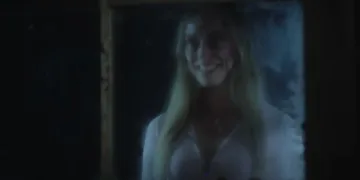










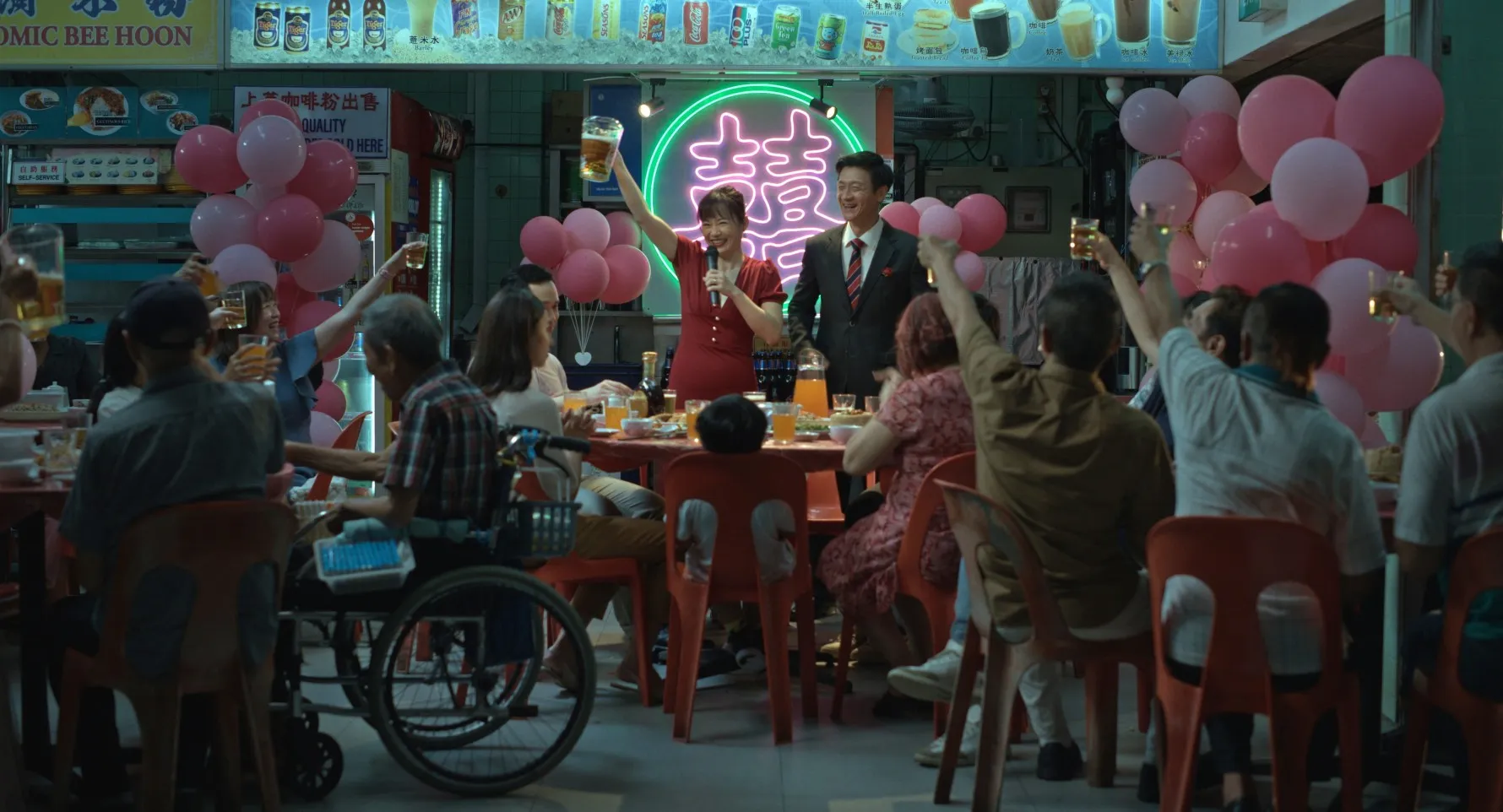

We Are All Strangers closes out an unofficial run of films by Anthony Chen that keep circling one stubborn fact: growing up inside a family is rarely clean, and it’s never polite. After earlier looks at domestic routine and forbidden connection, this film drops us into Singapore at its sweatiest.
The air hangs thick with wok-fried prawns and exhaust, a city running on heat, hunger, and hurry. Boon Kiat (Andi Lim) lives inside that grind. He runs a small noodle stall with a quiet, almost defiant dignity. For ten years he keeps his prices fixed, a mute act of resistance against the hyper-capitalism pressing in on all sides. Call it economic altruism. Call it self-erasure with good manners. It edges close to sacrifice.
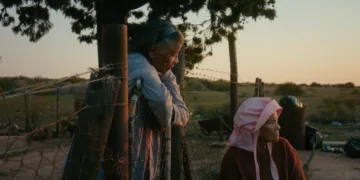
His son Junyang carries a different kind of friction. He wants out of the manual toil that has written his father’s life. Tradition pulls one way, the lure of ease pulls the other, and the rope snaps when Junyang’s girlfriend, Lydia, gets pregnant. The news punctures their soft, youthful bubble like a pin through plastic. One second they’re drifting through adolescence, the next they’re staring down survival’s cold checklist. The film stays with a class of people who rarely make it into the city-state’s glossy brochures.
The Mirage of the Digital Upgrade
Boon Kiat and Junyang read like a case study in “status-lag.” The father accepts physical labor with a stoic calm; the son chases a future made of screens and slogans. Junyang’s brief, disastrous flirtation with real estate makes the gap plain. He renames himself “Steve,” a shallow salute to Silicon Valley icons, as if a borrowed label can stand in for competence. It’s sad. It’s familiar. It’s the modern mask in its cheapest form: rebrand first, learn later.
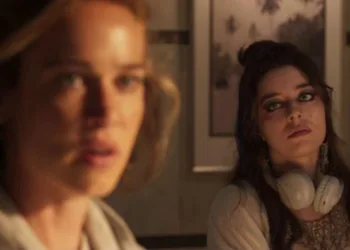
Lydia becomes collateral. She’s a serious student and a pianist, and the domestic reality of a child she never felt ready for mutes her music. The film treats that silencing as more than a personal tragedy. It feels like an argument about what modern “progress” asks people to pay, and who gets stuck holding the receipt.
Boon Kiat offers advice that pins down the film’s moral position. Lofty dreams can function as traps. A life free of suffering tips out of balance. His “gravity-philosophy” pushes against Junyang’s hunger for upward mobility, and the clash turns physical once the young couple moves into Boon Kiat’s cramped apartment. Privacy disappears. Space becomes pressure. Forced proximity turns the home into a resentment engine that also runs on obligation.
Adulthood here arrives with no ceremony. It feels like an ambush. Responsibility plays like a biological tax, collected hardest from people who already live near the edge.
The Beer Auntie and the Architecture of Belonging
Bee Hwa (Yeo Yann Yann) enters as a “beer auntie,” a Malaysian immigrant working the margins of Singaporean society. Her courtship with Boon Kiat comes with a welcome lack of cinematic perfume. They ride public buses for dates, chasing air conditioning while the city smears past the windows. Their romance runs on utility and quiet companionship, which sounds unromantic until you notice how honest it feels.
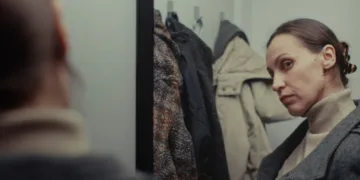
Yeo Yann Yann gives Bee Hwa a flinty, cynical shell with a capacity for startling loyalty underneath. She understands the world’s transactional nature better than anyone else in the apartment. She also reads people with the speed of someone who has had to.
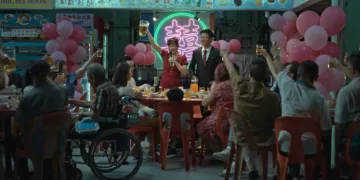
This foursome becomes a “collision-family,” held together by crisis more than bloodline or romantic fantasy. Bee Hwa’s outsider status keeps pointing to the invisible walls propping up the city’s economic success. She lives in permanent “nearness,” present in the scenery, never fully absorbed into it.
I kept thinking she was the true protagonist. The film keeps returning to her as the necessary “pragmatic-pivot,” the one person capable of stopping the household from collapsing under the weight of Junyang’s incompetence. She anchors a home full of drifting ghosts.
Saturated Skylines and Screen-Deep Survival
Teoh Gay Hian’s visual language cuts the class divide with surgical precision. Luxury condos glow with a saturated, hyper-real sheen as Junyang tries to sell a life he can’t possess. Their public housing block sits under grainier, flatter light, a different texture of existence entirely.
The film’s final act swings into a more frantic gear. The characters turn to social media live-streaming to sell over-the-counter medicine, a desperate, “algorithm-adjacent” hustle. The pacing shift lands like chaos breaking into the rhythm of daily survival.
Modern technology hangs over the story as a predatory shadow. It offers the feeling of escape, then tightens debt’s leash. The Singapore skyline keeps reappearing as a silent witness, glowing like an unreachable promise that taunts their cramped reality.
By the end, generational roles start to blur. The father slips toward companionship. The younger characters harden in the same fires that shaped the elders. The struggle continues as inheritance, passed along like a family name.
We Are All Strangers premiered at the 76th Berlin International Film Festival on February 16, 2026, where it competed for the Golden Bear. As the concluding chapter of Anthony Chen’s “Growing Up” trilogy, the film returns the director to his roots in Singapore, capturing the complex socioeconomic landscape of a nation sixty years after independence. The story follows a fractured quartet of characters whose lives collide through a series of tragic and humorous events, eventually forming an unconventional family unit. While a wide theatrical or streaming release date has not been finalized, the film is expected to follow the festival circuit throughout 2026 before becoming available on major global platforms.
Full Credits
Title: We Are All Strangers (Wo Men Bu Shi Mo Sheng Ren)
Distributor: Giraffe Pictures, TBA (International Distribution)
Release date: February 16, 2026 (Berlin International Film Festival Premiere)
Running time: 157 minutes
Director: Anthony Chen
Writers: Anthony Chen
Producers and Executive Producers: Anthony Chen, Wenhong Huang, Teoh Yi Ping, Gina Tan
Cast: Yeo Yann Yann, Koh Jia Ler, Andi Lim, Regene Lim
Director of Photography (Cinematographer): Teoh Gay Hian
Editors: Pu Yiwei, Hoping Chen
Composer: TBA
The Review
We Are All Strangers
We Are All Strangers is a heavy, humid exploration of the modern domestic trap. While it occasionally wanders into the tall grass of melodrama, the film is saved by its refusal to offer easy escapes. It captures the specific exhaustion of the working class with a gaze that is both clinical and deeply empathetic. The evolution from a quiet family study into a frantic survival drama highlights the fragility of stability in a hyper-capitalist landscape. It is a slow-burning, resonant piece of cinema that finds dignity in the grit of the daily grind.
PROS
- Exceptional, lived-in performances by Yeo Yann Yann and Andi Lim.
- Authentic portrayal of the socioeconomic friction in Singapore.
- Striking visual contrast between luxury aspirationalism and public housing reality.
CONS
- The two-and-a-half-hour runtime feels slightly overextended.
- Certain plot developments in the final act lean toward the soapy.
- The shift into crime-adjacent subplots is somewhat jarring.