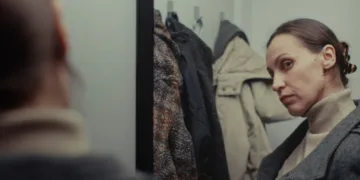
The film opens with an image that treats the human eye like an exposed nerve. The camera presses into a close-up of eyes that seem to quiver with a private, frantic signal. Laura arrives through this gaze, introduced inside the metronomic routine of a rehabilitation music workshop. Percussion lands with the comfort of structure, then the film lets that structure slip away as she returns to the wind-scoured quiet of Cape Cod.
Her family’s sprawling estate waits like a beautiful cage, inherited from a father whose legacy carries the same weight as the Atlantic breakers outside the windows. The narrative is tethered to a drunk-driving accident involving her young son, Felix, a trauma that pulls on every scene even when it stays unspoken. In the early stretch, it gets covered with a hollow story about a retreat in Bali.
Director Kornél Mundruczó and writer Kata Wéber step back from the breathless intensity of their previous work and settle into slow, observational fatigue. The script keeps its attention on the exhausting work of staying present without the chemical insulation of alcohol. What emerges is a quiet reading of a woman trying to live inside a space that learned to keep going without her.
The Architecture of Resentment
Domestic life after a long absence becomes a sequence of silent negotiations, small tests, and tactical retreats. Laura walks into a household that has built up its own calloused defenses. Martin, her husband, paints for a living and has set aside his own creative ambitions to keep the family afloat. His devotion registers in every practical choice he makes, and the home still feels saturated with a lack of day-to-day trust. His watchfulness clings to her like added gravity, turning ordinary moments into evaluations.
Josie, their teenage daughter, stands as the hardest emotional barrier. She spent months acting as a mother to her brother Felix, carrying responsibilities that shaped her into a substitute parent. She let college scholarships pass by so the household could hold together. Her hostility reads as a direct response to how much space her mother’s drama consumes, and that hostility has the blunt certainty of a survival skill. Felix stays distant and uneasy, his trauma expressed through quiet withdrawal that makes the rooms feel larger.
A scene with a jellyfish swarm on the beach lands as a sharp crisis point. The event echoes the earlier car accident and exposes how fragile Laura’s current state remains. Her sobriety changes the household’s choreography. This family has practiced living with her absence, learning the routes around a ghost. A present Laura arrives as a disturbance to the patterns that kept everyone moving. The shift in power sits in plain view. Laura feels like a stranger inside a life she once directed with authority.
The Shadow of the Choreographer
The specter of Ivan Baum drifts through the corridors of the beach house and the rehearsal halls of the dance company. He was a legendary choreographer, a high-functioning addict whose public brilliance lived beside cruelty and control. Laura inherits a version of his world and finds herself holding the reins of the Baum Dance Company while wrestling with impulses that marked his life. The organization teeters under a financial crisis, and the people around her treat recovery like an inconvenience that needs scheduling.
Board members such as George and assistants such as Peter watch her return with a hard, acquisitive focus. They want her back in position, and they want it fast. Their demands carry the chill of predation dressed up as professionalism. The film turns this pressure into commentary on the way wealth can varnish addiction. In these affluent rooms, alcoholism hides behind fine crystal and the practiced excuse of artistic temperament, turning damage into a style choice.
Laura’s conflict takes on the shape of an identity problem. She studies her own devotion to dance and asks what belongs to her, what arrived through inheritance, and what lingers as a symptom of her father’s influence. A brief connection with Keegan, a kite salesman on the beach, offers a rare pocket of honesty. He is a fellow addict, and the understanding he brings requires no performance of wellness, no polished competence for a boardroom audience. He becomes a mirror held close to her precarious state, reflecting it without ceremony.
Movement in the Faded Light
Yorick Le Saux shoots Cape Cod with a palette that feels sun-bleached and thin, as if the landscape has been washed out by salt and time. The light suggests a world in which color has started to drain, a visual corollary for a protagonist learning to look without blur. The film threads in dialogue-free flashbacks that sketch the architecture of Laura’s childhood. These fragments work conceptually, using interpretive movement to articulate violence and neglect from the past with the clarity of bodies speaking where language fails.
Four choreographed sequences appear across the narrative like pulses of buried memory. One rides the disco energy of a Barry White track, and that bright insistence crashes against the film’s surrounding gloom with a near-absurd jolt. The mother-daughter dance on the sand reaches for reconciliation through physical proximity, attempting a kind of repair that conversation cannot produce.
Joe Hisaishi’s percussive score anchors the film in rhythmic reality, keeping time with the effort of staying upright in a life that resists easy footing. Amy Adams draws on her background in dance to shape the performance. Exhaustion shows up in the slump of her shoulders, the precision of her stillness, and the particular way she holds her body as though every movement has a cost. The portrayal commits to the physical labor of existing, treating sobriety as a daily weight carried through rooms filled with history. The final stretch settles into peaceful acceptance, letting the film’s last note rest in quiet steadiness.