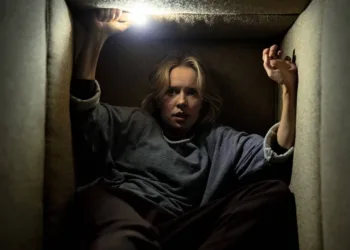









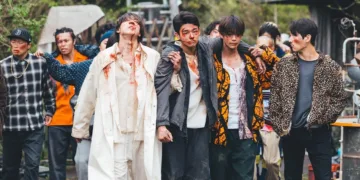


















The Evergreen Company reads like a small-scale industrial purgatory. Fluorescent lights hum with a patient, corrosive insistence; they flatten color and leave faces slack with exhaustion. Inside this Indonesian factory, workers tend vast cauldrons of human hair while rows of blank-faced mannequin heads keep a silent, courtroom-like vigil. The place functions as a literal image of stagnant capital. Director Edwin stages rooms whose angles feel hungry; the architecture itself comes off as predatory.
Manager Maryati rules this economy of motion with a ritualistic certainty. Her toreador-inspired outfits register as costume and command in equal measure (perhaps she enjoys the pageantry). Her voice comes through speakers, a cracked mantra that trades sacrifice for paltry bonuses. Fifteen-minute exercise breaks and morning rituals are performed with a reverence that reads like liturgy for what the script names the “church of the grind.” The building is faceless and run-down. Sleep is rare. Production is the recognized sacrament.
Blood-Finance and the Inheritance of Shadows
Putri and Ida arrive to settle a legacy labeled “blood-finance.” Their mother left them a mountain of debt, the familial liability that pushes descendants back into the very machinery that consumed the parent. That debt becomes a structural force; it funnels the sisters into predictable trajectories. Putri interprets the mother’s death as suicide, a rational exit from an irrational existence. Ida senses a theft of the soul and whispers of the supernatural. The two positions set up a friction between material explanation and spiritual interpretation.
Their brother Bona brings a grotesque biological twist. He can regrow severed limbs, though each replacement returns shrunken and infantile. He becomes, in the most literal sense, a “human resource” to be harvested. This recurring limb renewal acts as a grotesque metaphor for labor-power being consumed, discarded, and compelled to regenerate.
The siblings find no life past the drab employee dorms. Economic servitude is their daily condition. Managerial practices treat people like interchangeable components, and the debt functions as a haunting presence that outweighs any phantom spirit.
Physi-Gore and the Tactile Hairball
The film rejects the slickness of digital horror and embraces the messy fidelity of practical effects. Central to this is a massive, textured hairball that reads as a conglomerate of discarded identities seeking a host. Director Edwin and cinematographer Akiko Ashizawa favor disorienting close-ups that intensify the sense of bodily violation. The aesthetic leans toward 80s-style shlock, a preference for tactile impact over spectral suggestion.
Also Read

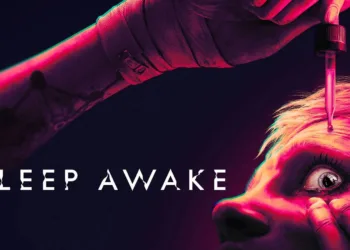




Workers slam heads into machinery. They gouge or tear at their own eyes in episodes described as “overtime-induced” psychosis. These hands-on sequences hold a gravity that CGI would struggle to reproduce. The hair motif links the factory’s output directly to the film’s terror; products are implied to be woven from human suffering.
The bloodied climax erupts into a frantic array of fluids and flying parts. It pays homage to the yurei spirits of Asian cinema while dressing that spectral reference in industrial grime. The handmade monster effects make the menace feel immediate and local.
Capitalist-Kitsch and the Cognitive-Slasher
Satire sits beside the screams. Corporate “well-being” becomes a pantomime: meaningless stars and stickers are handed out to top performers as if decoration could sanitize harm. Those stickers operate as a form of capitalist-kitsch, a bright, ludicrous veneer over lethal labor practices.
When the film adopts a lighter tone during scenes of mutilation, the result is what the review calls a “cognitive-slasher” effect. The tonal mismatch forces viewers to hold absurd performance alongside real brutality.
Pacing sometimes falters. The narrative lingers in shadowy detours that refuse the clarity some viewers might seek. Characters often respond to peers’ deaths with a curious indifference; this numbness functions as commentary on the desensitizing rhythms of repetitive work, though it can also read as narrative fatigue.
The film presses the work-until-you-drop mentality to a demonic logic. The true antagonist, the movie argues, is the system that treats a severed hand like an insurance footnote. The final act arrives with chaotic energy and a preference for spectacle over subtlety. It remains a loud, messy critique of trading hours for an existence that barely merits the name of life.
Sleep No More is a genre-bending horror fantasy that celebrated its world premiere on February 14, 2026, as part of the Berlinale Special Midnight program. Set within the claustrophobic and decaying environment of a Jakarta wig factory, the story explores the intersection of social allegory and body horror through the lens of two sisters investigating their mother’s mysterious death. The film is a significant five-country co-production involving Indonesia, Singapore, Japan, Germany, and France, marking director Edwin’s first venture into the horror genre. While it has toured international film festivals, it is primarily available through theatrical releases in participating regions and through specialized genre film distributors.
Where to Watch Sleep No More (2026) Online
Full Credits
Title: Sleep No More (Original Title: Monster Pabrik Rambut)
Distributor: Palari Films (Indonesia), Showbox Corp. (International)
Release date: February 14, 2026 (World Premiere at Berlinale)
Rating: NR (Not Rated/Genre: Horror Fantasy)
Running time: 96 minutes
Director: Edwin
Writers: Eka Kurniawan, Edwin, Daishi Matsunaga
Producers and Executive Producers: Meiske Taurisia, Muhammad Zaidy, Iqbaal Ramadhan, Dian Sastrowardoyo
Cast: Rachel Amanda, Lutesha, Iqbaal Ramadhan, Didik Nini Thowok, Sal Priadi, Luqman ‘Kev’ Hakim
Director of Photography (Cinematographer): Akiko Ashizawa
Editors: Daniel Hui
Composer: Hiroyuki Nagashima
The Review
Sleep No More
Sleep No More functions as a visceral indictment of the predatory nature of modern labor. Edwin transforms the mundane horror of the night shift into a grotesque carnival of practical gore and capitalist absurdity. The film occasionally stumbles through tonal inconsistencies and uneven pacing. The tactile quality of its handmade monsters provides a refreshing counterpoint to the sterile landscapes of digital cinema. It remains a messy, loud, and effective piece of industrial satire for those who prefer their social commentary served with a side of severed limbs.
PROS
- Tangible physical effects and handmade creature designs.
- Sharp satirical focus on predatory labor practices and corporate mantras.
- Strong, oppressive industrial atmosphere.
CONS
- Erratic tonal shifts between grim horror and kitsch comedy.
- Slowed pacing during the mid-section of the story.
- Detached character motivations that hinder emotional investment.