



























Tizza Covi and Rainer Frimmel observe a disappearing world with a careful, spectral patience in this film. The story follows Alois Koch, an eighty-year-old musician who moves through a condemned Vienna apartment block under the name Al Cook. He remains the last tenant, a solitary figure who resists the forces of urban redevelopment that aim to erase the traces of his life.
Surrounded by an analog graveyard of vinyl and the relics of a marriage, Koch nurses the idea of a pilgrimage to the American South, the mythic origin of the music that has guided him. The directors blend documentary truth and staged moments by placing the real musician at the center of a dramatized version of his existence.
The effect is an intimate character study that avoids sentimentality and records the quiet dignity of a man out of time. The camera measures the slow, deliberate movements of aging against the mechanical rhythm of demolition. Through a grainy, intimate lens we witness the twilight of a stubborn artist who seeks refuge in the ghosts of Mississippi blues while his city plans a sterile future.
The Ontology of the Performed Self
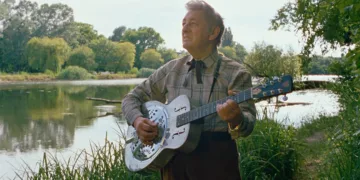
Cinema often confronts the tension between what is lived and what is represented. Covi and Frimmel address this tension with a docudrama approach that lets Alois Koch appear as himself. That choice roots the film in a particular kind of truth. Koch carries a gravity that is both physical and historical. His pompadour and his weathered, stoic features mark him as a figure suspended in an earlier age.
Around this genuine presence the filmmakers introduce fictional pressures on his life without fracturing the sense of veracity. A hired thug arrives to force an eviction and Koch answers with a deadpan weariness that slides toward the absurd. Those intrusions read as a form of comedy that nevertheless exposes his quiet resistance before an indifferent world.
Working with non-professional performers often risks a stilted result. Koch eludes that hazard by projecting a natural, weary charisma. He simply exists where the camera points, carrying the sorrow of a man who watches his days become a ghost story. The film’s authenticity comes from the bleed between his real history as a blues figure and the scripted solitude that surrounds him.
Small gestures feel earned by long years at the instrument. His stoicism functions as a protective posture against a modernity that regards him as an impediment to progress. By making a man play a version of himself the filmmakers remove much of acting’s artifice and present a direct meditation on identity as performance in late life.
Architecture as an Ephemeral Monument
Rooms record us. Koch’s Vienna flat behaves like a breathing repository, a melancholic capsule dense with vintage records, faded photographs, and simple shrines to his late wife. That localized cosmos faces erasure at the hands of property developers. Their methods transform lived memory into sterile, profit-driven space. The camera documents the painful labor of dismantling a life. Packing boxes and cataloguing objects exact an emotional tax that leaves Koch an exile in the rooms he once inhabited with ease.
The demolition of the building mirrors the physical decline of its last resident and signals the ebbing of a cultural moment. The film raises the existential dread of surviving the place that shaped you. When the rooms that house memory are reduced to rubble the memories themselves risk evaporation.
Each record sold and every mirror taken down carves a pale outline on the wallpaper, a visible wound where presence once pressed. The apartment stands as a fortress of the past while its walls grow thin. As cranes take down neighboring flats, the interior map of Koch’s life collapses. The destruction becomes an assault on being, proof that our lives remain keyed to the corners we occupy.

The Visual Cadence of Fading Time
Depicting the slow evaporation of a life calls for a precise visual language. The filmmakers choose 16mm stock and a grainy texture that suggests memory’s fragile decay. The camera favors fixed angles and a restrained rhythm that mirrors the exhausted tempo of Koch’s days. When the landlord cuts the electricity, candlelit interiors produce elongated shadows and turn the flat into a cavern of seclusion. From that stillness a dry observational comedy emerges.
That visual hush echoes the austerity of European minimal cinema by letting bleakness yield moments of absurdity. The film enforces an unhurried tempo that asks for patient attention and rejects the easy thrill of loud dramatic punctuation. It rewards a careful gaze with small revelations. Time acquires a weight that settles in each frame and asks the viewer to remain with the discomfort of decline.
The grainy film stock introduces a subtle social distance, making the present feel antique even before it has fully passed. This choice underscores obsolescence. Frames carry the physical labor of a man shifting from one room to another in a world that has ceased to pause for him.
The Sonic Geography of Exile
Sound in this picture functions as a cartography of longing. The film hinges on Koch’s lifelong devotion to American blues pioneers and on his persistent, unrealized wish to set foot in the American South. The music forms the narrative’s emotional engine. Original recordings from figures such as Lonnie Johnson intermix with Koch’s spare, solitary acoustic performances. There is a haunting irony and an austere beauty in a white, elderly Austrian man discovering his most urgent voice in a distinctly Black American art form.
The blues operate as a language for endurance and suffering. Koch’s dream of moving to America propels the final days he spends in Vienna. That reverie stands for a search for belonging. It frames an imagined refuge for a man whose physical home has pushed him aside and left him drifting in an unfamiliar city.
Music becomes the only bridge between a dusty apartment and the delta he seeks. As he rehearses for a journey that may never come, the songs organize a collapsing reality. The gap between Viennese streets and Mississippi rhythm underlines his spiritual displacement. He inhabits a state of persistent longing in which true shelter exists most vividly within the grooves of a spinning record.
The Loneliest Man in Town is an Austrian docufiction drama that had its world premiere in the main competition of the 76th Berlin International Film Festival on February 19, 2026. The film follows the real-life Viennese blues musician Alois Koch, known as Al Cook, as he plays a fictionalized version of himself facing eviction from his lifelong home. As of February 2026, the film is primarily appearing at international film festivals; while theatrical and streaming availability is currently limited to specialized European markets, it is being represented globally by sales agent Be For Films.
Where to Watch The Loneliest Man In Town (2026) Online
Full Credits
Title: The Loneliest Man in Town
Distributor: Be For Films, Stadtkino Filmverleih
Release date: February 19, 2026
Rating: Not Rated
Running time: 86 minutes
Director: Tizza Covi, Rainer Frimmel
Writers: Tizza Covi
Producers and Executive Producers: Tizza Covi, Rainer Frimmel
Cast: Alois Koch, Brigitte Meduna, Alfred Blechinger, Flurina Schneider, Sarah Morrissette, Natascha Hiermann, Ingrid Schaffernack
Director of Photography (Cinematographer): Rainer Frimmel
Editors: Tizza Covi, Emily Artmann
Composer: Al Cook
The Review
The Loneliest Man In Town
The film serves as a somber meditation on the friction between personal history and the relentless forward motion of urban life. While the minimalist pacing demands significant endurance, the rewards lie in the quiet authenticity of Alois Koch’s presence and the grainy, candlelit beauty of a world in decline. It is a work of profound stillness that captures the ache of outliving one’s own environment. A haunting, rhythmic character study that mirrors the weary soul of the blues itself.
PROS
- Deeply authentic lead performance.
- Tactile, nostalgic 16mm cinematography.
- Genuinely funny deadpan humor.
CONS
- Extremely slow narrative tempo.
- Minimal plot development.