


























![Kingdom Hearts Collection [I-III] Review](https://gazettely.com/wp-content/uploads/2026/10/Kingdom-Hearts-Collection-I-III-1-360x180.webp "Kingdom Hearts Collection [I-III] Review: KHII Holds Steady as Newer Entries Fluctuate 40")


Deep in the Punjab, Sahiwal serves as a place where long-standing agricultural traditions press against the demands of modern life. It is the setting for Sajawal and Zeba’s marriage. Sajawal carries a striking red birthmark on his face. That mark drives his withdrawal from others and sharpens a constant expectation of ridicule.
Zeba arrives already shadowed by rumor. Three previous suitors died before their weddings and the community treats her as a bearer of misfortune. The wedding opens with the boisterous energy of Punjabi ritual: music and chaotic ceremonies fill the air. A celebratory pistol suddenly misfires and a bullet hits the groom’s mother, Sohni Ammi.
That abrupt violence converts a rite of passage into alarm and sets the story’s central tension. The film places superstitious dread and domestic reality in direct contact. Married life begins beneath the weight of an omen.
The Subversion of Household Roles
Farazeh Syed turns expectations about the mother-in-law inside out. As Sohni Ammi she is loud and practical. Though wounded by the shot, she insists the wedding continue. She protects Zeba with an unsentimental care. Her presence separates practical authority from conventional notions of masculinity.
Channan Hanif renders Sajawal as brittle and haunted by his image. His character is an accumulation of childhood injuries. He reads his facial mark as proof of permanent inadequacy. That private shame moves outward: he attempts to reclaim value by enforcing total control over Zeba.
Mamya Shajaffar’s Zeba meets rumor with quiet steel. She does not play the passive victim. She retains agency and tact. The narrative frames the supposed curse as a human construction. Characters confront inherited trauma and superstition serves as a container for long-held resentments and coercive practice.
Household life is shaped by those stories passed down through generations. The true specters are behavioral patterns learned earlier. Social pressure displaces any need for supernatural force. The script handles these pressures with precision.
The Crimson Shadow and Cloistered Spaces
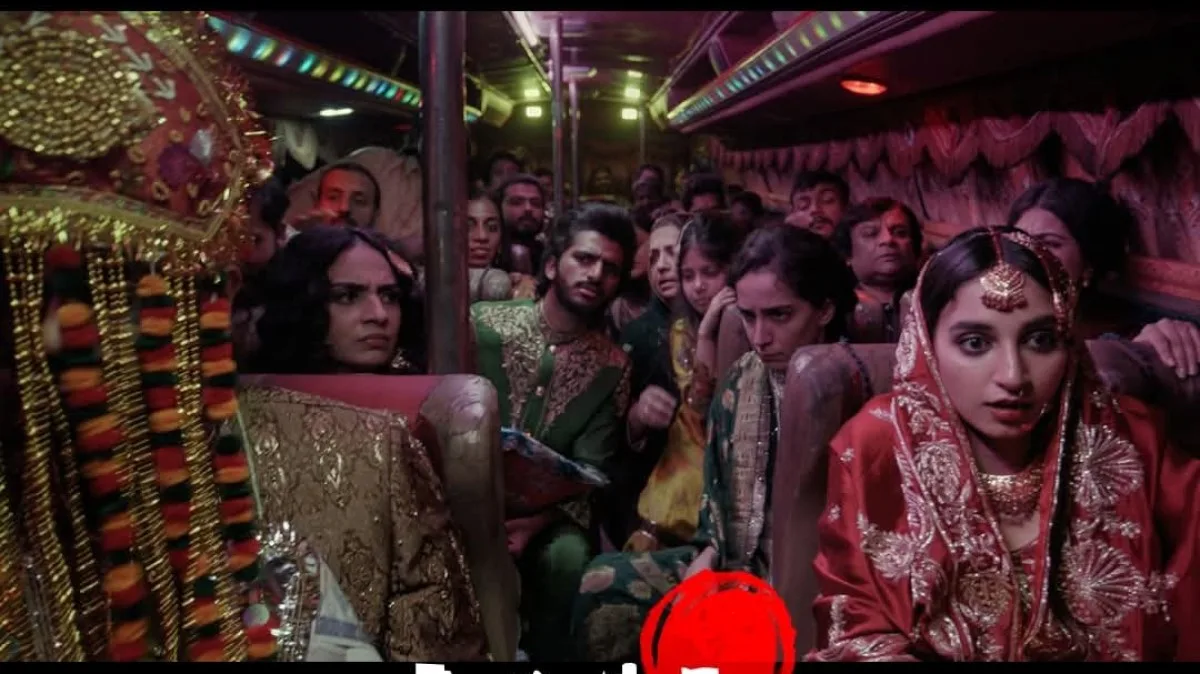
Visual design carries much of the film’s emotional burden. Saturated reds dominate the frame. Red links Sajawal’s birthmark to wedding textiles and the blood of the accident. The color becomes a marker of mounting psychological strain inside the house. Music operates as a key sensory element. Diegetic singing by characters offers brief harmonic relief.
Neighbors and relatives use song to bridge distance. That auditory warmth erodes as the marriage deteriorates. Production design charts the domestic decline. The house begins as a place of exuberant celebration and converts into a claustrophobic prison. Sajawal locks doors to cut Zeba off from the world.
Rooms contract and jealousy thickens the air. Stylized crossfades and visions of the dead introduce a mild surrealism. These images blur memory and present time. The dunes of the landscape carry the women’s recollections. Visual flourishes insist that the past remains present. The film constructs a mournful, atmospheric saga that keeps the viewer in steady anticipation.
The Construction of a False Myth
Tonally the story shifts from dark comedy of errors to tense psychological drama. That progression exposes the central relationship’s fragility. The environment’s real poison is the husband’s insecurity. Sajawal lacks the maturity to accept his wife or her past. He weaponizes superstition to mask personal failure.
In the final act a character claims possession by a djinn and the sequence reads as an attempt at manufactured myth. Sajawal stages an explanation using a red blanket to dress his cruelty in cosmic terms. The exorcism functions as a performance of power rather than a spiritual act. The film denies easy resolution and avoids the familiar beats of crowd-pleasing closure. It records a household sealing itself away.
The narrative shows how mythology becomes an excuse for male violence and a way to divert blame from private weakness. The story ends by revealing those falsehoods and by underscoring persistent patriarchal anxiety. The red blanket remains a symbol of a man attempting to cloak shame with a story.
Lali had its world premiere at the 75th Berlin International Film Festival in February 2025. This production holds the distinction of being the first all Pakistani feature selected for the Panorama section of the event. It remains available through international festival circuits and specialized theatrical releases in specific regions.
Where to Watch Lali (2026) Online
Full Credits
Title: Lali
Distributor: Khoosat Films
Release date: February 13, 2025
Rating: Unrated
Running time: 108 minutes
Director: Sarmad Sultan Khoosat
Writers: Sarmad Sultan Khoosat, Sundus Hashmi
Producers and Executive Producers: Sarmad Sultan Khoosat, Kanwal Khoosat
Cast: Mamya Shajaffar, Channan Hanif, Farazeh Syed, Mehr Bano, Rasti Farooq, Adnan Jaffar, Salmaan Peerzada
Director of Photography (Cinematographer): Khizer Idrees
Editors: Saim Sadiq
Composer: Zohaib Hassan, Ayesha Imran
The Review
Lali
Sarmad Sultan Khoosat creates a jarring study of domestic isolation and the weight of inherited stories. The film succeeds through its striking visual saturation and the powerful performances of its lead cast. While the narrative occasionally circles its themes without progression, the focus on the intersection of masculinity and myth remains potent. It serves as a sharp critique of the way personal fragility is masked by cultural superstition.
PROS
- Farazeh Syed provides a commanding and unconventional performance.
- The symbolic use of red tones creates a visceral visual experience.
- Authentic depictions of Punjabi rituals grounding the drama.
- Effective subversion of traditional domestic power dynamics.
CONS
- Pacing slows significantly during the middle chapters.
- The final supernatural pivot lacks narrative clarity.