































Subliminal opens through Caleb’s first person perspective as he moves inward, entering a psyche that the game renders as a place to be crossed, handled, and slowly understood. Its narrative is built around a visit to a mental construct formed from childhood memories. Caleb seeks to repair his present condition by collecting fragments of forgotten happiness, a premise that gives the episode a quiet therapeutic charge.
The experience begins in a basement packed with artifacts from his youth, turning the room into a site of psychological excavation. Max Howarth voices Caleb’s conscience, guiding him toward positive thoughts with the calm persistence of a reflective exercise. Beneath that guidance sits the implication of trauma, with certain memories held out of reach by repression.
This opening episode sets an episodic pattern and treats the subconscious as physical territory. Caleb must walk through his own history, which gives the familiar act of exploration a confessional shape. The guiding voice recalls modern therapeutic practices and frames movement through the space as self reflection.
That approach connects Subliminal to global trends in narrative horror visible in South Korean cinema, where internal rupture often becomes the main source of fear. The game turns memory, unstable and abstract, into a landscape with floors, objects, passages, and scars.
Visual Aesthetic and Liminal Environments
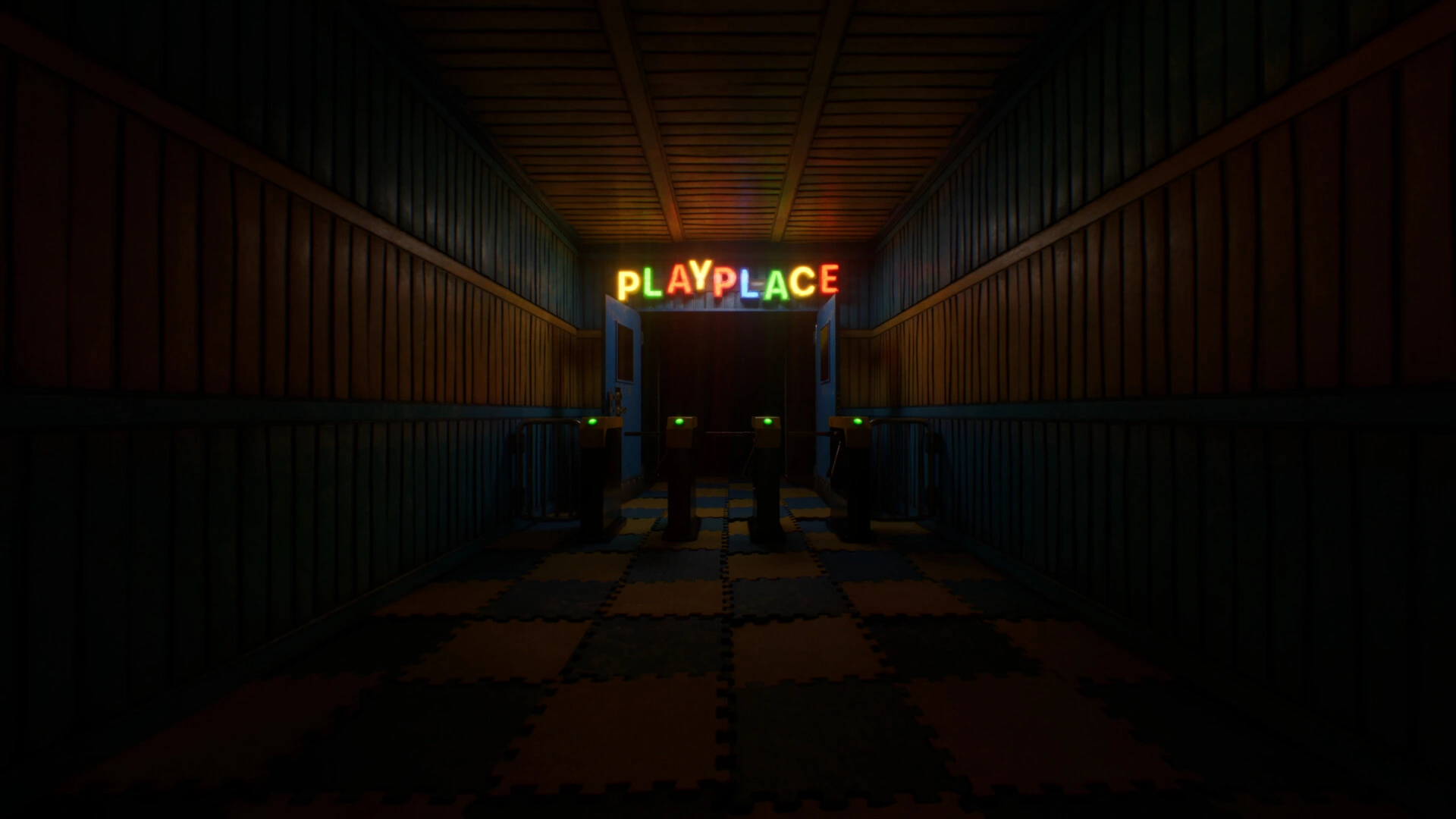
The game’s visual language draws heavily on liminal spaces, those familiar locations made uncanny by human absence. This mode of horror has circulated widely through internet folklore, with the Backrooms as its most recognizable reference point. Subliminal leans into that shared digital vocabulary while rooting its unease in a precise childhood archive.
The graphics reach a high level of realism, and that fidelity gives the emptiness a grave emotional texture. The world is filled with relics of a late twentieth century childhood: View Masters, Game Boys, Nerf guns, and roadway play mats. These objects anchor the surreal material in a specific cultural moment, giving the game a memory bank that still reads across borders. Its primary setting combines a water park and a fast food play area, an architectural pairing that evokes communal joy after the warmth has drained away.
A bright post processing filter gives the screen a hazy, dreamlike cast, suggesting memory as unstable light. Silence carries much of the tension. The missing crowd makes the space feel physically wrong. Some areas contain a black substance called the Rot, a visible form of psychological decay. It marks how trauma infects bright memories and turns recreation into contamination.
The play zones beside the spreading blackness create a sharp visual metaphor. Through these spaces, the game studies hauntology, asking how the past keeps occupying the present. Its visual method recalls the slow cinema of Andrei Tarkovsky, especially in its attention to empty space, abandoned objects, and the ache left behind by use.
Interactive Mechanics and Puzzle Logic
Interaction in Subliminal is organized through light based puzzles. The core action asks players to move energy beams from the ceiling into switches, a physical task that works as a metaphor for linking disjointed thoughts. Different colors introduce distinct rules. Red tracks travel through the environment.
Blue lights operate on timers. Purple spots reshape room layouts. Each variation asks the player to accept the strange grammar of the subconscious and adapt to it. A second system uses electricity and line of sight, requiring players to power sockets through careful positioning. The lack of explicit instruction makes observation the main tool. An old television set supplies clues through commercials and game shows that point toward solutions, turning media residue into a guide for inner repair.
That detail carries a quietly global logic: external images, once absorbed, help shape the internal world. Progress comes through trial and error. Players squeeze through hidden gaps in walls and search the scenery for passwords. The design captures the irritation of trying to recover a specific detail from memory.
Its puzzles fit the theme of mental reconstruction because they ask the player to gather scattered information and form a route forward. Pacing slows in these sections, encouraging close study of the surroundings. This loop shares a lineage with Japanese adventure games, where environmental logic carries dramatic weight and combat recedes. The result is a story space that behaves like an active participant.
Threats and Tension Management
Conflict enters through a force called the noise, a phenomenon that represents happy memories corrupted by anxiety. These inner fears acquire physical shape. The primary antagonist, Smile, appears as a warped version of a mascot from a children’s play venue. His arrival moves the tone from quiet dread into immediate panic and triggers chase sequences that demand fast reflexes.

A single mistake brings failure, while checkpoints at the start of these segments allow repeated attempts. Repetition can alter the player’s reading of Smile. Fear gives way to mechanical execution, and the monster becomes a movement problem. That shift exposes one of horror design’s recurring tensions: terror can weaken once the player understands the rules too well.
The narrative includes multiple endings shaped by player choices, encouraging a return to the subconscious for different outcomes. The chases interrupt exploration with violence, making intrusive thought feel like an event that breaks the rhythm of healing.
Smile also works as a cultural icon of innocence gone wrong, a figure that remains popular across global media markets. The trope reflects a widespread anxiety about the commercialization of childhood. The creature links psychological horror with viral creepypasta culture, giving Caleb’s private crisis a form that feels native to the internet age.
The Review
Subliminal
This first episode offers a striking visual exploration of the subconscious. The liminal settings capture a specific sense of childhood unease. While the atmosphere remains dense, the mechanical execution falters. Vague puzzle logic and repetitive chase sequences disrupt the psychological immersion. The game stands as a visually polished but mechanically uneven introduction to Caleb’s story.
PROS
- Detailed liminal environments.
- Strong voice performance.
- Nostalgic atmosphere.
- High fidelity graphics.
CONS
- Frustrating trial and error puzzles.
- Repetitive mascot chase sequences.
- Brief play time.
- Unfocused gameplay identity.







