















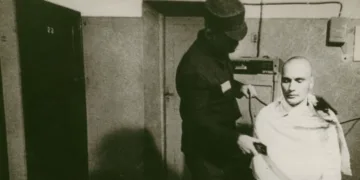









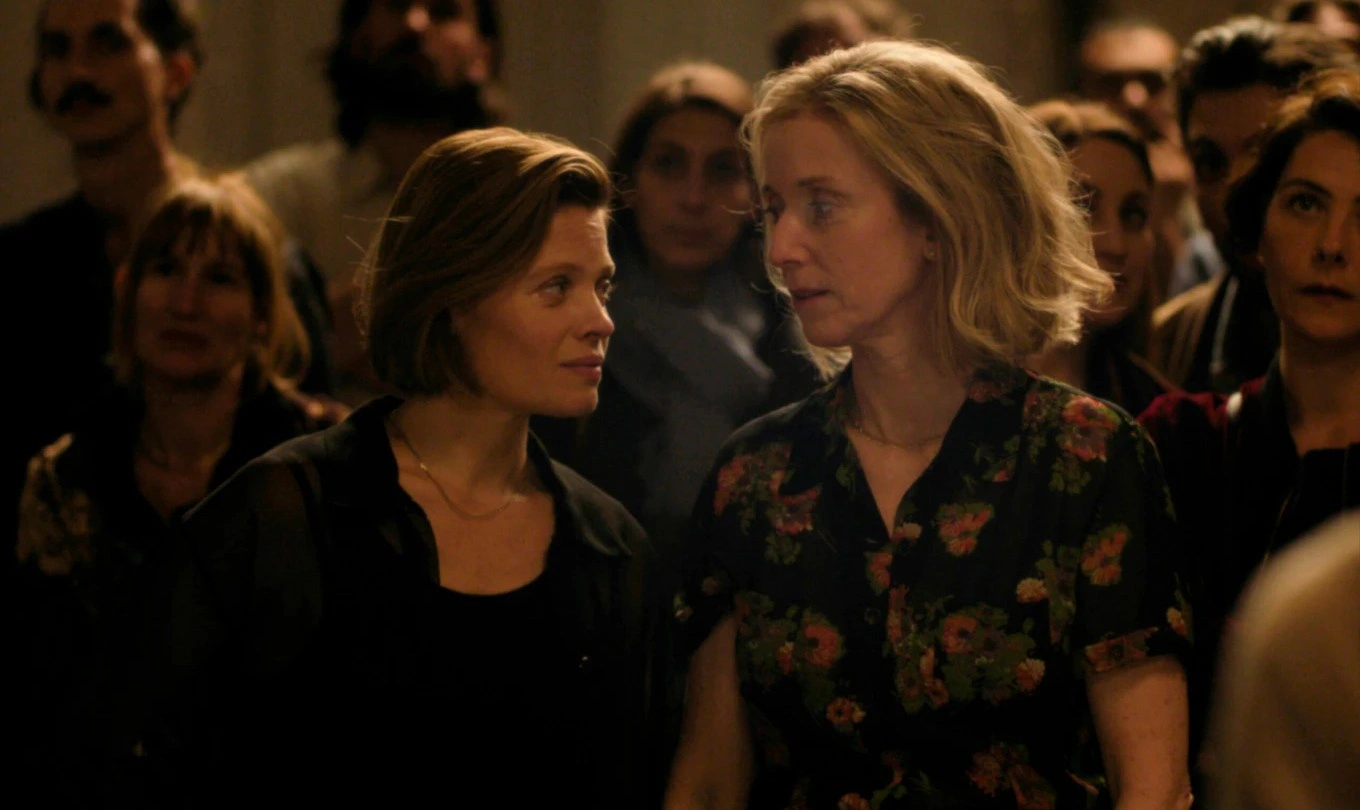

Gabrielle moves through life as if still standing under operating-room lights. At fifty-five, she works at punishing speed as a maxillofacial surgeon in a crowded French hospital, reconstructing faces while absorbing the grind of an institution stretched thin. Her home life has its own packed choreography. She lives with her husband, Henri, and his adult children, having made peace with a life untouched by biological motherhood.
The film’s inciting shift arrives through Frida, a novelist allowed to observe Gabrielle at work. What begins as professional access develops into a gaze with warmer, less easily classified intent. Gabrielle’s cherished clinical distance starts to fail her. The story then moves from the sterile pressure of Lyon to the quiet altitude of the Italian Alps, where a different version of Gabrielle can finally take shape.
The Logic of a Controlled Life
Léa Drucker builds Gabrielle from restraint, discipline, and a faint impatience for anyone who mistakes exhaustion for virtue. The performance rests on a precise professional stoicism. Gabrielle is rational, blunt, and clear about the life she chose. That clarity often lands like a scalpel. She chose work, accepted the costs, and refuses the language of regret.
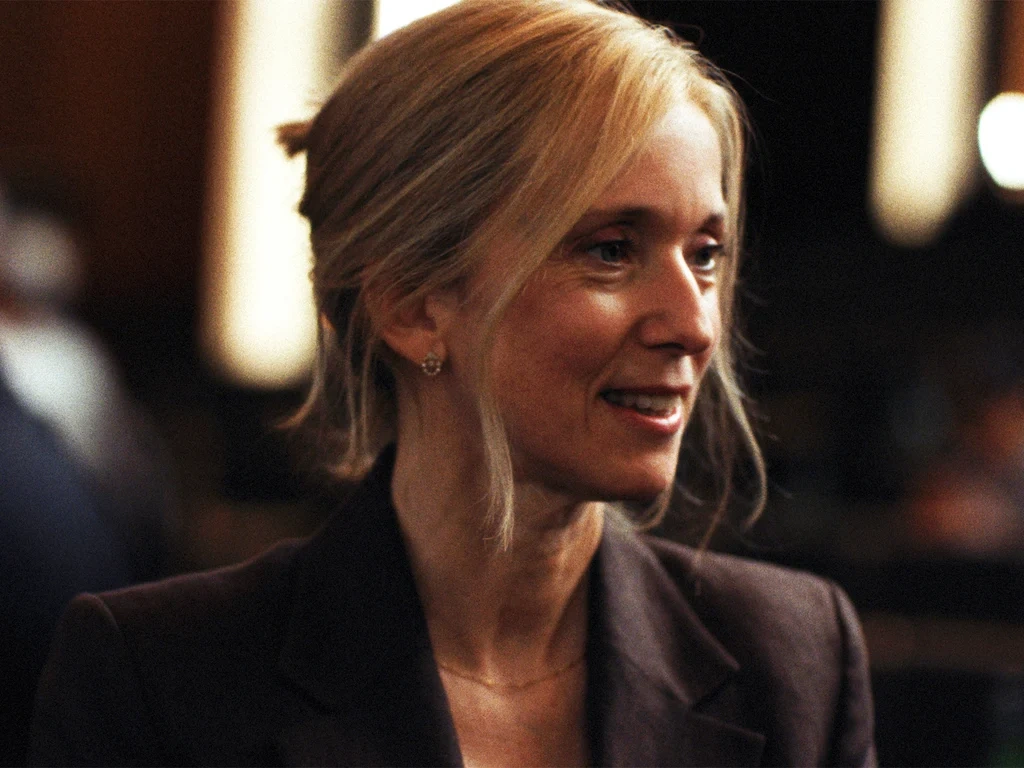
The film mirrors that ordered psychology through eleven chapters, a structure that gives the story the feel of case notes for a life beginning to change. Headings such as Pity and I Want It All give each stage a frame, making Gabrielle’s arc feel observed, catalogued, and quietly tested.
Her reaction to her colleague Kamyar reveals the limits of her creed. His request for paternity leave reads to her as a breach of their shared discipline, an indulgence that leaves the work behind. At home, Arlette’s dementia creates a pain Gabrielle cannot repair with expertise. Her mother’s fading exposes the blunt edge of medical knowledge.
Gabrielle is formidable because she tends to everyone. She is isolated for the same reason. Henri, the children, and the hospital staff rely on her competence so heavily that her needs seem to vanish from the room. The film understands the trap of being necessary. It looks efficient from the outside. It feels lonely from within.
Catalysts of Desire and Identity
Frida enters the story as a disruption with unusually good timing, which is to say terrible timing for Gabrielle’s marriage. Their chemistry destabilizes a relationship that has settled into distance without quite announcing its collapse. Frida offers a different rhythm of existence: she watches, listens, waits, and converts life into language. For Gabrielle, whose entire personality has been organized around action and control, the attraction carries the shock of an unplanned incision.
The sequence in the Italian Alps, at the home of novelist Erri De Luca, gives the film a necessary pause. Removed from the hospital’s pace, Gabrielle can exist outside the title and function that have defined her for decades. The thin mountain air becomes a narrative device, clearing space around a character who has spent much of the film pressed against duty.
The film treats her pursuit of desire with care. Gabrielle rejects victimhood and owns her choices, including those that injure her. Her change is measured, credible, and rooted in character. She leaves a comfort zone she built brick by brick across decades, and the film respects the labor that went into building it. Frida remains difficult to read. Her interest may come from romance, creative hunger, or some unstable mix of the two. That uncertainty sharpens their scenes. Gabrielle sees the danger and follows the feeling.
The Aesthetics of a Divided Self
The film’s visual design keeps returning to the split between Gabrielle’s public command and private unrest. Noé Bach lights the hospital sequences brightly and sends the camera rushing through corridors with tracking shots that match her relentless schedule. The effect is brisk, almost procedural, with the daily mechanics of surgery and institutional strain pressing against every frame.
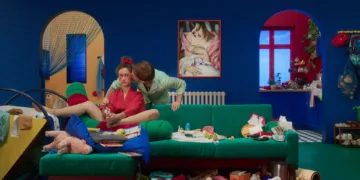
The private scenes with Frida move by another grammar. The camera softens, the lighting warms, and the rhythm loosens into something tactile. Intimacy appears through texture before anyone can fully name it. The editing builds Gabrielle’s life from short vignettes, creating a mosaic that favors selected pressure points over a straight line of cause and effect. That structure suits a character who understands bodies in fragments and slowly begins to understand herself the same way.
A classical piano score supplies the film with a steady pulse, keeping the chaptered design from feeling static. One immersive ballet sequence brings the method into sharp focus. The camera closes in on Gabrielle’s face and catches minute changes in expression, letting performance carry the narrative turn. The film presents her as a brilliant surgeon and a woman stunned by her own vulnerability. It moves past each wound and triumph before either stiffens into a statement. It gathers the pieces and trusts their arrangement.
A Woman’s Life premiered today, May 13, 2026, at the 79th Cannes Film Festival. This feature marks the return of its director to the international stage following her successful debut. The film is currently screening in competition and is scheduled for a wider theatrical release in France this season. Viewers can expect to find the title on specialized art-house streaming platforms once the festival circuit concludes.
Full Credits
Title: A Woman’s Life (La vie d’une femme)
Distributor: Haut et Court, VVS Films
Release date: May 13, 2026
Running time: 99 minutes
Director: Charline Bourgeois-Tacquet
Writers: Charline Bourgeois-Tacquet, Fanny Burdino
Producers and Executive Producers: David Thion, Philippe Martin
Cast: Léa Drucker, Mélanie Thierry, Charles Berling, Marie-Christine Barrault, Laurent Capelluto, Suzanne De Baecque, Erri De Luca
Director of Photography (Cinematographer): Noé Bach
Editors: Clément Pinteaux
Composer: Classical Selection
The Review
A Woman’s Life
A Woman’s Life succeeds as a sharp character study of a woman who refuses to apologize for her ambition. Léa Drucker provides a grounded performance that anchors the episodic structure. The film avoids easy sentimentality and offers a realistic look at midlife transition. It is a precise and thoughtful exploration of identity.
PROS
- Strong lead performance by Léa Drucker.
- Authentic and detailed medical setting.
- Honest depiction of life choices.
CONS
- Fragmented chapter structure.
- Underdeveloped secondary characters.