



























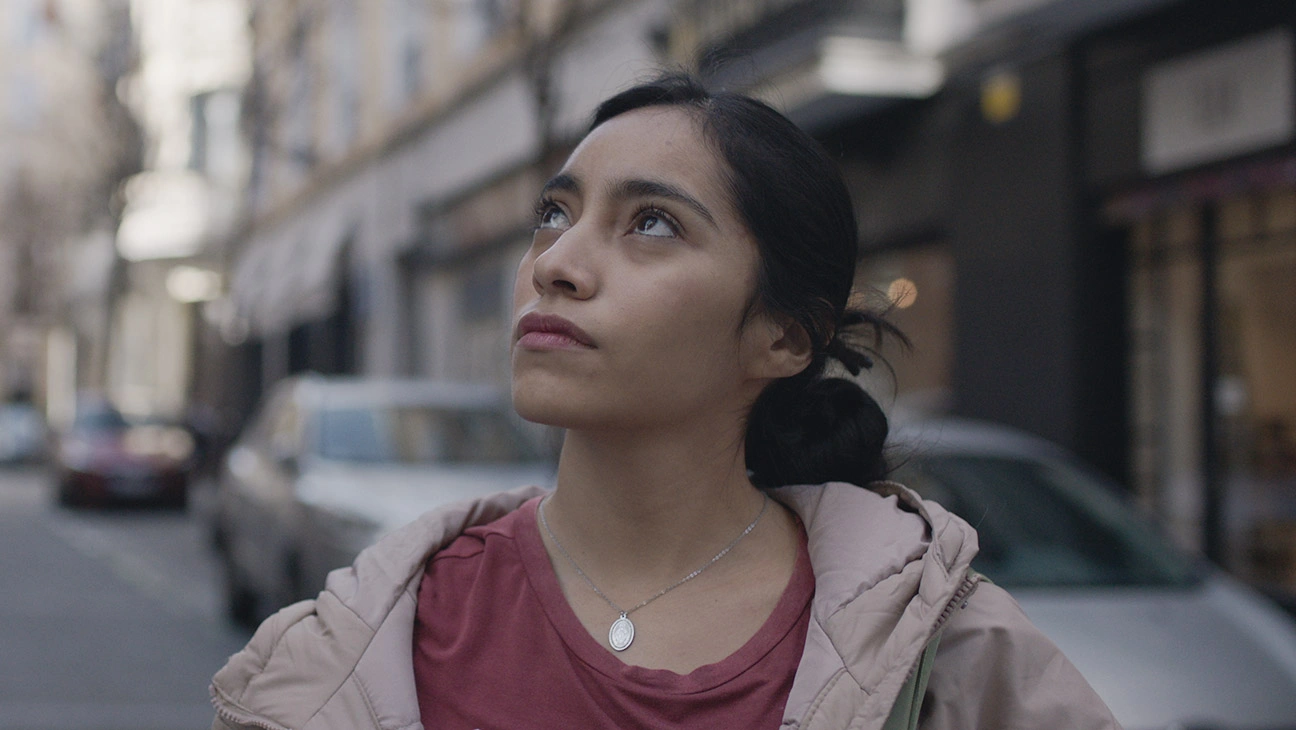

In a darkened Mexico City bedroom, Isabel wakes her young daughter, Lucila. She must leave. She asks Lucila to protect Diego, her four-year-old brother. Through a pane of glass, Lucila watches a taxi carry her mother away, an image composed like a wound held at a distance. The absence lasts eight years. Based on Brenda Navarro’s fiction, the narrative follows Lucila and Diego after they relocate to Madrid to search for Isabel.
The Spain they enter feels drained of welcome. Old abandonment and severe financial pressure have split the family into separate emotional territories. Lucila works as a caretaker for affluent Spanish households. Her teenage brother meets isolation and aggression at school.
Director Diego Luna studies the psychic abrasion suffered by those who leave their origin and discover that arrival has its own form of exile. The plot travels from the paved streets of Madrid to the Barcelona coast, then carries Lucila back to her Mexican birthplace after a sudden family tragedy. The film regards stability with a cold eye, seeing it as a prize kept behind glass for outsiders.
The Architecture of Erasure
Lucila’s daily labor becomes a study in quiet erasure. She works as nanny for a demanding architect. Later, in Barcelona, she turns to elder care and food deliveries. The visual grammar places gilded apartments against her precarious living conditions with cruel precision. The camera lingers on wealth’s cold surfaces. One suspects her English musician boyfriend might find the evening less romantic if he recognized her as the courier of his late-night calories. Love, meet the delivery app.
A shared language between Mexico and Spain cannot repair the cultural fracture. Spain is presented as a place where xenophobia hides inside ordinary speech. The dialogue carries a low voltage of hostility, grammar polished, manners poisonous. Lucila maintains a secret life, concealing her low-wage work behind the facade of academic pursuit. The deception exposes the shame attached to class position and the walls raised by money, citizenship, and accent.
The narrative strips romance from the idea of the homeland. A return to one’s birthplace grants no automatic belonging. Home emerges as an inward condition, fragile and portable, separate from any point on a map. Luna observes survival as a universal arrangement. The film keeps its characters human, resisting the flattening effect of political symbolism. Financial limits shape choice. Free will, here, is a narrow corridor rented by the hour. Gravity wins again.
Maternal Echoes and Sibling Shrapnel
The bond between Lucila and Diego defines the film’s emotional geography. Lucila has acted as a mother since childhood. Their rapport carries tenderness, irritation, and old fatigue. Diego appears crushed by their condition. His dependence on Lucila becomes another load placed on a woman with scarcely enough room to possess her own life.
The resentment between Lucila and Isabel burns with the patience of a fuse. Eight years of distance have cut a canyon wider than the sea between them. Lucila blames Isabel for that first departure, then begins to echo the same cycles of withdrawal. Daughter becomes caretaker. Caretaker becomes fugitive. Anna Diaz gives Lucila stoic, exhausted force, registering dissatisfaction through minute facial shifts. A glance tightens. A mouth stills. She carries the film through resolve that has nearly curdled into hopelessness.
Adriana Paz plays Isabel as a woman trapped by a life with no air. The role carries the terror of limited choices. The film occupies an ethical gray zone: Isabel’s flight wounds her children and still reads as survival. The climactic scene between mother and daughter becomes the film’s emotional peak, built from speech that feels almost surgical in its honesty. The grandparents in Mexico provide brief warmth and explain the pressure that drove Isabel away years earlier. Family history here resembles a script written in disappearing ink: legible for a moment, gone when one needs it most.
The Geometry of a Vanishing Past
Damián García’s ultra-wide framing gives Lucila’s world a severe geometry. The compositions emphasize her independence. They leave her looking small, exposed, and untethered. Windows recur as thresholds of spectatorship. Isabel behind glass. Lucila behind glass. Mother and daughter are joined through separation, looking across spaces they cannot cross.
The lighting leans into darkness and silence. Its chiaroscuro is muted, stripped of theatrical swagger, closer to emotional weather than genre ornament. The film favors quiet pressure over grand style. Whiteouts mark shifts in location, sudden flashes that strike the narrative like camera bulbs. Time jumps, memory blinks.
The sound design assumes control during the most painful moments. Lucila’s screams dissolve into the loud metallic noise of the city, a harsh auditory cut that turns private anguish into urban machinery. The minimal score leaves room for environmental sound to guide tension and perception. The audience listens for danger before it fully appears.
The return to Mexico changes the film’s temperature. Streets hum with latent violence. Military vehicles move through blackouts. The homecoming feels alienating because the neighborhood has become a place of random aggression. The title gathers literal and metaphorical remains into a single burden. Carrying the ashes turns the past into an object with weight, residue, and moral demand. The act becomes a meditation on loss, forcing Lucila to face a future without a map. In its final movement, the film studies a life rebuilt from the wreckage of memory.
Ashes premiered on May 13, 2026, at the Cannes Film Festival. It was shown in the Special Screenings section. Netflix purchased the distribution rights for Latin America and Spain. You will be able to watch it on that service following its run on the festival circuit.
Full Credits
Title: Ashes (Ceniza en la Boca)
Distributor: Netflix, Luxbox
Release date: May 13, 2026
Running time: 102 minutes
Director: Diego Luna
Writers: Abia Castillo, Diego Rabasa, Diego Luna
Producers and Executive Producers: Inna Payán, Valérie Delpierre, Diego Rabasa, Luis Salinas, Diego Luna
Cast: Anna Díaz, Adriana Paz, Sergio Bautista, Teresa Lozano, Irene Escolar, Laura Gómez, Luisa Huertas, Guillermo Ríos
Director of Photography (Cinematographer): Damián García
Editors: Sofi Escudé
Composer: Raquel García-Tomás
The Review
Ashes
Diego Luna offers a film that rejects simple consolation. It exists as a study of the silent tension between hope and the grinding weight of displacement. The fragmented structure might challenge some viewers. Yet, the technical mastery and Anna Diaz’s stoic presence provide a firm foundation. This work avoids typical sentimentality. It presents the internal cost of survival with visual sophistication.
PROS
- Striking and purposeful cinematography.
- A nuanced, grounded lead performance by Anna Diaz.
- Realistic focus on the economic friction of migration.
CONS
- Deliberate, slow pacing that requires patience.
- Elliptical narrative structure that may feel disconnected.