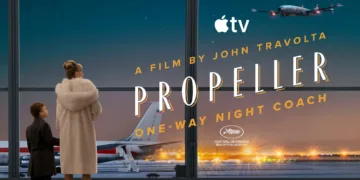



























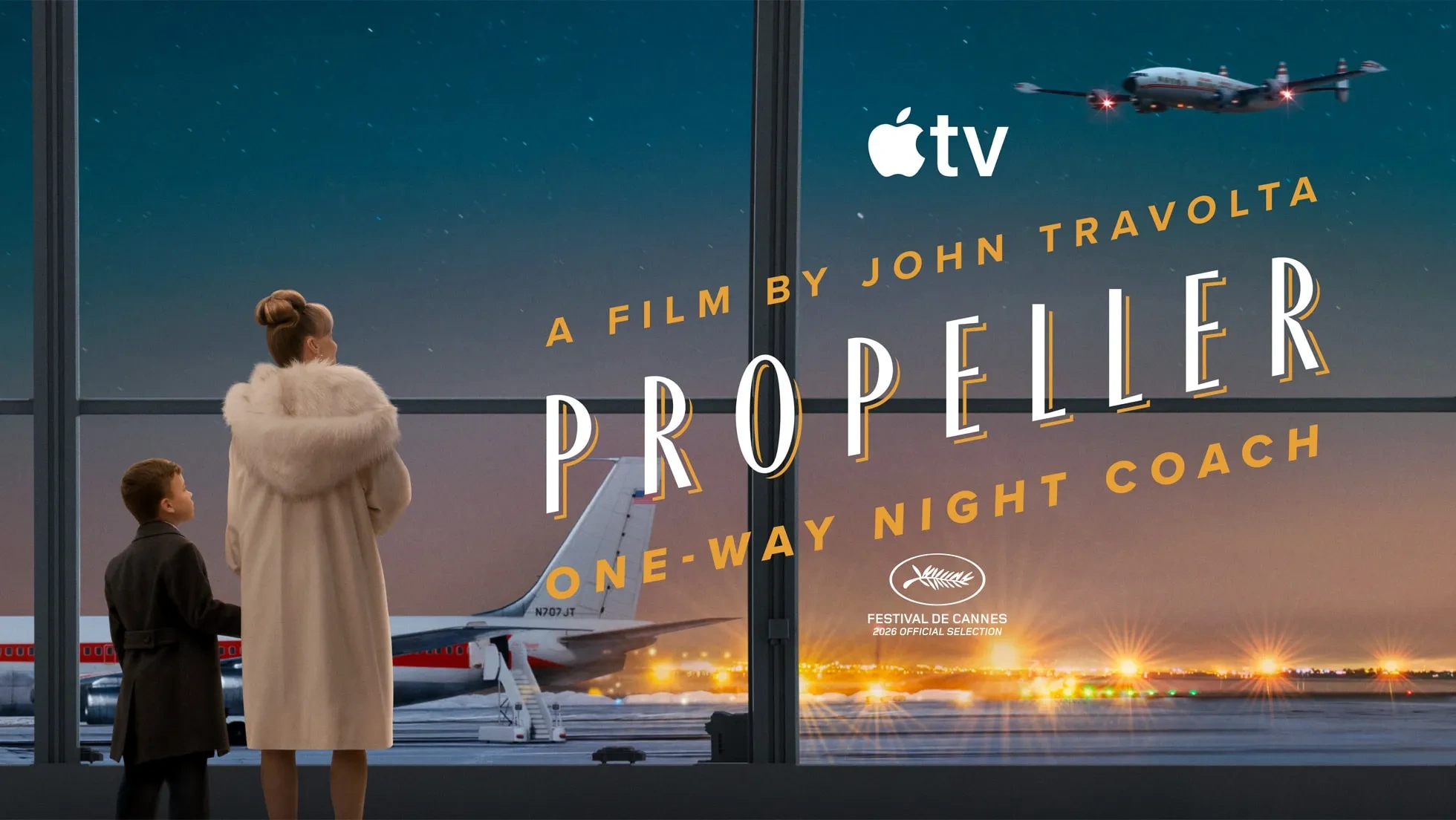

Cinema has difficulty preserving the exact grain of a childhood obsession rooted in a specific place and time, and Propeller One-Way Night Coach takes on that challenge inside a tight sixty-one-minute frame. This Apple Original Films production grows from a 1997 children’s novella by John Travolta, who serves here as screenwriter and director while reconstructing his own historical daydreams.
The year is 1962, when commercial aviation still carried the sheen of exclusive luxury. Jeff, an eight-year-old boy, has a fixation on aircraft that exceeds ordinary childhood hobbies. His mother, Helen, decides to leave the East Coast for Hollywood to pursue an acting career, and the pair rejects the speed of a modern jet. They choose a long, multi-stop transcontinental flight on a traditional propeller aircraft. A domestic relocation becomes an extended sensory expedition, placing a young boy’s inner weather against the tactile facts of mid-century flight.
An Episodic Mid-Century Travelogue
The screenplay moves in loose, episodic fashion, leaving standard dramatic arcs behind to imitate travel-diary entries. The route begins at New York’s Idlewild Airport, crosses the American landscape, and reaches Los Angeles after a final upgrade to a Boeing 707 jet. Inside this linear itinerary, the film finds friction between a child’s polished innocence and the untidy reality of adult behavior.
Helen emerges as a deeply flawed parent. She regularly drinks Manhattans, flirts with unattached male passengers, and leaves her son alone in hotel rooms during overnight stopovers while arranging encounters with married men. Conventional dramatic criticism would treat those details as signs of emotional rupture or lost innocence. The film moves along a calmer path, letting Jeff greet adult disorder with a shrug.
That choice keeps a protective pane over the child’s point of view. Potential trauma is softened so the aviation fantasy can remain intact. Maternal neglect becomes atmospheric background noise, and the script settles into an unhurried, comfortable rhythm, like the steady hum of propeller engines.
The storytelling gives primary attention to Jeff’s quiet fascination, suggesting that a child’s focus can isolate beauty inside parental dysfunction. The cultural texture here lies in that insulation: a fantasy of mid-century movement where polish, travel, and machinery seem able to muffle domestic failure.
Also Read





The Sensory Artifacts of the Space Age
The film’s formal life depends on physical environment, with visual and auditory details used to establish historical identity. Cinematographer Paul de Lumen works with the design team to rebuild a specific space-age aesthetic. Art Deco terminals, vintage aircraft livery, geometric wallpaper, and authentic airline cutlery fill the frame.
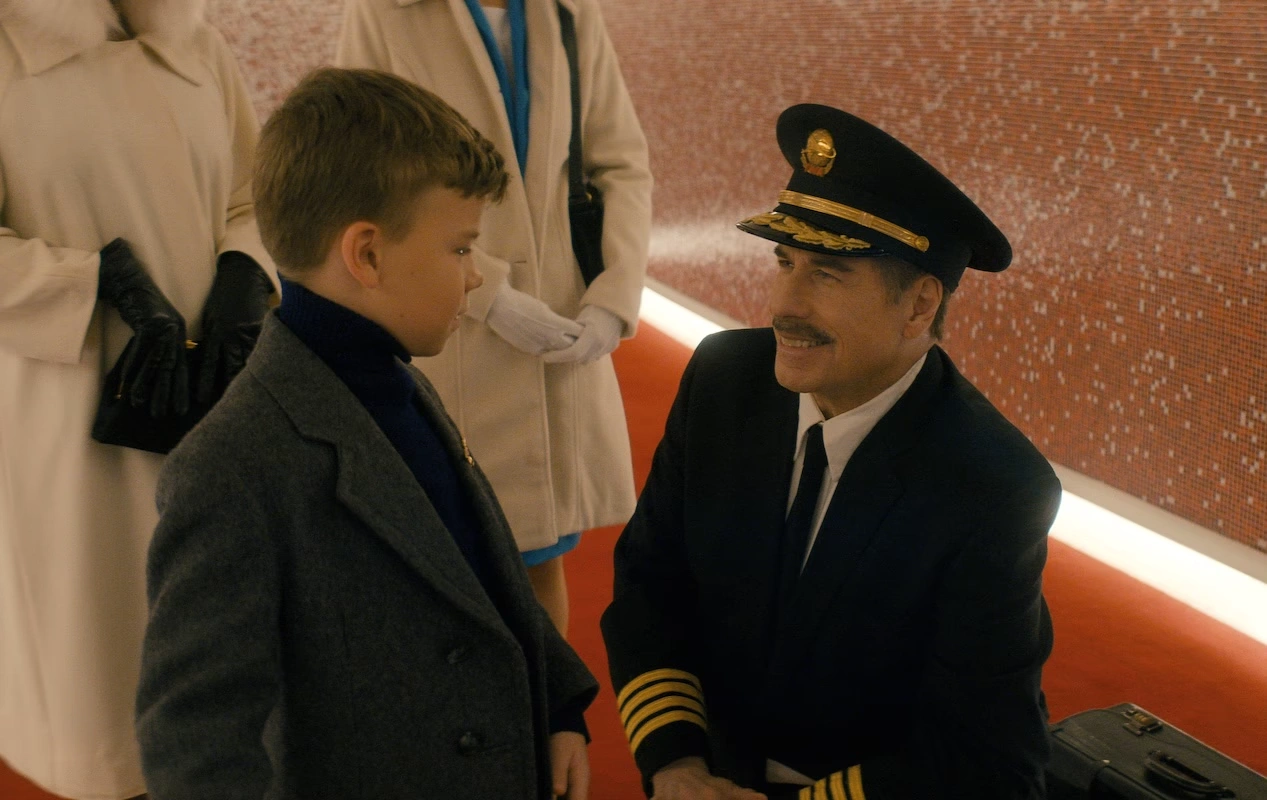
Travolta’s eye treats these objects with devotional intensity. Characters handle props directly for the camera, including a moment where a vintage plate is turned over so its historical authenticity can be plainly observed.
This fixation on design creates a material atmosphere echoed by the music. The soundtrack uses period selections from Frank Sinatra, João Gilberto, Barbra Streisand, and Stéphane Grappelli, drawing on familiar melodies to reinforce a smooth, idealized past. John Travolta’s heavy spoken voiceover narration guides that visual and auditory field across the full running time.
The narration carries little subtext. It translates the screen into plain speech, explaining Jeff’s feelings and describing objects already visible to the viewer. The effect reshapes the cinematic experience. Moving images begin to feel like a direct reading of the original printed book, with scant room left for independent interpretation.
Kinship and the Limits of Personal Passion
The performances reveal a sharp separation between individual talent and the firm limits imposed by the direction. Clark Shotwell brings natural ease to Jeff, keeping the character endearing while moving through several stiff, awkward line readings that suggest off-camera cue cards. Kelly Eviston-Quinnett gives Helen professional steadiness, while the screenplay confines her to repeated notes of vanity and detachment. The character remains thin, denied the psychological depth her behavior might have invited.
The project takes on the atmosphere of an expensive home movie because Travolta fills supporting roles with members of his own family. Among them, Ella Bleu Travolta appears as Doris the stewardess, bringing natural warmth and charisma to her scenes with the young protagonist. The final film shows how fierce personal attachment can complicate artistic form.
Travolta is staging cherished childhood memories, and the staging assumes the audience will share his wonder. Individual remembrance takes command of the film’s shape, bypassing the dramatic development external viewers need. What remains is a beautiful, closed system of nostalgia, a polished chamber where private passion takes precedence over structural clarity.
This historical feature had its world premiere two days ago on May 15, 2026, at the Cannes Film Festival within the Cannes Premiere section. Viewers looking to stream the feature can watch it globally on the Apple TV platform starting May 29, 2026. The film represents a distinct creative milestone for its creator, who received an honorary award at the festival to commemorate his extensive career in front of the camera.
Where to Watch Propeller One-Way Night Coach (2026) Online


Full Credits
Title: Propeller One-Way Night Coach
Distributor: Apple TV
Release date: May 15, 2026
Rating: G
Running time: 61 minutes
Director: John Travolta
Writers: John Travolta
Producers and Executive Producers: John Travolta, Jason Berger, Amy Laslett, Mark J. Marraccini
Cast: Clark Shotwell, Kelly Eviston-Quinnett, Ella Bleu Travolta, Olga Hoffmann, John Travolta, Ellen Travolta, Margaret Travolta, Ann Travolta, Sam Travolta, Joey Travolta, Edouard Philipponnat
Director of Photography (Cinematographer): Paul de Lumen
Editors: Mark J. Marraccini, Adam Varney
Composer: Tim Aarons, Alec Puro, Eric Meyers
The Review
Propeller One-Way Night Coach
Propeller One-Way Night Coach remains a localized curiosity rather than a fully realized piece of storytelling. While the visual details and specific mid-century design capture the historical era with beautiful precision, the narrative lacks the dramatic structure necessary to engage viewers outside the director's personal memories. It plays like an expensive memory book that prioritizes private nostalgia over cinematic substance, leaving audiences to look at artifacts rather than invest in characters. It stands as an earnest but structurally compromised piece of cinematic vanity.
PROS
- Meticulously detailed mid-century production design that faithfully recreates the 1962 aviation era.
- Polished cinematography from Paul de Lumen that captures a clean, space-age look.
- An evocative period soundtrack featuring classic tracks that establish a steady atmospheric mood.
- A charismatic supporting performance from Ella Bleu Travolta.
CONS
- A thin, narrative-light script that lacks traditional plot progression or meaningful conflict.
- An over-reliant, constant voiceover narration that describes events already visible on screen.
- Stiff and uneven line readings from the young lead actor due to rigid direction.
- An overly indulgent, personal focus that handles parental flaws with a dismissive attitude.