


















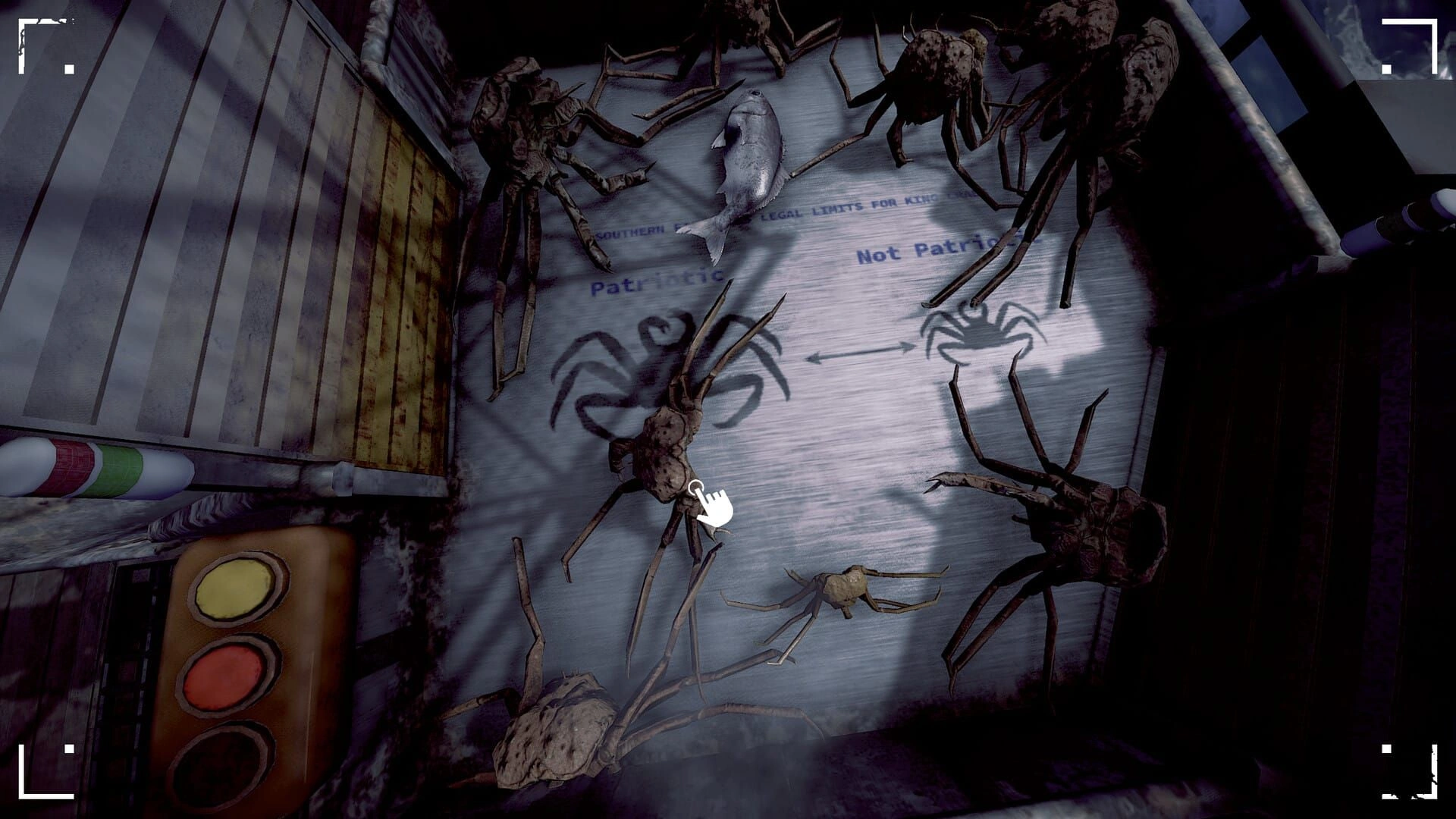

The contemporary indie scene often turns ordinary work into a pressure chamber for social fear. Developers Nicholas McDonnell and Mitchell Pasmans take that familiar form into harsher territory with Crabmeat, a first-person survival horror and simulation game published by Searching Interactive.
The game belongs to a subgenre where industrial labor becomes dark political storytelling, close in spirit to the claustrophobic dread of Iron Lung. Players inhabit an impoverished citizen locked inside the dystopian Feudostate of Australia. Poverty itself has become a crime.
After overdrawing a MelbBank account by $656 to pay basic rent, the protagonist receives a sentence shaped by debt, exile, and state violence. Citizenship is revoked, and the character is sent to the frozen Southern Fisheries Penal Colony in the Antarctic Sea. The demand is simple and brutal: harvest 500 kilograms of king crab within one week.
A lethal explosive capsule injected into the protagonist’s neck keeps obedience in place, set to detonate at any sign of refusal or institutional failure. The regime completes the punishment by transferring the debt to the next of kin and forcing the protagonist’s family into immediate expatriation.
Labor as Kinesthetic Friction
The game’s politics become physical through a strict, mouse-driven point-and-click control scheme. Traditional WASD movement disappears, leaving players with deliberate clicks to move, double-clicks to sprint, and manual cursor dragging to rotate the camera.
That stiffness shapes every passage through the multi-deck government trawler, turning control itself into a form of imposed labor. The ship has an upper bridge fitted with charts, radar, throttle controls, and a closed-circuit television monitor tied to multiple ship cameras. A mid deck holds basic living quarters and a rear crane. The lower deck contains the engine room, storage areas, and a crab tank that can be checked directly.
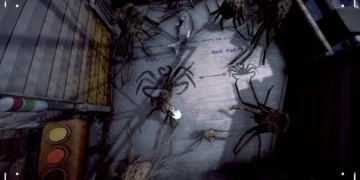
The working routine is slow, exacting, and intentionally heavy. Players prepare large pots, collect bait buckets, fill and seal traps, and operate the crane to drop them into the freezing water. Retrieval requires positioning the massive ship near the traps, then using a hook gun and winch system placed on opposite sides of the vessel. Once the catch is aboard, the game shifts to a tactile, physics-based sorting table.
Players drag huge king crabs into the hold, reject undersized catches, and clear away stray marine life. Each action carries the weight of the larger system. The clumsy turning radius, the divided tool stations, and the constant drag of manual interaction make the body feel conscripted by the interface. In cross-cultural terms, the game turns a local dystopian fiction into a recognizable global grammar of debt, extraction, and forced productivity.
The Rhythm of High-Seas Coercion
Progression moves between routine industrial work and sudden existential danger, controlled by a countdown timer displayed inside the bridge. That clock makes every decision feel transactional. Time spent chasing green fishing zones increases the chance of meeting the quota.
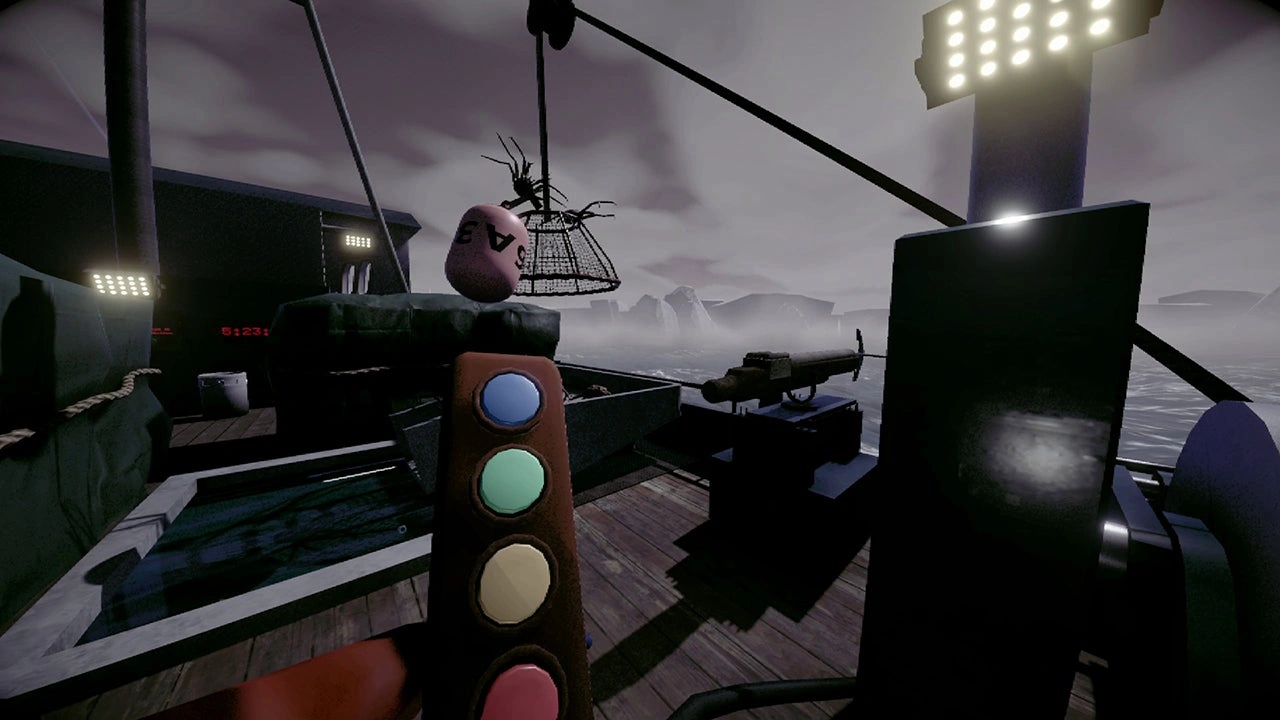
Time spent investigating question-mark icons can reveal supply stashes, replacement traps, keys, and secret documents that expose the state’s machinery. The structure links resource management with political discovery, making the map a space of production and testimony at once.
The routine breaks apart when mechanical hazards appear. Aggressive marine parasites can stall the engine, forcing players to rush across the ship and repair highlighted hull damage with a blowtorch. The danger grows with mutated crustacean species, the Paralomis and Brachyura, which board the vessel to damage machinery and attack the player directly.
Combat follows the same point-and-click tool logic that governs work. Players raise and lower an axe or steady a shotgun taken from a mid-deck emergency locker. This creates a meaningful bond between labor and violence. The interface used to harvest crab also becomes the interface used to survive.
The pacing has a strange instability. Skilled players may find the one-week limit too forgiving, which softens the fear of failure. Ship breakdowns are scripted and non-random, so repeated deaths reveal patterns that can dull the horror. That predictability slightly weakens the simulation’s coercive force, since institutional terror depends on uncertainty as much as punishment. The game still finds pressure in its routine, yet its systems sometimes become legible too soon.
Low-Fidelity Desolation and Diegetic Isolation
Crabmeat builds its visual identity through a low-polygon style reminiscent of late-era legacy consoles. The retro look reads as a deliberate artistic language, giving the world an uncanny, clinical harshness that suits the frozen setting.
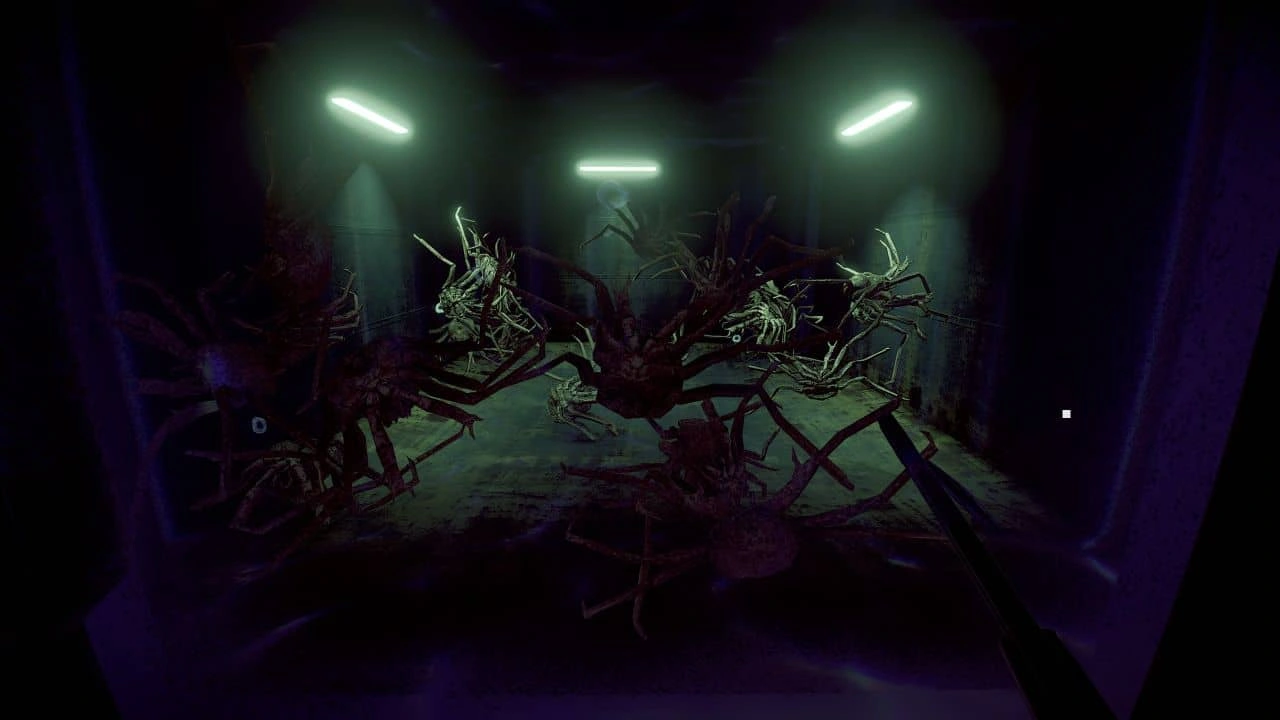
Human faces appear behind distorted mosaic patterns, a choice that strips individuals of legible expression and fits the game’s fixation on bureaucratic erasure. The environmental design adds grounded detail: realistic waves splash across the hull, thick sea spray clouds the bridge windows, and dark storms interfere with radar reliability.
Sound carries much of the game’s isolation. There is no traditional musical score, so the Antarctic Sea feels vast, empty, and hostile. The diegetic soundscape takes on the work usually assigned to music. The player hears the ship frame groan, metal floorboards creak underfoot, the engine hum, seabirds cry in the distance, and icebergs crunch with frightening force. These sounds also function as operational signals.
A sudden gurgle or metallic bang can warn of an unseen hull breach or an intruder hidden in the dark. The design links atmosphere to survival information, giving every noise practical and psychological weight. In that alignment of visual austerity, mechanical labor, and political horror, Crabmeat turns a fishing trawler into a small moving state, cold, surveilled, and built to make exhaustion feel normal.
The Review
Crabmeat
Crabmeat is a compelling exercise in systemic distress, successfully transforming the monotony of industrial labor into an explicit critique of bureaucratic violence. The deliberate friction of its mouse-only interface beautifully reinforces the thematic weight of penal servitude. While the narrative tension slightly dissipates once the predictable timing of the mechanical breakdowns and combat encounters becomes clear, the bleak atmosphere and masterful lack of a traditional musical score preserve an overwhelming sense of maritime isolation. It remains a memorable, bite-sized experiment in economic horror.
PROS
- The granular, multi-step crabbing and sorting mechanics create an engaging, oddly meditative labor loop.
- The completely diegetic soundscape masterfully utilizes silence, ship groans, and environmental cues to build deep isolation.
- The low-polygon, retro visual style perfectly mirrors the cold, uncanny, and hostile tone of the dystopian setting
CONS
- The restrictive point-and-click control scheme can feel frustratingly clunky during fast-paced combat or urgent repairs.
- Scripted, non-random event triggers can lessen tension and introduce repetition after experiencing a player death.
- A highly generous macro time limit reduces the long-term stress of the survival elements.