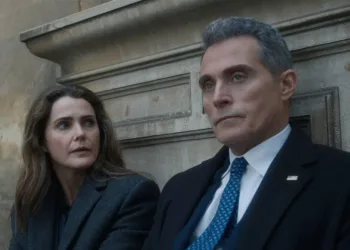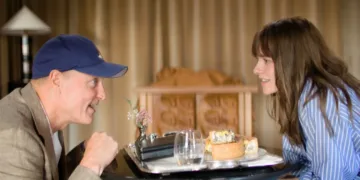























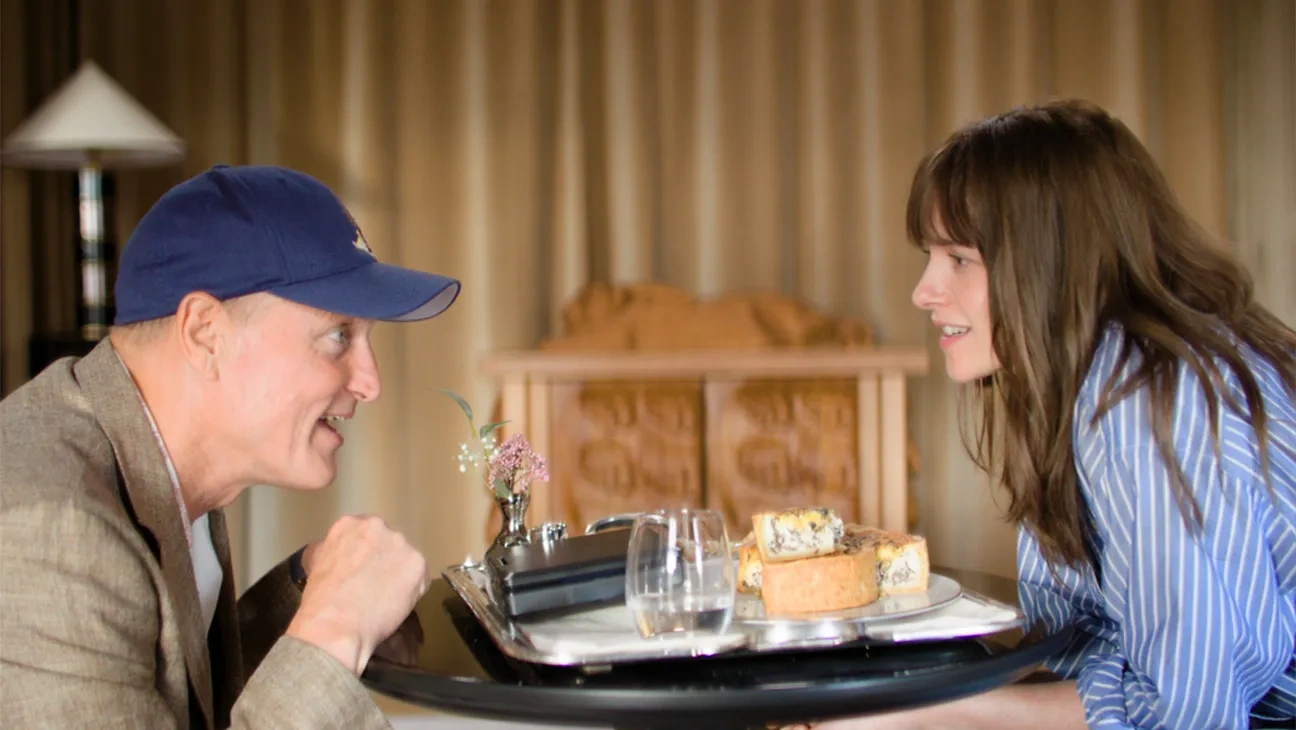

The foundational design of Full Phil places a family rupture inside the antiseptic hush of luxury. Philip Doom, a wealthy and deeply neurotic patriarch nearing sixty, arrives at an upscale Parisian hotel with Madeleine, his estranged, acid-tongued thirty-two-year-old daughter. The vacation has been arranged as a last, expensive attempt at repairing their damaged relationship.
Emotional repair evaporates at once. Father and daughter begin sparring, turning their beige suite into a sealed chamber of resentment, wit, and compulsive irritation. Then the film’s absurdist premise takes hold with perverse elegance. Madeleine, dodging the weight of her buried feelings, starts devouring huge amounts of gourmet room service. Her consumption triggers a grotesque miracle: Philip’s stomach swells in direct relation to every bite she takes.
French auteur Quentin Dupieux serves as the film’s single creative engine, working as director, screenwriter, cinematographer, and editor on this 78-minute surrealist chamber piece. The film marks a rare English-language project for the prolific filmmaker, bringing recognizable American star power into his familiar theater-of-the-absurd machinery. The result is spare, farcical pseudo body horror, a black comic modern Grimm fable glazed with socioeconomic satire and a Buñuelian appetite for civilized decay.
Spatial Hostility and Parallel Horrors
The hotel suite’s bright, clinical opulence becomes a pristine trap. Its expensive emptiness throws the deadlock between Philip and Madeleine into harsh relief, making their relationship feel preserved under glass. The story moves through petty skirmishes that gain strange moral weight through repetition. A blocked toilet on Philip’s side of the room becomes the suite’s defining domestic catastrophe.
He refuses to call hotel maintenance, paralyzed by social shame, then redirects that panic into policing imaginary territorial lines across the floor. His need for control grows more brittle with the arrival of Lucie, an overzealous hotel employee who reads the family tension through the wrong lens. She installs herself in the room as a self-appointed guardian against possible elder violence, turning the suite into a monitored space and feeding Philip’s defensive spiral.
Dupieux cuts through the claustrophobia with a secondary fiction. During her acts of psychological avoidance, Madeleine repeatedly watches a cheap, black-and-white, low-budget retro 1950s creature feature on a portable DVD player. The film inside the film follows two eccentric, nerdish mad scientists, played with deadpan absurdity by Tim Heidecker and Eric Wareheim.
They study and resurrect a humanoid gill-man monster apparently made from papier-mâché, a creature driven by a violent craving to rip off and eat human heads. Emma Mackey appears in a high-profile cameo as the monster’s first screaming victim, lending the B-movie spectacle a stylized horror charge that interrupts the main action.
The sealed family conflict also sharpens the film’s satire of American insulation from public turmoil. Outside the hotel, Paris is aflame with violent social protests, burning vehicles, and armored police. Inside, Philip and Madeleine remain absorbed in their private war. Dupieux draws bleak comedy from that imbalance. Philip steps onto the balcony for a cigarette and appears untouched by the smoke and unrest below. Later, a Molotov cocktail hits their taxi, drawing a tired sigh from the driver, who suggests walking may be faster because of traffic.
Performance Metrics and Visceral Defiance
Kristen Stewart strips away her established aura of high-fashion elegance and builds Madeleine as a bratty, passive-aggressive millennial straight-shooter with a talent for emotional sabotage. The performance is bluntly physical, almost proudly unvarnished.
Stewart spends much of the film tearing into greasy steaks with her bare hands, chewing meat off the bone, and burying herself in elaborate room service platters. Eating becomes a bodily shield, an act of refusal performed through appetite. Her line delivery supplies the blade: dry, fast, and corrosive, cutting through Philip’s therapeutic language and reducing his appeals to hollow behavioral jargon.
Woody Harrelson answers with loud, domineering panic. His Philip is an insecure patriarch ruled by neurotic agitation, hygiene obsession, and a frantic hunger for an emotional breakthrough on his chosen schedule. Harrelson pushes the role through high-strung bursts of shouting, letting Philip’s mania and paternal desperation press against each other until they become nearly indistinguishable.
The film makes that burden visible through bodily distortion. As Madeleine eats, Philip’s abdomen grows to grotesque size, leaving him by the final act with the appearance of a man on the verge of giving birth. His body becomes the storage unit for shame, anger, guilt, and every family feeling he cannot metabolize.
The supporting cast supplies sharp satirical pressure. Charlotte Le Bon plays Lucie with rigid, comic hyper-vigilance, and her presence activates Philip’s most brittle instincts. Heidecker and Wareheim, meanwhile, bring strange voltage from the B-movie strand, delivering odd, highly stylized readings that puncture the suffocating family drama inside the beige room.
Technical Aesthetics and Metaphorical Limits
Dupieux’s work as cinematographer shapes the film’s emotional grammar. The hotel room’s flat, bright luxury creates a mood of sterility, as if the characters have been placed inside a showroom for unresolved damage. That clean surface clashes with the grainy, shadowed cheapness of the 1950s sci-fi pastiche flickering on Madeleine’s portable screen. Sound adds another layer of unease. Siriusmo’s original electronic score uses rumbling atmospheric synthesizers to create a mood touched by whimsy, oddness, and unexpected melancholy.
The swollen belly gives the film its strongest visual argument about late-stage parenthood. Philip absorbs Madeleine’s gastronomic and emotional debts, carrying her refusal, his shame, and their shared anger under his own skin. Dupieux draws a clear line between several hungers: Madeleine’s bottomless appetite, the head-eating monster in her B-movie, and familial love curdled by failed communication. These ideas work best as fable mechanics, circling back on themselves with ritual precision. They remain sharper as symbols than as sources of expanding psychological insight.
The pacing follows that circular design. At 78 minutes, the film feels compact and slightly elongated, compressed by its runtime and stretched by repeated hotel-room quarrels. The loop breaks through an explosive, gore-spattered body horror finale that resolves the plot with brutal efficiency. The sudden escalation lands because Stewart and Harrelson keep the emotional geometry firm. What remains is a vivid, three-dimensional portrait of a parent-child bond that has reached a point of no return.
Full Phil is an absurdist comedy-drama film that had its highly anticipated world premiere on May 17, 2026, screening out of competition in the prestigious Midnight Screenings section of the 79th Cannes Film Festival. Serving as French director Quentin Dupieux’s first English-language feature in over a decade, the movie is handled by Diaphana Distribution for its domestic market and StudioCanal for international reach. Because the film has just launched its festival run on the international circuit, a wide streaming or theatrical release schedule for global territories has not yet been finalized, meaning it is currently hitting film markets rather than standard subscription platforms.
Full Credits
Title: Full Phil
Distributor: Diaphana Distribution (France), StudioCanal (International Sales)
Release date: May 17, 2026 (World Premiere at the Cannes Film Festival)
Running time: 78 minutes
Director: Quentin Dupieux
Writers: Quentin Dupieux
Producers and Executive Producers: Hugo Sélignac
Cast: Woody Harrelson, Kristen Stewart, Charlotte Le Bon, Tim Heidecker, Eric Wareheim, Emma Mackey, Nassim Lyes, Nicolas Raffy
Director of Photography (Cinematographer): Quentin Dupieux
Editors: Quentin Dupieux
Composer: Siriusmo (Moritz Friedrich)
The Review
Full Phil
Full Phil functions as a striking conceptual amusement park that trades traditional narrative progression for a hyper-focused, metaphorical duel of wits. Quentin Dupieux successfully leverages the distinct energies of his American leads to anchor an otherwise fragile chamber piece, allowing the visceral imagery of consumption and expansion to carry the weight of the domestic commentary. While the repetitive structure and disjointed horror cutaways threaten to stall the brief runtime, the commitment to its central, bizarre conceit prevents it from completely unraveling. It is a minor, loose, yet undeniably memorable exercise in surrealist friction.
PROS
- Kristen Stewart delivers an unpolished, physically daring comedic performance that effectively dismantles her elegant public persona, while Woody Harrelson anchors the escalating absurdity with exhausted paternal desperation.
- The physical manifestation of generational resentment via a swelling prosthetic belly provides a potent, visually arresting metaphor for the unseen weights of parenthood.
- The original synthesis-heavy score by Siriusmo expertly infuses the sterile, confined hotel setting with an underlying layer of melancholy and whimsy.
CONS
- The dialogue and central hotel squabbles rely on cyclic, surface-level arguments that run out of creative steam well before the conclusion.
- The black-and-white, film-within-a-film horror interruptions act more like a disjointed sketch padding the runtime than a meaningful thematic extension.
- The sudden, gore-splattered body horror climax fumbles any deeper psychological insights, opting for a shocking physical payoff rather than an intellectually resolved narrative conclusion.