




























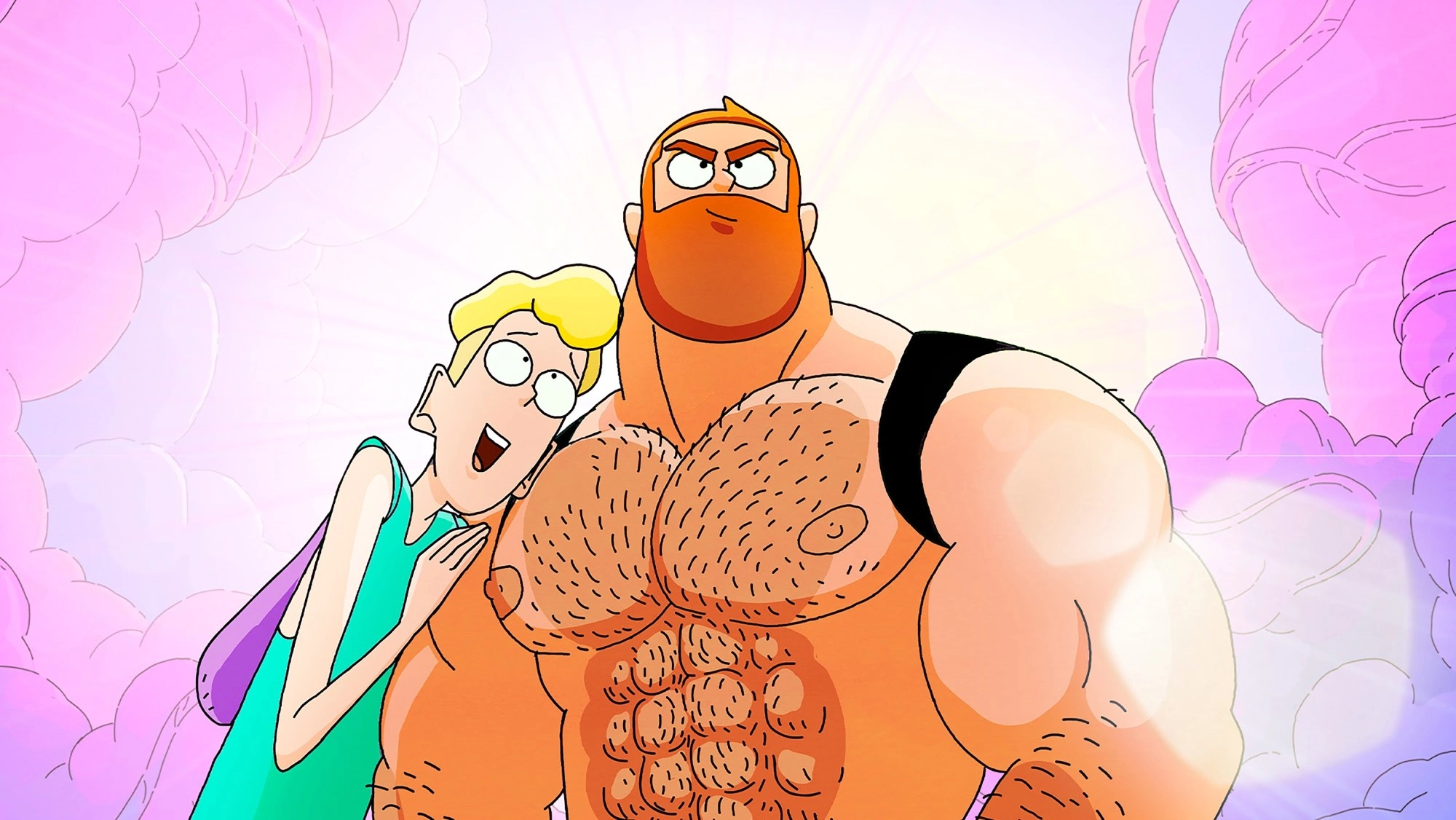

Directors Nicolas Athané and Marco Nguyen set their 2D animated feature debut, Jim Queen, inside a heightened, hyper-stylized vision of gay Paris, a city rendered as social organism and thirst trap. The story follows Jim Parfait (voiced by Alex Ramirès), an ultra-buff fitness influencer perched atop a rigid digital caste system. Jim lives through validation. His sculpted body operates as currency, theology, résumé, and emergency fund, all packed into one aggressively moisturized package.
That curated life collapses when a highly contagious virus called Heterosis spreads through the community. The pathogen changes its victims physically and behaviorally, turning gay men straight. Jim’s prized abdominal muscles deflate, his follower count plunges, and his status evaporates with comic cruelty.
His shallow social circle abandons him at once. Stranded without resources, he enters a desperate alliance with Lucien (Jérémy Gillet), an insecure, deeply closeted young twink living under the strict control of his powerful, conservative mother. The pairing is almost chemically unstable. Together, they race across the city searching for a mysterious rogue doctor rumored to possess a cure.
Anatomy of the Hetero-Mutation and Tribal Satire
Jim Queen uses the frame of a comedic road movie confined to Paris, pushing its protagonists through a sequence of sharply coded subcultures. The script moves them through drag queens, leather and sneaker fetishists, and the literalized “bear” community.
Each stop becomes a satirical specimen jar, allowing Athané and Nguyen to poke at the hyper-segmented taxonomy of modern gay culture. The joke carries a sour little aftertaste: classification can begin as self-recognition and curdle into social bureaucracy.
The film gives Heterosis a set of absurd, specific symptoms. Straightness arrives through sudden comprehension of soccer rules, indifference to grooming, a growing belly, and a fervent appetite for traditional church weddings. The inversion is gleefully crude, almost proudly lazy, which may be part of the point.
Heterosexuality becomes a clinical affliction, and straight cliché gets dragged under fluorescent laboratory light. At the same time, the film turns its scalpel toward gay digital hierarchy, where beauty functions as law and the body becomes a share price. Once the aesthetic asset fails, the market crashes. Capitalism, with abs. Humanity had a good run.
The comedy veers from raunchy sexual humor into institutional parody with little warning. One standout sequence has Lucien perform a musical number parodying Ariel’s signature ballad from The Little Mermaid. His secret cavern, patterned after a treasure hoard, contains an extensive collection of adult novelties. The sweetness of the reference sits beside sharp political jabs at conservative moral watchdogs and public health officials, giving the film a distinctly European suspicion of state-mandated virtue.
The Contagion of Conformity and Allegorical Friction
The relationship between Jim and Lucien carries much of the film’s thematic weight, pushing the story into a confrontation with digital narcissism. After losing his followers and physical perfection, Jim undergoes a forced ego death, the influencer’s version of monastic retreat, minus serenity.
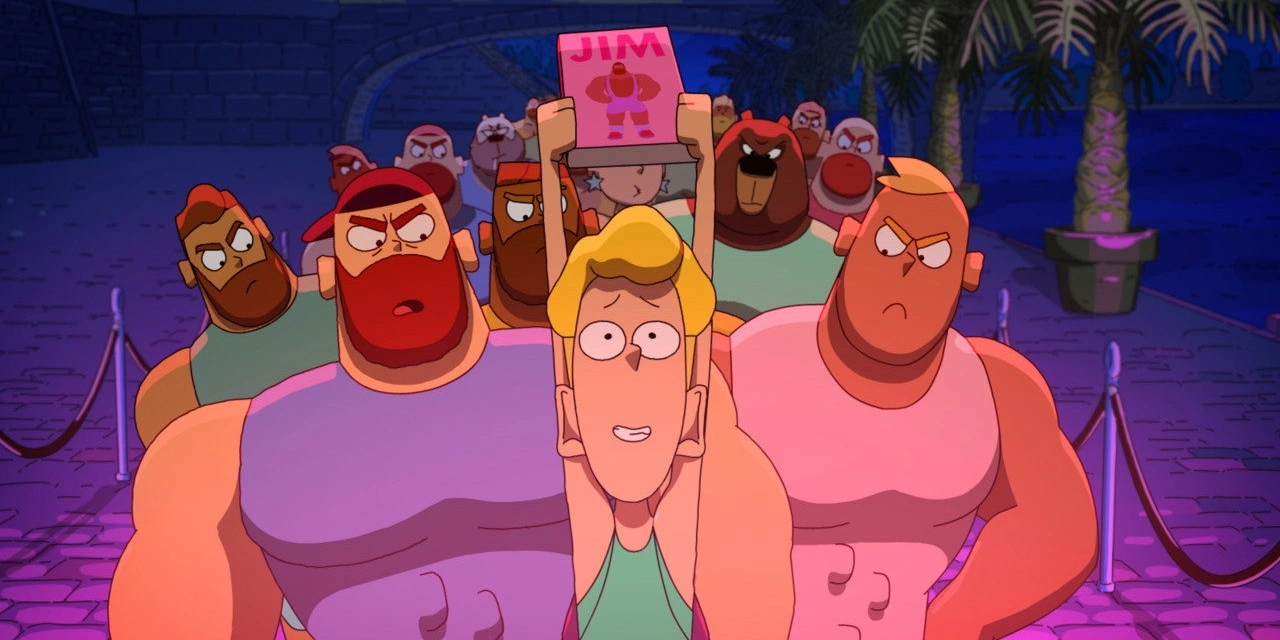
He learns to value the loyalty of a skinny femme peer he once viewed as socially worthless. Lucien learns that internet fame can conceal an empty personality. Their dynamic suggests a condition one might call algo-alienation: human value translated into metrics until the person disappears behind the dashboard. Jim’s platonic best friend, Nina (Shirley Souagnon), steadies this arc, offering a sane perspective while Jim’s choices swing wildly with his shifting biological desires.
On a wider scale, the film makes a loud plea for solidarity inside a fractured community. It calls for pluralism, then somewhat damages its own thesis by keeping its attention largely on gay cisgender men. The contradiction matters. It gives the film an odd self-bruising quality, as if its inclusive politics are trying to outrun its own habits.
The most academically charged element remains the premise. A transmissible, devastating virus targeting gay men creates an unmistakable, thinly veiled AIDS allegory. That historical parallel gives the comedy enormous friction. One reading sees a bold subversion of communal trauma, transforming a real-world catastrophe into a grotesque joke where the final terror is assimilation into mainstream suburban life.
Another reading hears the metaphor clang against the film’s irreverent tone. The script handles this echo with visible clumsiness, trying to place profound communal grief beside jokes about prostate orgasms. The tonal machinery grinds. Fascinatingly. Badly. Productively, perhaps, in the way a cracked bell still makes a sound.
Aesthetic Excess and Low-Budget Avant-Garde
Produced by the European studio Bobbypills, Jim Queen embraces a low-budget avant-garde visual identity. Its animation uses a flat, retro 2D style filled with highly saturated color. Since the frames lack much visual depth, the filmmakers lean on kinetic markers borrowed from anime. The screen bursts with exaggerated dramatic poses, shimmering expressive eyes, and heavily stylized slow motion.
The character designs reject mainstream commercial normality and often slide into the grotesque. Bodies stretch and warp. Muscles swell past plausible anatomy. Sweat appears with almost devotional intensity, every droplet a tiny sermon against respectability. This aesthetic choice matches the film’s refusal to court polite, middle-class taste.
The production performs considerable stylistic labor on what was plainly a fraction of a mainstream studio budget. That resourcefulness becomes clearest in the final act, which delivers surprisingly high-energy, mock-blockbuster action sequences with genuine cinematic heft.
The imagery works in tandem with an aggressive soundscape. Pulsating electronic dance tracks and profane musical numbers sustain a relentless velocity, keeping the viewer pinned to the screen as narrative logic threatens to melt into glitter, panic, and bass.
The adult animated comedy film Jim Queen and the Quest for Chloroqueer made its official world premiere at the prestigious Cannes Film Festival in the Midnight Screenings section. Following its festival run, the movie is scheduled to hit theaters across France starting June 17, 2026, distributed by The Jokers Films, before expanding internationally across physical and digital platforms later in the year.
Full Credits
Title: Jim Queen and the Quest for Chloroqueer (Jim Queen)
Distributor: The Jokers Films
Release date: May 18, 2026
Running time: 85 minutes
Director: Nicolas Athané, Marco Nguyen
Writers: Nicolas Athané, Marco Nguyen, Simon Balteaux, Brice Chevillard
Producers and Executive Producers: David Alric, Arthur Delabays
Cast: Alex Ramirès, Jérémy Gillet, Shirley Souagnon, François Sagat, Harald Marlot, Élisabeth Wiener, Alexandre Brik, Philippe Katerine, La Briochée
Director of Photography (Cinematographer): Not Applicable (Animated Feature Film)
Editors: Ivy Buirette
Composer: Mathieu Rosenzwig, Benjamin Nakache, Kirosen
The Review
Jim Queen
Jim Queen is an aggressive, uneven, yet wildly entertaining assault on the senses that subverts historical trauma into a pastel-hued farce. While its clumsy handling of the underlying pandemic allegory exposes a distinct intellectual laziness, the film succeeds wildly as an energetic takedown of modern digital narcissism and rigid tribal hierarchies. It trades nuance for relentless velocity, offering a crude but vibrant celebration of queer culture that thrives on its own aesthetic excess. It is far from perfect, but it is undeniably memorable.
PROS
- Vibrant, high-energy 2D animation that creatively maximizes a limited budget with anime-inspired kinetics.
- Sharp, hilarious subversion of straight clichés alongside a savage parody of fitness influencer culture.
- Memorable, irreverent musical numbers that successfully balance vulgarity with a strange sweetness.
CONS
- A clumsy, poorly integrated virus premise that creates jarring friction as an insensitive AIDS allegory.
- The script relies heavily on creaky, surface-level gay stereotypes rather than offering genuine new insights.
- The exclusive focus on cisgender gay men severely undermines the story's broader message of community solidarity.