
























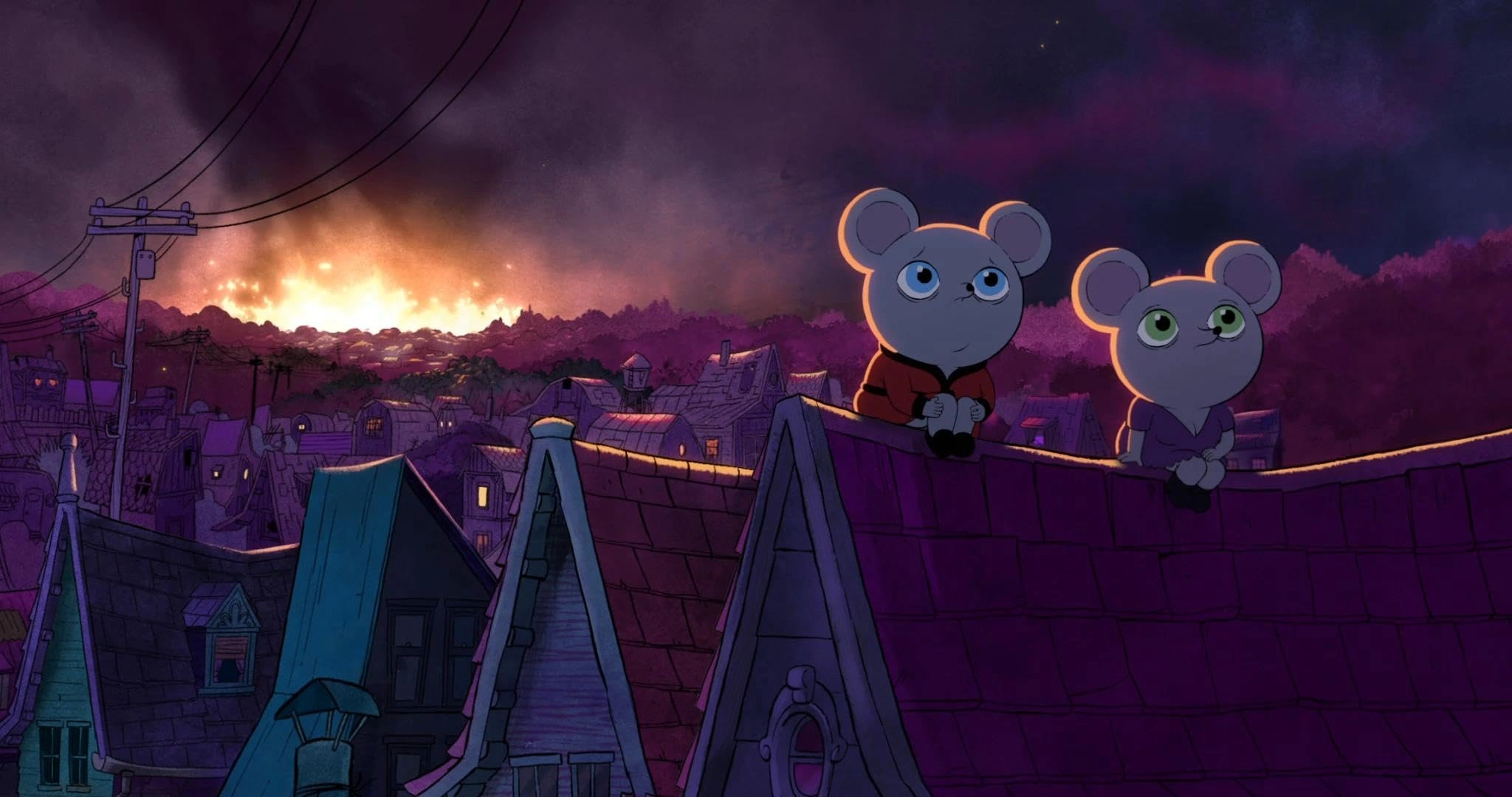

The parting of a theatrical curtain gives birth to Anywheres, a municipal simulation of pastel surfaces, rounded childhood shapes, and spiritual rot. Spanish auteur Alberto Vázquez expands his short film into an animated feature inhabited by anthropomorphic creatures and sentient flora, a soft bestiary trapped inside a civic nightmare. Arnold, an unemployed mouse, remains sealed in his bathrobe; the garment hangs on him like cloth laid over a will that has gone cold.
His wife, María, keeps their household alive by drawing editorial cartoons, converting ink, fatigue, and talent into survival. Above them stands A.L.M.A., the Almighty Limitless Megacorporation Agency, a power that administers work and death with the same clean administrative pressure.
After the unexplained death of his companion Ramiro, Arnold abandons his state-sanctioned psychological medication, and reality begins to split around him. He grows certain that their world is a physical fabrication, a grand decorado built to imitate life. The thought opens a cruel existential inquiry: is Arnold sinking into madness, or has a sedated mind finally touched the first nerve of waking?
The Grotesque Ink of Childhood Memory
Vázquez shapes the film through formal contradiction, taking the soothing grammar of classic animation and pressing it against a philosophical wound. The hand-drawn figures have the soft, curved bodies of mid-century Sunday comics, and they drift through a landscape whose sweetness has soured into hostility and decay.
That friction finds a bruised emblem in Pato Roni, a homeless, discarded cartoon star sitting beside garbage bins, asking for coins and speaking of fame that has already forgotten him. Authority carries the same corrupted fairy-tale logic. The headquarters of A.L.M.A. rises as an industrial distortion of Cinderella’s castle, a palace where magic has curdled into bureaucracy.
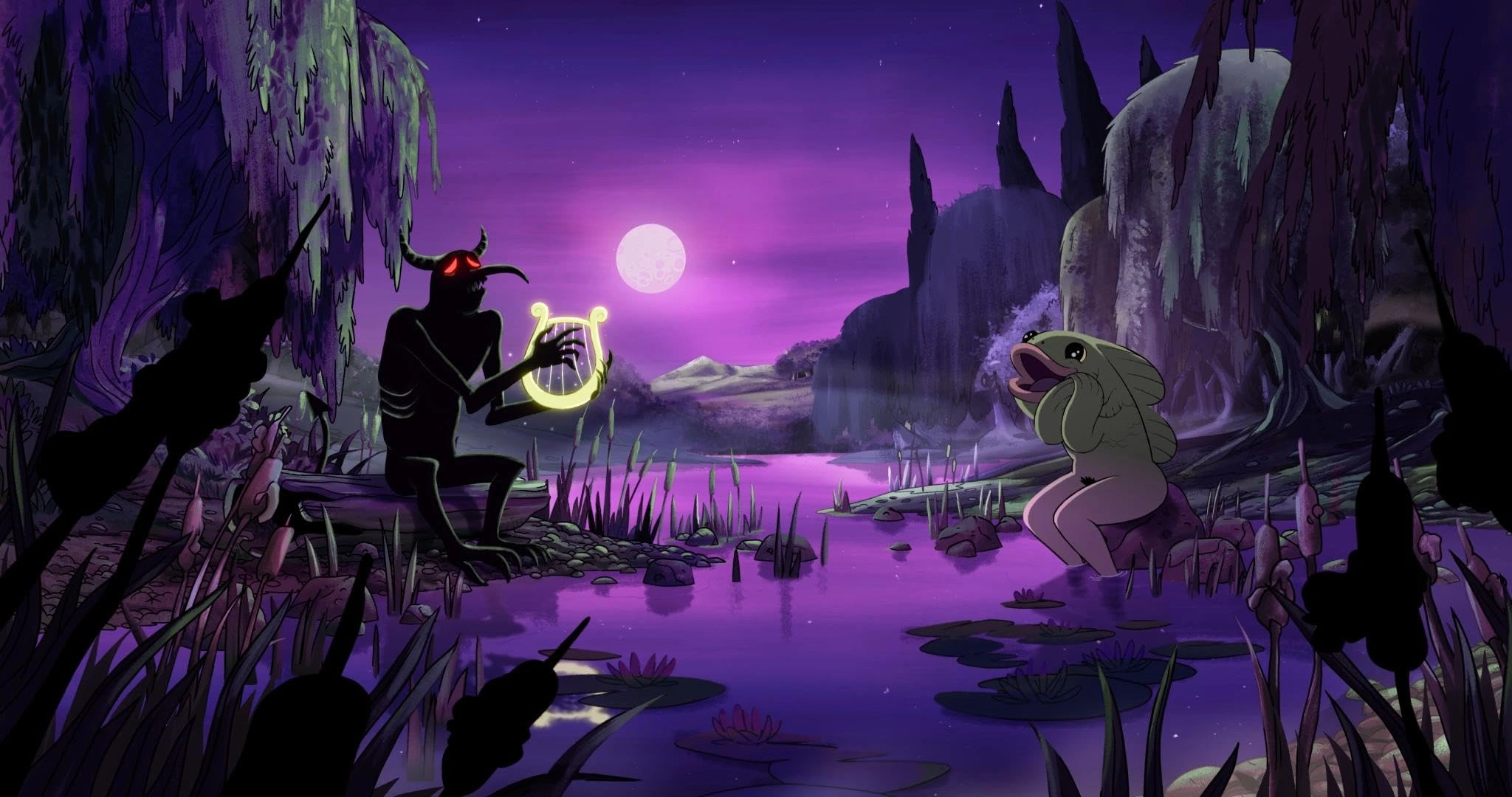
The world divides itself into two zones of containment. The city has a rigid geometric order that restricts movement, and the bordering forest thickens into a wilderness of hidden terrors under the gaze of a massive surveillance owl. During the film’s most charged passages, including a frantic chase through the thickets and the ritualistic conjuring of a spirit, the animation loosens into fluid elegance.
Also Read






An incongruous classical score gives these scenes a strange ceremonial calm, letting violence and high art fuse into a beautiful image of dread. The beauty feels unstable, perhaps belonging to the characters, perhaps to the machine that watches them breathe.
The visual design keeps returning to a bitter idea: innocence can become an instrument of control when a structured world learns how to use it. The bright palette gives little warmth; it feels like department-store lighting, engineered to erase the passage of time and soften the ache of isolation.
Every forest tree and city brick carries a faint, oppressive perfection, strengthening Arnold’s suspicion that an unseen worker has painted his surroundings into place. Cute bodies and bleak spaces press against each other until the film takes the shape of a classic-cartoon parody haunted by a complex visual meditation on human entrapment.
The Ledger of the Sedated Soul
The screenplay moves as an uncompromising fable of systemic exhaustion under late-stage capitalism, showing an all-powerful corporate entity hollowing out the inner lives of its citizens. A.L.M.A. holds a monopoly on existence, controlling manufacturing, basic healthcare, and the gravestones in the local cemetery.
Vázquez refuses easy moral binaries by revealing how institutional machinery compromises the entire population and locks every creature into survival. Economic precarity reaches corporate agents such as Mr. Mushroom, a desperate salesman whose starving children resort to cannibalism, and it reaches the drug-addicted outcasts living in squalor among the forest trees.
Psychological collapse appears through striking allegorical figures, most memorably the Depression Fairy. This gray, withered presence hovers over María, murmuring doubts about her artistic talent and her failing marriage. Through these inner burdens, the screenplay ties corporate dominance to existential paralysis with a bleak directness. The characters repeat a central observation: dreaming has become impossible in this world. The line places the film’s dark humor near Camus and Orwell, where existence contracts into forced conformity, unchosen labor, and the dull ritual of continuing.
Corporate saturation creates a society that treats genuine human emotion as a systemic error requiring correction. The company’s “happiness” pills make Arnold’s exploitation bearable, turning his lack of purpose into a manageable silence. After he stops taking them, his suffering becomes the single authentic fact in his life. That is the tragedy of Anywhere: citizens have been trained to call numbness peace. The system dismantles resistance slowly, almost tenderly, by rewriting the language of desire until even longing feels like a malfunction.
Broken Domesticity on a Scavenged Stage
The film’s emotional weight rests on the domestic quiet shared by Arnold and María. Their fracturing relationship supplies a grounded emotional base that was occasionally missing from the director’s harsher previous features. Asier Hormaza and Aintzane Gamiz give exceptional vocal performances, filling the animated bodies with a palpable, world-weary exhaustion that feels human through the animal forms. Vázquez sharpens the absurdity of their condition through biting comic vignettes, exposing the distance between the faces they present publicly and the solitude they endure privately.
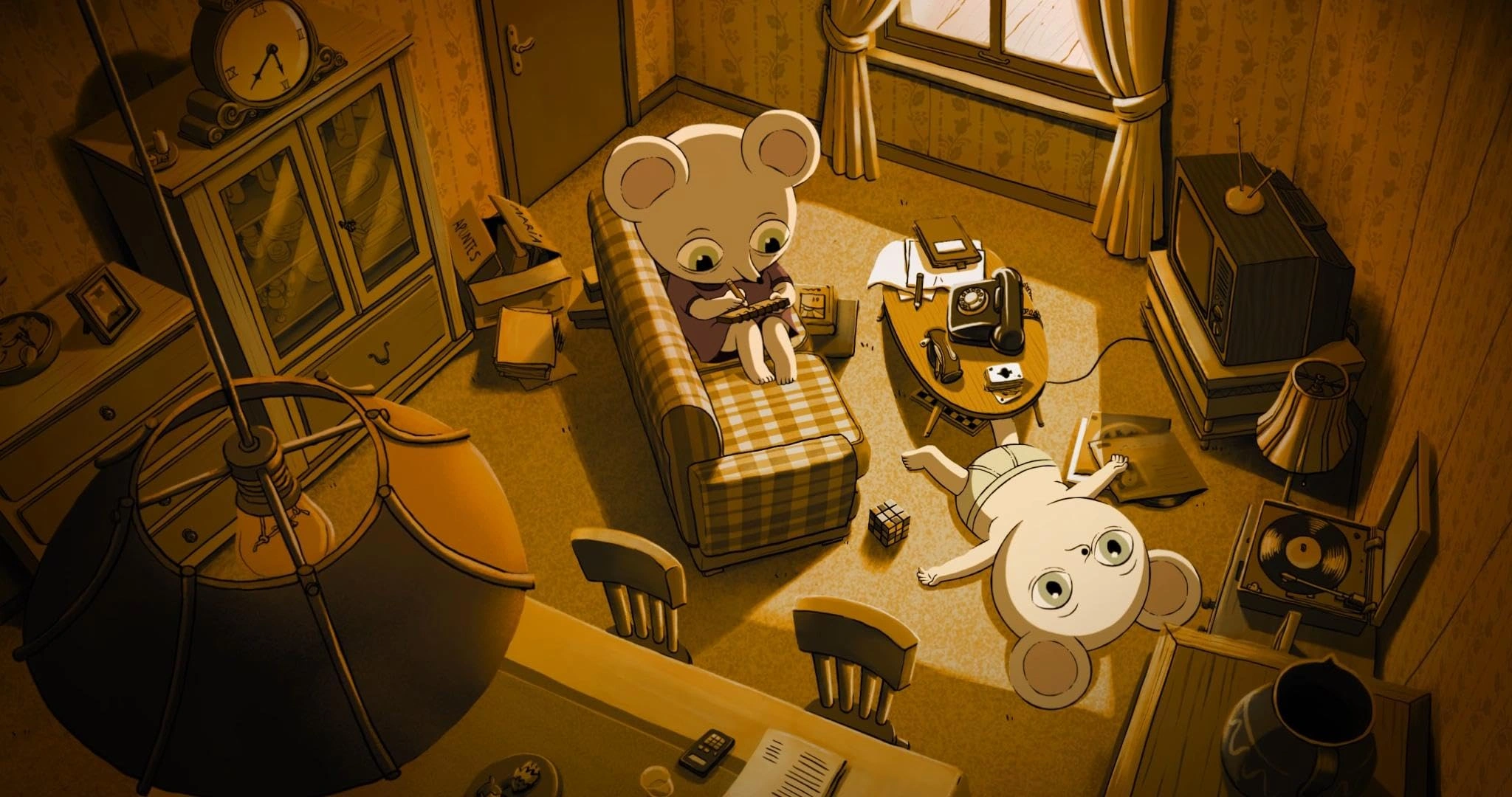
In the opening sequence, the mice exchange tender vows of devotion, then the camera pulls back to reveal separate, detached twin beds. The intimacy of that wound is weakened at times by an overambitious screenplay trying to critique too many social concepts at once, drifting into subplots about predatory medicine, urban gentrification, and modern spirituality. Narrative focus becomes especially fragile in the final act, where the film strains to resolve its competing thematic ideas.
The sudden arrival of self-conscious fourth-wall breaks, canned laugh tracks, and predictable narrative shifts undercuts the authentic paranoia built earlier. These meta-narrative devices convert a profound study of grief into a thinner intellectual exercise, pulling attention away from the human sorrow that gives the film its purpose. As the film turns from the characters’ emotional reality toward abstract commentary about storytelling itself, the final scenes lose the quiet intimacy that made the domestic struggles of Arnold and María linger like a bruise.
The dark animated fantasy-horror film Decorado originally made its world premiere at Fantastic Fest in September 2025 before launching its domestic theatrical run in Spain later that autumn. Following its critical success and winning the Goya Award for Best Animated Feature, the acclaimed animation house GKIDS acquired the film for North American distribution, releasing it in theaters on May 15, 2026, with options for both the original Spanish language track with English subtitles and a newly produced English-language dub.
Full Credits
Title: Decorado
Distributor: GKIDS, Barton Films
Release date: September 21, 2025 (World Premiere at Fantastic Fest), October 24, 2025 (Theatrical release in Spain), May 15, 2026 (Theatrical release in North America)
Running time: 1 hour 35 minutes
Director: Alberto Vázquez
Writers: Alberto Vázquez, Francesc Xavier Manuel Ruiz
Producers and Executive Producers: Iván Miñambres, Chelo Loureiro, J.M. Fdez de Vega, Nuno Beato, Sofía Chávez
Cast: Asier Hormaza, Aintzane Gamiz, Kandido Uranga, Mikel Garmendia, Ander Vildósola, Raúl Dans, Aintzane Crujeiras, Iñaki Beraetxe
Editors: Alberto Vázquez
Composer: Joseba Beristain
The Review
Decorado
Decorado stands as a striking, deeply unsettling fable that transforms childhood aesthetics into an existential battleground. While its late-stage narrative diversions and self-conscious meta-gimmicks slightly dilute the narrative momentum, the film remains a visually mesmerizing exploration of systemic exhaustion and domestic sorrow. It is a haunting reminder of the artificial structures that shape our daily survival.
PROS
- Striking formal contrast between cute, vintage character designs and bleak existential horror.
- Grounded, emotionally resonant portrayal of Arnold and María’s fracturing marriage.
- Hypnotic integration of fluid traditional animation and an incongruous classical score.
CONS
- Overstuffed screenplay that dilutes its core focus by addressing too many societal targets.
- Intrusive late-game fourth-wall breaks and laugh tracks that disrupt the established paranoia.