




























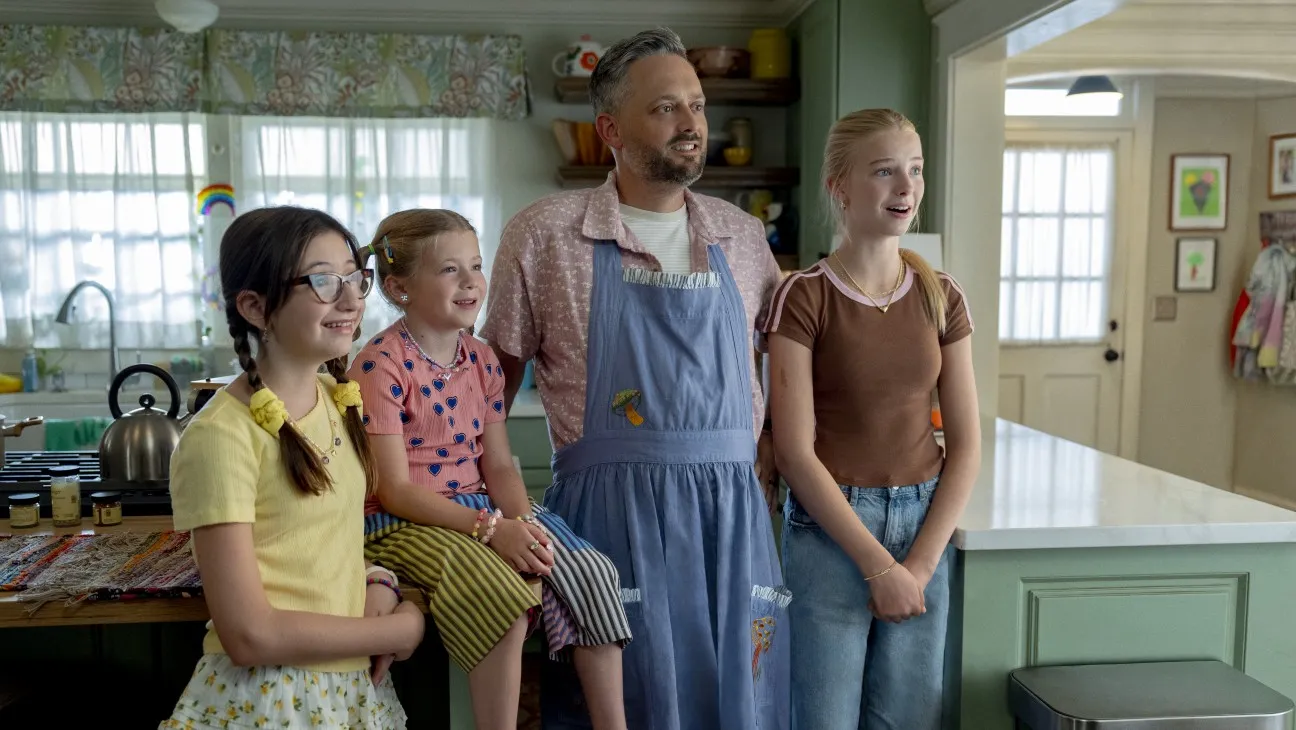
Nate Bargatze has spent two decades selling audiences on the idea that ordinary suburban life is quietly, absurdly funny. With The Breadwinner, directed by Eric Appel and co-written by Bargatze and Dan Lagana, that stage persona gets its first proper cinematic test. Bargatze plays Nate Wilcox, the reigning Salesman of the Year at a Nashville Toyota dealership and a father of three daughters who has, by his own cheerful admission, left the actual running of his household entirely to his wife Katie, played by Mandy Moore.
When Katie pitches a children’s organizational accessory on Shark Tank and lands a deal with investor Lori Greiner, she’s off to South Korea to oversee manufacturing, and Nate is suddenly, inescapably in charge. The supporting cast, including Will Forte, Kumail Nanjiani, Colin Jost, Kate Berlant, and Zach Cherry, orbits this domestic setup with varying degrees of usefulness. Prominently visible throughout: Toyota vehicles, Walmart aisles, KFC buckets, Bud Light, and an Apple Watch that catches the light with suspicious frequency.
Familiar Ground, Occasionally Fertile
The premise of The Breadwinner arrives with baggage. The spectacle of a capable adult man discovering that housework requires effort is a comedic premise worn smooth by decades of use, and the film does nothing to pretend otherwise. Nate Wilcox is established as fundamentally decent and politically harmless, which removes any edge of karmic comeuppance from his domestic struggles. He isn’t being punished. He’s simply, belatedly, being asked to show up. The two-week time limit on Katie’s absence keeps the film’s stakes deliberately low, and that choice quietly undermines any genuine transformation arc before it has a chance to develop.
The first two acts traffic in familiar comic disasters: burned toast, a spaghetti avalanche from a kitchen cabinet, baffled paralysis in the egg aisle at the grocery store. These sequences feel assembled from prefab cultural memory, and most of them play accordingly. The horse sequence, in which a seemingly deceased animal revives and proceeds to rampage through the family home, is chaotic rather than funny, a distinction the film doesn’t seem to recognize.
What occasionally rescues the material is a specific kind of sincerity. When Nate tips a pizza delivery boy twenty dollars and promises he’ll be seeing a lot of him, and the young man responds with complete earnestness, “This is the nicest thing anyone’s ever done for me,” the scene lands cleanly. Its comedy is rooted in human detail rather than setup mechanics. A kitchen montage pairing Nate using a power drill to scrape hardened oatmeal from a pot with shots of him literally drowning in laundry is the film’s most visually inventive passage, briefly suggesting a stranger, more surreal comedy underneath the commercial surface.
The script also earns credit for a structural idea borrowed from Nate’s professional life: he motivates his daughters through a reward system modeled on the Toyota dealership’s incentive program, with Tennessee Titans tickets as the prize. It’s a joke with an actual comic engine. The Shark Tank sequence, by contrast, feels transactional, Lori Greiner playing herself in a sequence that functions more as branded content than as narrative. The condition Greiner attaches to her investment, that Nate must become a full-time stay-at-home parent, is a contrivance that the film accepts without examining.
Also Read






Bargatze on Screen: Rhythm as Performance
Nate Bargatze’s comedic identity is built on unhurried rhythm and a studied air of mild bewilderment, and Appel largely constructs the film around those qualities rather than against them. When Katie asks whether Nate knows what laundry detergent they use at home, he replies, “It doesn’t matter. We probably have it at home,” and the line works precisely because of how little effort he seems to put into it. His Nate Wilcox is kind, amorphous, and so genuinely disconnected from domestic logistics that his confusion reads as natural law rather than comic exaggeration.
The limitations become visible when the film asks for more. Bargatze is a stand-up comedian playing a version of his stage persona, and Appel wisely avoids pushing him into emotional registers that would expose that ceiling. The gap between the sharp comedian performing on stage and the slightly fog-brained character he’s written to inhabit creates a mild friction throughout. The script borrows directly from Bargatze’s live material, his observations about supermarket variety and laundry volume, and the result sometimes feels less like cinema than an illustrated version of a podcast episode.
That impression is reinforced by the end credits, which roll over clips from Bargatze’s stand-up routines alongside footage of the cast laughing. The contrast is revealing. The stand-up material crackles with the specific timing and control of a performer in his element. The film, by comparison, frequently uses his persona as a placeholder where a character might otherwise be. His third-act declaration that the month at home has been the best of his life arrives as an announcement rather than an arrival, the screenplay telling us something happened that the preceding scenes didn’t show.
The Cast Earns Its Keep, Unevenly
The most reliably alive moments in The Breadwinner involve Bargatze opposite fellow comedians, and the pattern holds consistently enough to feel diagnostic. Will Forte, as Keegan, an amateur roofer originally hired by Katie as negotiating leverage and accidentally absorbed into family life by Nate, operates at a frequency the film can’t quite contain or fully use. He steals every scene he’s in, projecting a golden retriever energy that would thrive in a different, weirder film. The character is never developed enough to pay off the goodwill Forte generates.
Kumail Nanjiani channels genuine workplace desperation as Peyton, a rival Toyota salesman whose running joke centers on his compulsive physique-flaunting as a sales strategy. It’s a thin premise elevated by commitment. Zach Cherry wrings consistent returns from his role as the dealership manager, who grows increasingly resentful that Nate seems more emotionally invested in his children than in his coworkers. Both performances demonstrate what a sharper script might have done with the film’s peripheral world. Kate Berlant, one of the most distinctively funny performers working today, is given almost nothing to do, a waste that registers as a genuine missed opportunity.
The three daughters, Gracie, Hadley, and Sam, played by Stella Grace Fitzgerald, Birdie Borria, and Charlotte Ann Tucker respectively, are individualized with care: teenage skincare rituals and boy-awareness, a spelling-bee obsession, and small-child directness. Their shared dynamic gives the film its most credible emotional warmth, and Gracie gets the film’s best line, watching her mother drive away and sighing, “Guess we’re on our own now: three orphans.”
The parent-child dynamics are, somewhat paradoxically, less convincing than the ensemble comedy happening around them, which inverts the film’s stated priorities. Mandy Moore is effortlessly personable as Katie, though her performance occasionally settles into the aspirational-matriarch warmth she refined over years on television. A high-tech smart-home display she uses to remotely manage the family’s schedule gives the film a faint futuristic gloss that it doesn’t otherwise pursue.
The Sponsors Are Always in the Room
Near the beginning of The Breadwinner, there’s a close-up of a Sony-branded microphone sitting on a Shark Tank set. Sony Pictures produced this film. Sony also owns Shark Tank. The shot lasts only a moment, but it captures something essential about the experience of watching the film: the corporate architecture is structural, present in every room.
Toyota vehicles, Walmart, KFC containers, Bud Light, and an Apple Watch all appear with an emphasis that goes beyond background decoration. Three KFC buckets occupy a single shot long enough that the Colonel’s face reads as a fourth character at the table. A Walmart montage set to Twisted Sister’s “We’re Not Gonna Take It” is the film’s most openly branded sequence and, oddly, among its more energetic passages. What makes the placement unusual is that it never attempts to fold itself into the comedy. The products are simply there, lit well and held in frame, which somehow makes them harder to dismiss than ironic winking would have.
The Wilcox household, with its bright lawn, tasteful renovation project, two Toyotas in the drive, and a single income funding all of it, represents a version of American middle-class life that companies want audiences to accept as current reality. The Tennessee setting is too generic to evoke any particular place; the Tennessee Titans are its most repeated geographic marker. Appel manages, impressively, to prevent the film from fully dissolving into advertising language. There are pockets of genuine warmth and absurdist invention that pull it back from that edge, and that control represents real directorial skill given the surrounding conditions.
The gender politics sit at the center of this tension. A premise in which a woman earns and a man manages the home is framed throughout as relatable rather than examined. Lagana’s work on American Vandal displayed a willingness to probe cultural performance with satirical precision; that instinct is almost entirely absent here. What remains is a film that functions as mild, hopeful evidence that theatrical comedy can still draw audiences, while being equally candid, in every sponsored frame, about what it cost to get made.
The Breadwinner is a 2026 American comedy film that follows Nate Wilcox, a salesman whose life flips upside down when his wife, Katie, lands a massive, once-in-a-lifetime business deal on Shark Tank. As her newly successful business takes her away on an extended business trip, the lifelong breadwinner is forced to step into the role of a first-time stay-at-home dad, hilariously attempting to keep their chaotic household from completely falling apart. Directed by Eric Appel and marking the feature film debut of popular comedian Nate Bargatze, the movie will premier theatrically in the United States on May 29, 2026. Audiences looking to watch the film can catch it during its current theatrical run in cinemas nationwide.
Where to Watch The Breadwinner (2026) Online






Full Credits
Title: The Breadwinner
Distributor: Sony Pictures Releasing
Release date: May 29, 2026 (United States)
Rating: PG
Running time: 99 minutes
Director: Eric Appel
Writers: Nate Bargatze, Dan Lagana
Producers and Executive Producers: Jeremy Latcham, Nate Bargatze, Dan Lagana, JoAnn Perritano, Michael Musgrave, Tyler Zacharia
Cast: Nate Bargatze, Mandy Moore, Colin Jost, Zach Cherry, Martin Herlihy, Kate Berlant, Kumail Nanjiani, Will Forte, Stella Grace Fitzgerald, Birdie Borria, Charlotte Ann Tucker, Maddox Batson, Brett Cullen
Director of Photography (Cinematographer): Luke Geissbuhler
Editors: Jamie Gross
Composer: Leo Birenberg, Zach Robinson
The Review
The Breadwinner
The Breadwinner is a competently assembled family comedy that delivers enough quiet laughs to justify its existence while rarely threatening to exceed it. Bargatze's deadpan rhythm is genuinely appealing, Appel's direction is better than the material deserves, and scattered moments of real invention suggest a sharper film lurking underneath. The premise is exhausted, the third-act transformation is unearned, and the corporate fingerprints are everywhere. Harmless, occasionally funny, and honest about its own limitations in ways it probably didn't intend.
PROS
- Bargatze's deadpan delivery generates consistent low-key laughs
- Strong supporting performances, particularly Will Forte and Kumail Nanjiani
- Appel injects genuine warmth and sporadic surrealism
- The three daughters provide the film's most credible emotional core
CONS
- Premise is thoroughly exhausted before the film even begins
- Product placement is relentless and unintegrated
- Third-act character transformation feels announced rather than earned
- Kate Berlant is wasted entirely
- Lagana's satirical instincts are almost completely absent