































Maa Behen, directed by Suresh Triveni and written by Triveni with Pooja Tolani, takes one of Indian street language’s most loaded insults and turns it into a darkly comic family emergency. The setup is deliciously frantic: Rekha, played by Madhuri Dixit, is a glamorous widow living in Patna’s conservative Adarsh Colony. One night, she calls her estranged daughters after discovering her neighbor Charitra Kumar Gupta dead inside her home.
Those daughters arrive with their own baggage. Jaya, played by Triptii Dimri, is stuck in a suffocating marriage to Manas, while Dharna Durga’s Sushma is chasing online visibility with the restless energy of a new-generation influencer. Around them orbit Ravi Kishan’s Gupta, Geetanjali Kulkarni as his wife, and Arunoday Singh as Maheshwari, a police officer with old feelings for Jaya.
The film works as farce, feminist crime comedy, social satire, and wounded family drama. Its central pleasure lies in watching three women, each judged in a different language, try to survive a crisis that society is already prepared to misread.
Adarsh Colony as a Surveillance Machine
The dead body gives Maa Behen its plot, yet Adarsh Colony gives it its bite. This is a neighborhood where every balcony seems like a witness box and every neighbor behaves like a self-appointed moral court. Rekha has been found guilty long before Gupta’s corpse appears. Her sleeveless blouses, confidence, single status, and refusal to shrink into widowhood make her a public scandal in private clothing.
That makes the film recognizably Indian in texture, while its larger concerns connect with a global wave of female-led crime comedies and domestic thrillers. Like many recent films about women pushed into criminal chaos, Maa Behen uses genre as camouflage. Under the corpse jokes and frantic cover-up lies a clear question: who gets to control the story once a woman has been accused?
Rekha is branded dangerous, Jaya is trapped inside the performance of ideal wifehood, and Sushma is dismissed as a shallow screen addict. Their reputations are assembled by gossip, family expectation, media spectacle, and internalized shame. The film’s cleverest device is Khalbali, a sensational crime show that turns the women into lurid caricatures. It does not seek truth. It packages suspicion.
This is where Triveni’s satire lands hardest. Indian popular culture has long divided women into pure mothers, obedient daughters, and scandalous outsiders. Maa Behen tosses those categories into one house with a corpse and lets them panic. The film is less graceful when it underlines its own commentary too aggressively. Some scenes feel too engineered, with characters functioning like symbols. Still, its portrait of moral policing has sting.
The Trio Carries the Chaos
Madhuri Dixit’s Rekha is the film’s glittering problem and its emotional mystery. She is funny, evasive, wounded, vain, sharp, and sometimes impossible to believe. Dixit brings unmistakable star presence to the part, which helps the film sell Rekha as a woman whose very existence invites gossip. Her glamour becomes part of the character’s rebellion. A sari, a sleeveless blouse, a smile held too long, each detail reads like a refusal to apologize.
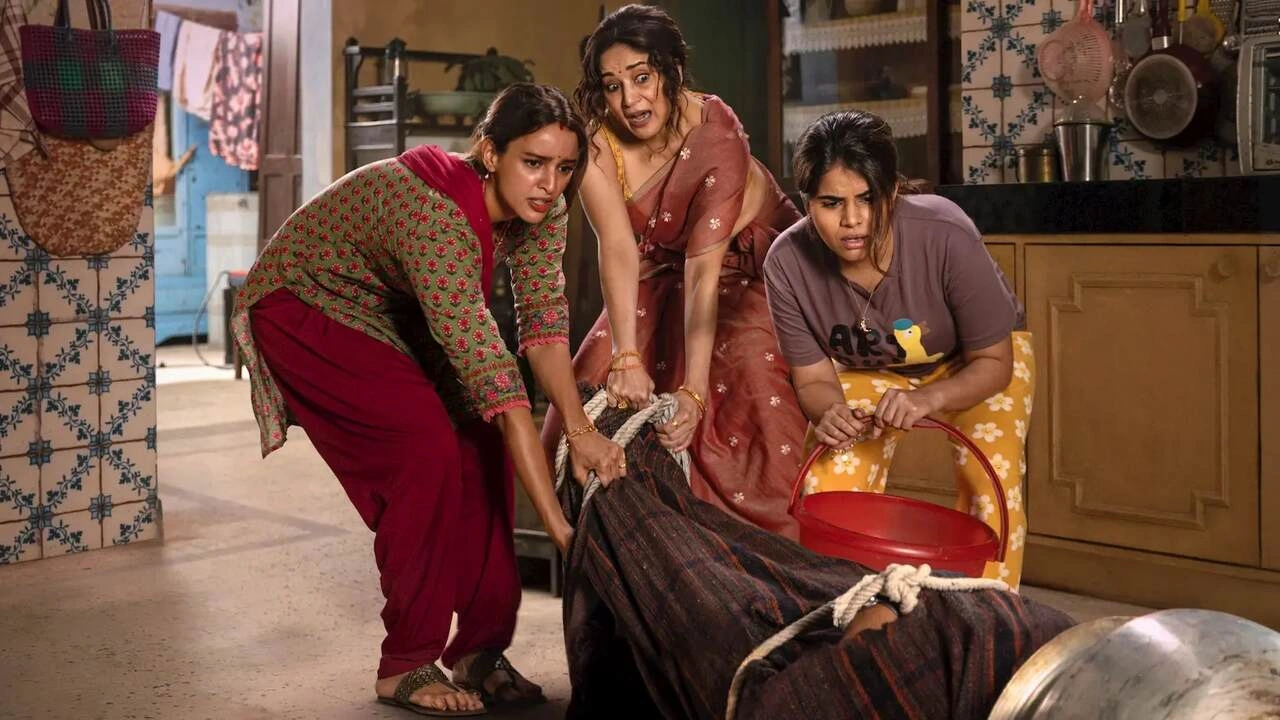
There are moments where the performance feels heightened to the point of theatrical display, yet Dixit becomes strongest when Rekha sobers into fear and memory. In those quieter beats, the film suggests that survival has made her theatrical. She performs because the world has always watched.
Triptii Dimri gives the film its most forceful dramatic arc. Jaya begins as the responsible daughter, the one trained to keep the family respectable and the rotis round. Her marriage to Manas has drained her, and Dimri plays that exhaustion with tight control. Her eventual outburst feels earned because the film has let us see how long she has been swallowing anger. When Jaya finally erupts, the comedy briefly clears space for something raw.
Dharna Durga brings a spiky freshness to Sushma. The character could have become an easy influencer joke, yet Durga gives her insecurity, speed, and a need to be seen. Sushma’s phone is her shield, her audience, and her escape route.
The women’s rhythm is the film’s strongest engine: bickering, panic, blame, improvisation, and sudden tenderness. Their bond feels messy in a recognizably familial way. Geetanjali Kulkarni gives Gupta’s wife surprising texture, Arunoday Singh adds a comic romantic wrinkle, and Ravi Kishan has presence, though Gupta feels thinner than he should.
Stylish Fun with Uneven Control
Suresh Triveni directs Maa Behen with a taste for noise, color, exaggeration, and deliberate artificiality. The film leans into camp performance, crime-show parody, frantic blocking, narration, quick reversals, and shouted confusion. At its best, this style gives the movie the flavor of pulp fiction filtered through middle-class domestic panic. The house becomes a stage, the colony becomes an audience, and the corpse becomes the prop everyone is trying to hide.
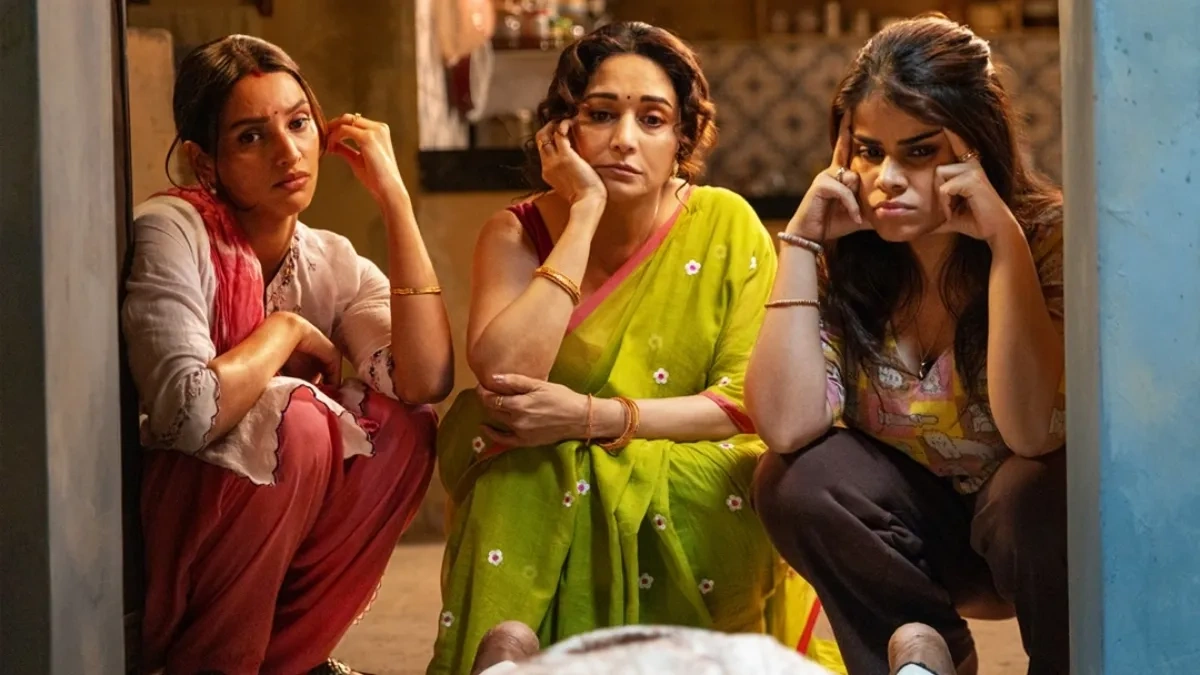
The technical craft keeps that theatrical energy moving. Anuj Rakesh Dhawan’s cinematography gives Rekha’s home and Adarsh Colony a slightly polished quality without losing the cramped texture of neighborhood life. The production design, centered on an ageing house and watchful residential spaces, creates a social trap around the women. Dipika Kalra’s editing keeps the early stretch sharp, especially during the first waves of panic. Subhajit Mukherjee’s background score matches the film’s quirky crime-comedy pulse.
The songs work unevenly. “Kaari Kaari” leaves the strongest impression, while “Dhak Dhak Reloaded” has playful energy tied to Madhuri’s screen legacy. Other tracks fade faster.
The film’s biggest weakness is control. Ransom calls, a police inquiry, wedding chaos, side cameos, and family conflicts compete for attention. The middle stretch repeats beats of panic, and the climax feels convenient. Sometimes the film tries to create energy by making everyone louder, which weakens the tension. Still, Maa Behen has enough spark to hold interest. Its best scenes understand that shame can be a prison, gossip can be violence, and laughter can be a weapon women use before the world lets them breathe.
Maa Behen is a dark crime-comedy movie directed by Suresh Triveni and co-written with Pooja Tolani. The plot follows a widow and her two estranged daughters who are forced to collaborate when they unexpectedly discover a neighbor’s dead body in their kitchen. To protect themselves, they must figure out how to clean up the crime scene and dispose of the evidence while evading the law and outsmarting the highly nosy neighborhood gossip network. The film premiered globally on June 4, 2026, and is available for streaming exclusively on Netflix.
Where to Watch Maa Behen (2026) Online


Full Credits
Title: Maa Behen
Distributor: Netflix
Release date: June 4, 2026
Rating: 15 (BBFC)
Running time: 127 minutes
Director: Suresh Triveni
Writers: Pooja Tolani, Suresh Triveni
Producers and Executive Producers: Vikram Malhotra, Suresh Triveni
Cast: Madhuri Dixit, Triptii Dimri, Dharna Durga, Ravi Kishan, Geetanjali Kulkarni, Arunoday Singh, Shardul Bhardwaj
Director of Photography (Cinematographer): Anuj Rakesh Dhawan
Editors: Dipika Kalra
Composer: Akashdeep Sengupta, Subhajit Mukherjee
The Review
Maa Behen
Maa Behen is a lively, uneven dark comedy powered by Madhuri Dixit, Triptii Dimri, and Dharna Durga’s chaotic chemistry. Its satire of gossip, patriarchy, and moral policing lands with bite, especially through Rekha’s defiance and Jaya’s emotional release. The film loses some control through crowded subplots and a convenient climax, yet its wit, performances, and sharp social anger make it an entertaining watch.
PROS
- Strong female trio
- Sharp satire on moral policing
- Triptii Dimri’s standout arc
- Stylish crime-comedy energy
- Memorable Khalbali TV-show device
CONS
- Uneven pacing
- Too many side plots
- Convenient climax
- Some characters feel underused
- Loudness sometimes weakens tension