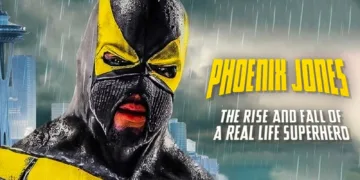


























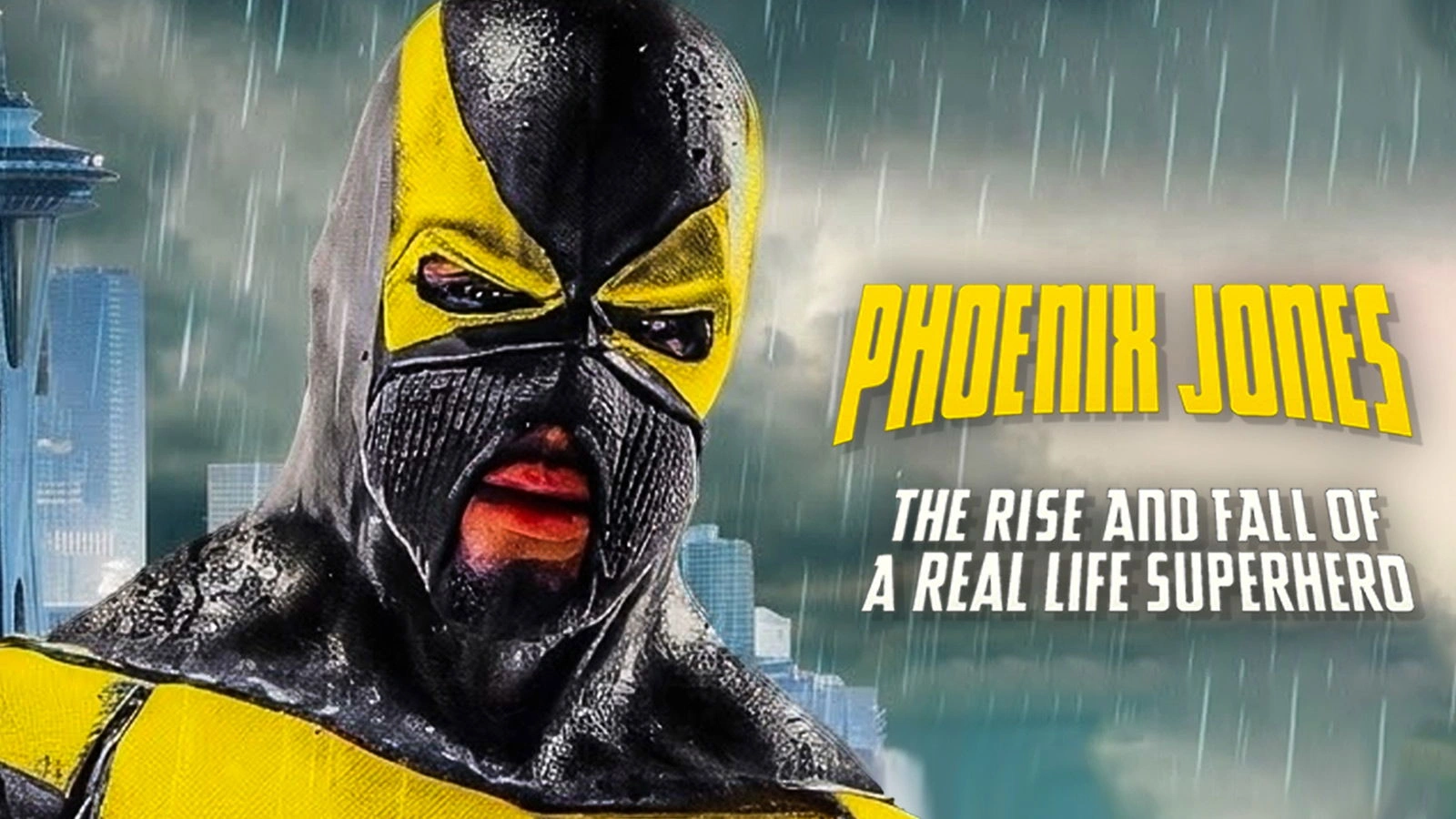

Phoenix Jones: The Rise and Fall of a Real Life Superhero is the kind of documentary that sounds like a fake movie pitch until the footage begins proving otherwise. Directed by Bayan Joonam, the film follows Benjamin Fodor, the Seattle man who turned himself into Phoenix Jones, a costumed crimefighter who patrolled the city streets in a rubber suit while superhero cinema was busy conquering multiplexes.
The film traces his rise around 2010 and 2011, when Phoenix Jones became a local curiosity, then a national oddity, then a figure whose story grew harder to frame as harmless spectacle. He led the Rain City Superhero Movement, revealed his identity in public, clashed with police, faced legal trouble tied to drug charges, vanished for a time, then returned in 2020 as Seattle’s streets were filled with protest, anger, and institutional distrust.
Joonam treats that arc less like a punchline than a playable moral scenario, almost like a narrative game where every choice carries a consequence the hero did not fully anticipate. Phoenix wants to protect people. The film keeps asking who gave him permission, and how much of the mask is courage, trauma, ego, performance, or survival.
Benjamin Fodor and the Myth He Needed
The strongest part of Joonam’s film is its refusal to flatten Benjamin Fodor into either a hero or a clown. Fodor is charismatic in the way great documentary subjects often are: open enough to invite empathy, slippery enough to make every confession feel slightly staged. He can sound sincere one moment, then like a man editing his own origin story in real time the next.

His motives are given emotional shape through trauma, distrust of authority, and fatherhood. The film suggests that the birth of his son, Freedom, and a violent incident connected to his family pushed Fodor toward a fantasy of direct action. That material gives Phoenix Jones a human engine. He is not simply a man who wanted attention, though attention clearly became part of the reward loop. He is a person trying to convert fear into purpose, with a costume acting as both armor and amplifier.
Joonam is sharpest when he lets the contradictions breathe. Fodor’s family challenges important parts of his personal mythology, including claims about his childhood and adoption. The film does not treat those discrepancies as cheap “gotcha” moments. It studies the emotional usefulness of the lie. Phoenix Jones becomes a self-designed character class, built from pain, exaggeration, and wish fulfillment.
The Rain City Superhero Movement adds a strange communal texture. Purple Reign, Ghost, Midnight Jack, and other costumed figures make Fodor seem less like a lone glitch in the system and closer to the most visible player in a fringe movement. Their presence gives the film its oddball warmth, where absurdity and sincerity keep sharing the same frame.
Vigilantism, Fantasy, and Civic Failure
The documentary’s most interesting question is also its most uncomfortable one: why does Phoenix Jones feel ridiculous in real life when a similar figure would be celebrated in fiction? Superhero stories have trained audiences to accept masked intervention as catharsis. A lone figure sees a broken system, steps outside normal channels, and acts. On actual streets, that fantasy becomes unstable fast.
Jones breaks up fights, confronts suspected drug users and dealers, uses pepper spray, and enters volatile situations with limited information. In a game, those encounters might be readable as side missions with clear objectives. In life, the quest markers are missing. People are scared, angry, intoxicated, confused, or simply minding their own business. Jones’s intentions may be protective, yet the method can tip a tense moment into something worse.
The Seattle setting matters. The film places Phoenix Jones against a city where public trust in policing has already frayed. In that climate, a self-appointed protector can seem understandable, at least at first glance. The deeper problem is that a broken system does not become healthier because one man puts on body armor and starts improvising justice.
The 2020 material gives the film its toughest stress test. Phoenix’s return during the Black Lives Matter protests forces his comic book morality into a world of political grief, racial anger, and police violence. Simple hero logic collapses under that pressure. Joonam does not need to overstate the point. The footage makes clear that real public safety is messier than any origin story can handle.
Style, Access, and a Story That Could Be Tighter
Joonam gives the film a visual identity that matches its subject without surrendering to the fantasy. The documentary combines talking-head interviews, archival patrol footage, reenactments, comic book-style graphics, and darkly lit interview spaces that feel pulled from a low-budget vigilante thriller. That stylization works because the film keeps dragging the myth back to pavement, rain, courtrooms, and shaky street footage.
The access is valuable. Fodor speaks at length, as do his son, family members, former allies, journalists, and cultural observers. The archival footage is especially important because Phoenix Jones documented so much of his own activity. That habit becomes a key piece of character design. He wanted to stop crime, yet he also wanted a camera present. The film understands that tension and keeps returning to it.
The craft is polished, sometimes surprisingly so. Warehouse interviews, graphic flourishes, and superhero imagery give the documentary a moody charge, while the raw footage keeps puncturing the coolness. The clash is effective. One moment Phoenix looks like a cult-film vigilante, the next he seems like a man caught inside a role he cannot fully control.
The weakness is length. At nearly two hours, the film circles some points too often, especially the question of whether Jones is protector, nuisance, performer, or cautionary figure. A tighter cut would make the emotional and ethical beats hit harder. Still, the subject has enough strangeness, sadness, and cultural bite to hold
Phoenix Jones: The Rise and Fall of a Real Life Superhero is an American independent documentary film that made its official world premiere at the South by Southwest (SXSW) Film Festival on March 13, 2026, followed by regional festival presentations including the Seattle International Film Festival. Directed by Bayan Joonam, the chronicle delves into the stranger-than-fiction reality of Benjamin Fodor, a charismatic mixed martial artist who gained international media notoriety patrolling the streets of Seattle in a custom superhero suit before facing unmasking, fractured team alliances, and high-profile legal troubles. Audiences can currently experience the complex character profile at select theatrical film festival circuits, while its wider streaming platform premiere and international television broadcast rights are currently under negotiation by its commercial sales agency.
Where to Watch Phoenix Jones: The Rise and Fall of a Real Life Superhero (2026) Online
Full Credits
Title: Phoenix Jones: The Rise and Fall of a Real Life Superhero
Distributor: Gersh (Sales Agent), Laugh Cry Wow Production
Release date: March 13, 2026 (South by Southwest world premiere)
Running time: 116 minutes
Director: Bayan Joonam
Writers: Bayan Joonam
Producers and Executive Producers: Jami Gertz, Bayan Joonam, Claire Chubbuck, Marlowe Blue, Duncan Dickerson, Ryan McNamee
Cast: Phoenix Jones, Rainn Wilson, Jon Ronson, Midnight Jack, Freedom Fodor, Caros Fodor, Ryan McNamee, Ghost, Lance Coulter, El Caballero
Director of Photography (Cinematographer): Chris Koser
Editors: Duncan Dickerson, Karl Steig
The Review
Phoenix Jones: The Rise and Fall of a Real Life Superhero
Phoenix Jones: The Rise and Fall of a Real Life Superhero is a strange, absorbing documentary about a man trapped between public service, self-mythology, and spectacle. Bayan Joonam gives Benjamin Fodor enough room to fascinate and frustrate, while the film’s sharpest moments question the fantasy of real-world vigilantism. It runs longer than it should, with some repeated ideas, yet its access, visual polish, and uneasy emotional pull make it memorable.
PROS
- Fascinating central subject
- Strong access to Fodor, his family, and former allies
- Stylish use of archival footage and superhero imagery
- Thoughtful treatment of vigilantism and public safety
- Strong emotional thread through Fodor’s relationship with his son
CONS
- Runs too long
- Repeats key ideas
- Some threads feel underexplored
- The structure can feel familiar
- Certain ethical questions could use sharper focus