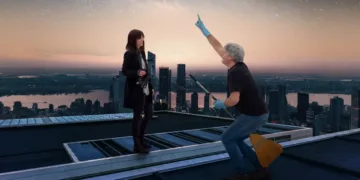














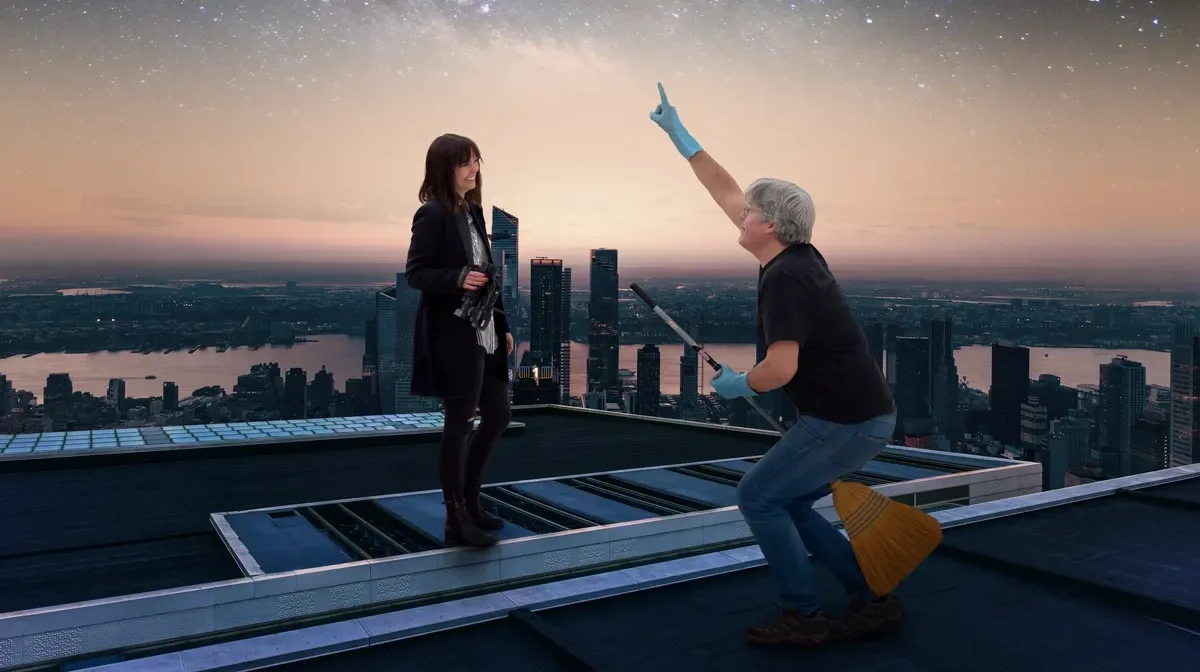

We Are Stardust begins with a wonderfully strange proposition: what if the history of the solar system has been landing on our rooftops, sliding into gutters, and gathering in road dust while the rest of us walked past it? Elisabeth Rasmussen’s documentary follows Jon Larsen, a Norwegian jazz musician and producer who turns into an amateur micrometeorite hunter through sheer patience, curiosity, and a willingness to look ridiculous before he looks right.
The tools are almost comically humble. A broom. A magnet. Small bags. A sifter. A microscope. Larsen searches for microscopic particles from space in places most people associate with clogged drains and maintenance bills. That contrast gives the film its emotional charge.
Rasmussen sees the comedy in the setup, yet she never treats Larsen as a joke. His search has the shape of obsession, but it carries the warmth of play. He is someone who has found a way to keep wonder active in adulthood, which may be rarer than the particles he is chasing.
The Amateur Who Makes Wonder Practical
Larsen is the kind of documentary subject who could carry a far messier film through personality alone. He speaks about micrometeorites with the calm excitement of someone showing you a favorite record, and that musical background matters. His life in jazz gives the film a useful emotional rhythm: improvisation, repetition, close listening, then a sudden pattern appearing where there seemed to be noise.

Rasmussen gives him the time to become a person before he becomes a case study. The scene with his elderly mother is especially revealing. She remembers moving his childhood rock collection to the basement because she feared it might break through his bedroom floor.
Also Read





It is a funny image, a child gathering so much Earth that the house can barely hold it, and it makes his later search feel like the same instinct sharpened over decades. Larsen has always been collecting evidence that the world is larger and stranger than daily life admits.
The film also catches the cost of that devotion. Scientific recognition does not arrive with a clean victory lap. Emails go unanswered. Experts hesitate. Money remains tight. Larsen reportedly has to sell guitars and production equipment for living expenses, which gives the story a painful twist: the universe may reward curiosity with meaning, but rent still prefers cash. Rasmussen does not milk this for pity. She lets the detail sit there, awkward and human.
Proof, Skepticism, and Tiny Glass Worlds
The scientific tension in We Are Stardust is easy to grasp because Rasmussen keeps the stakes clear. Micrometeorites are tiny extraterrestrial particles that survive their fall through the atmosphere. Some reach back to the early solar system.
The established view had been that meaningful samples were best found in places like glacial regions or the ocean floor, far away from urban contamination. Larsen’s claim is both simple and disruptive: they can be found in cities too, if someone knows how to look.
What keeps the film from sliding into outsider-genius fantasy is its respect for caution. The scientists who doubt Larsen are not presented as fools. Their resistance makes sense. Science needs standards, especially in a world full of noise, false certainty, and people confusing enthusiasm for evidence. The drama comes from watching caution harden into dismissal, then watching Larsen keep working anyway.
His alliance with Norwegian mineralogist Jan Braly Kihle gives the film one of its best turns. Kihle’s photographic equipment allows the possible micrometeorites to be captured with startling precision, and the connection begins partly through Larsen’s music. That small accident feels true to how discovery often works. Not as a clean institutional pipeline, but as a chain of people, tools, friendships, and timing.
The particles themselves are gorgeous. Magnified on screen, they look like tiny blown-glass sculptures, polished by violence and distance. This is where the film’s cinematic language clicks into place. Rasmussen does not ask us to admire science as abstract knowledge. She lets us see the thing. Once those little forms fill the frame, Larsen’s fixation becomes easier to understand. He is holding a speck, but the speck opens into deep time.
Myth, Mortality, and the Feeling of Scale
Rasmussen’s smartest choice is to place Larsen’s science beside myth rather than beneath it. Drawing from her Sámi heritage, she frames parts of the film through the story of Gabba, the cosmic white reindeer descending from the heavens.
In another documentary, that might have felt decorative. Here, it gives Larsen’s search a wider emotional vocabulary. The film is not asking myth to replace science. It shows how both begin with the same human posture: looking upward, then trying to make sense of what looks back.
That personal thread deepens when Rasmussen brings in her own brush with death. The shift could have pulled the film away from Larsen, but it gives the documentary a second pulse. Stardust stops being only a scientific object and becomes a way to think about fragile bodies, ancestry, chance, and the strange fact that matter keeps moving through forms. The film’s title sounds poetic at first. By the end, it feels almost literal.
The craft supports that feeling. Cinematographers Jannicke Mikkelsen and Jason Leeds move between close observational scenes and images that suggest cosmic distance without losing the human scale. Little Shadow’s visual effects make astrophysics legible without turning the film into a classroom slideshow, though a few animated passages have less force than the magnified particles themselves. Philip Owusu’s score, touched by jazz warmth, gives Larsen’s search a sense of motion and wonder. It does what the best music in documentaries can do: it makes thought feel physical.
We Are Stardust works because it understands that discovery is an emotional experience before it becomes a published fact. A man bends over a gutter with a magnet, searching through urban dirt for particles older than human memory. It should look small. Rasmussen makes it feel immense.
The European independent science documentary We Are Stardust (originally titled Vi er stjernestøv) had its world premiere in March 2026 at the Thessaloniki International Documentary Film Festival before making its Nordic debut at the CPH:DOX festival in Copenhagen. The film chronicles the true story of Jon Larsen, a Norwegian jazz musician and amateur scientist who challenges mainstream scientific orthodoxy by using a broom and a magnet to search for cosmic micrometeorites in urban gutters and rooftops. Interweaving his quest with the director’s own personal reflections on her Sámi heritage and a deep connection to the cosmos, the narrative captures a moving look at curiosity, perseverance, and citizen science. Viewers interested in tracking the documentary can currently find it screening globally throughout the international film festival circuit or via upcoming public television broadcasts in Scandinavia.
Full Credits
Title: We Are Stardust
Distributor: Copenhagen Film Company, Wonderline, F(x) produksjoner
Release date: March 2026
Running time: 101 minutes
Director: Elisabeth Rasmussen
Writers: Elisabeth Rasmussen
Producers and Executive Producers: Benedikte Bredesen, Ulrik Gutkin, Jamie Hever
Cast: Jon Larsen, Elisabeth Rasmussen, Jan Braly Kihle, Mike Zolensky, Matthew J. Genge
Director of Photography (Cinematographer): Jannike Mikkelsen, Jason Leeds
Editors: Ash Jenkins
Composer: Philip Owusu
The Review
We Are Stardust
We Are Stardust turns a man with a magnet and a gutter full of dust into a quietly wondrous meditation on curiosity, proof, and human scale. Elisabeth Rasmussen keeps the science clear, the mythic thread intimate, and Jon Larsen’s obsession deeply endearing. Some animated passages lack the force of the magnified particles, yet the film’s warmth, music, and sense of discovery carry it beautifully.
PROS
- Jon Larsen’s infectious presence
- Gorgeous micrometeorite imagery
- Clear science storytelling
- Warm jazz-inflected score
- Moving Sámi mythic thread
CONS
- Some weaker animations
- Occasional expert material feels dry
- Personal thread may feel late to some viewers