





















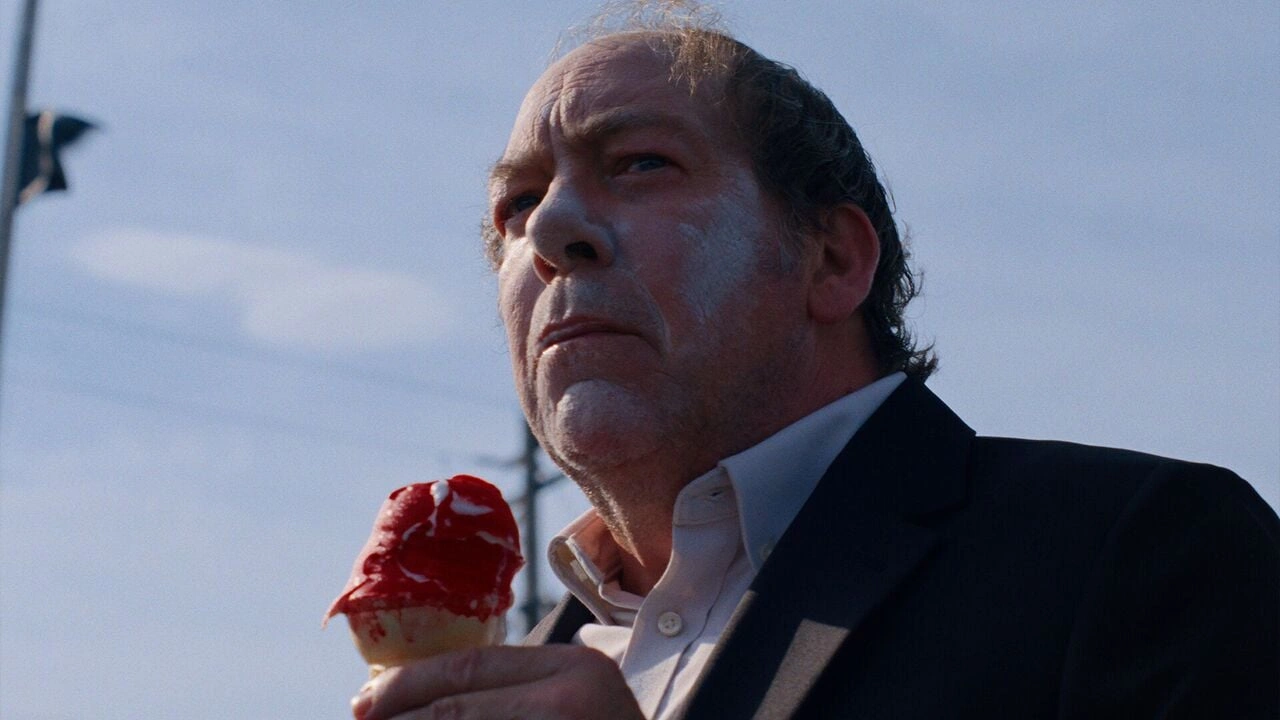

The parking lot may be the most honest character in Ponderosa. It sits there, wide and blank, absorbing the dead time of people who have no clear reason to be anywhere else. Rob Rice’s black comedy understands that modern suburbia does not need fog, haunted houses, or expressionist corridors to become uncanny. It only needs a buffet restaurant, a construction site, a few men with money, and a young person too tired to resist their ideas about the future.
Zeke (Jack Dylan Grazer) drifts through a drab Illinois town with the soft inertia of someone raised inside endless options that all lead to the same place. He scrolls. He drives. He visits his mother Sandra (Alexis Bledel) at the Ponderosa Steakhouse, where her job gives him cheap food and a small daily anchor. Then the restaurant faces closure, and the anchor loosens. That is when George appears.
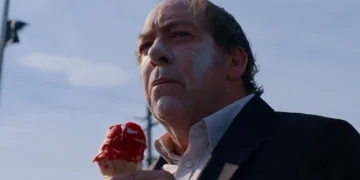
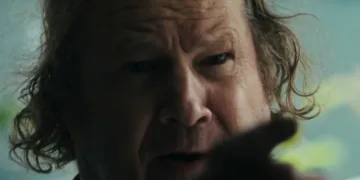
Played by Bill Camp with the smile of a man who has mistaken need for wisdom, George offers Zeke mentorship in the parking lot. This is already funny because nothing about George suggests he should be mentoring anyone. He is a property developer attached to Walden Colonies, a housing project whose name sounds like someone tried to turn spiritual retreat into zoning paperwork.
He has business contacts, a truck, and the awful confidence of men who believe adulthood is transferable through proximity. Call it paternal extraction. George sees youth, vacancy, and pliability in Zeke, then decides all three belong to him.
The Mentor Nobody Ordered
The funniest and most disturbing thing in Ponderosa is that George’s plan depends on Zeke caring. Zeke does not care. Or he does, somewhere under the surface, but Grazer plays him as a person whose emotional responses have been sanded down by repetition, screens, and suburban sameness. When George offers him work at the construction site, Zeke accepts with the energy of someone agreeing to hold a door open. It is not consent in any meaningful dramatic sense. It is drift taking human form.
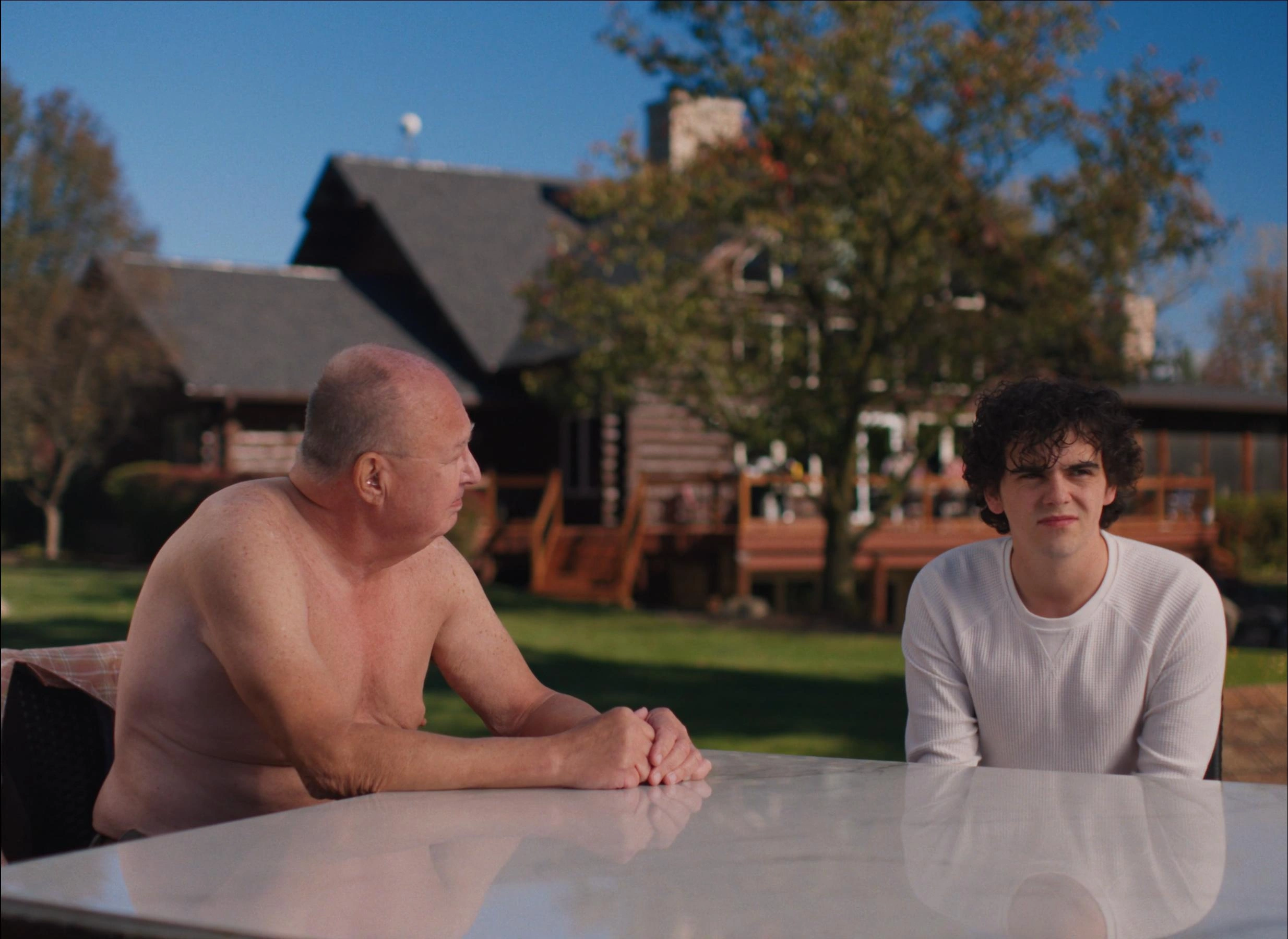
Camp makes George both ridiculous and quietly dangerous. He leans into the older man’s loneliness without softening the threat inside it. His George is no grand villain. He is worse, maybe: a banal man who has lived long enough to confuse his own disappointments with a worldview. Each attempt to guide Zeke has the rhythm of a sales pitch delivered after the customer has already left the room.
The film keeps George’s fixation at an uneasy temperature. His interest in Zeke reads as paternal, possessive, possibly sexual, sometimes all three in the same awkward pause. Rice does not clarify the discomfort because clarity would make it safer. The scenes work through pressure. George presses. Zeke stares. George presses harder. Zeke remains a locked door with bad posture.
This is where the film’s generational argument starts to sharpen. George does not want a son in any tender sense. He wants confirmation that his version of masculinity still has buyers. Zeke, with his blank face and low pulse, becomes the worst possible audience for that performance. He refuses the role by failing to perform back. A small rebellion, yes. Almost microscopic. Still a rebellion.
The Horror of Bland Men
Rice’s sharpest visual idea is to make menace look ordinary. The Ponderosa Steakhouse, with its empty tables and buffet logic, feels like a place built to satisfy appetite without pleasure. The roads appear to lead everywhere and nowhere. The construction sites look pre-dead, future homes already haunted by repetition. Barton Cortright’s digital cinematography gives these spaces a cold flatness, as if the town has been photographed by a security camera that briefly developed aesthetic standards.
The backyard gathering pushes the film into its most openly surreal territory. George brings Zeke among other older men who seem less like friends than copies produced by the same exhausted machine. They perform suburban male sociability with the dead-eyed discipline of people following instructions from a manual nobody remembers writing. Then the film reveals the younger bodies nearby: gym-built teen boys, silent and trained, like heirs being manufactured in a basement lab for real estate masculinity.
That image sounds absurd because it is absurd. It also makes a nasty kind of sense. Ponderosa imagines a world where older men cannot persuade the young, so they try to produce them instead. Not raise them. Produce them. The distinction matters.
The comedy lives inside that horror. George’s failed speeches to Zeke are funny because Camp lets us see the panic under the confidence. Zeke’s near-total refusal to meet his energy becomes its own comic weapon. Nothing explodes. Nobody delivers a perfect punchline. The film finds its laugh in the terrible gap between George’s hunger for legacy and Zeke’s talent for passive noncompliance.
A Strange Film That Sometimes Escapes Itself
Ponderosa is deliberately slow, and that deliberateness will test people. Scenes hang past conventional timing. Conversations avoid release. The plot does not climb so much as hover, then tilt. There are stretches where Rice’s commitment to dead air becomes admirable and stretches where it begins to feel like a private joke told in an empty food court.
The final movement pushes the film deeper into social nightmare, raising questions about how literal George’s designs are meant to be. The ambiguity has force because the film has already trained us to distrust ordinary surfaces. Still, Rice sometimes lets the weirdness drift beyond dramatic contact. The idea remains visible, while the emotional thread thins.
Camp keeps pulling it back. Watch the way his face changes when Zeke fails to respond correctly. There is injury there, then irritation, then a flash of something uglier. Grazer’s flatness works because Camp keeps throwing feeling against it and watching it slide off.
That is the film’s best argument. The old world is not always defeated by revolution. Sometimes it is defeated by a young man who simply cannot be bothered to inherit it.
The surreal independent comedy-drama horror mystery film Ponderosa premiered on June 6, 2026, at the Tribeca Festival as part of the U.S. Narrative Competition. The plot follows a young man named Zeke whose mother works at a local buffet restaurant; after it closes down, he is forced to handle the intense, aggressive advances of an incredibly wealthy regular determined to become his surrogate father. Currently moving through its 2026 film festival run, the feature is represented by 42West and Full Spectrum Features, with wider digital and theatrical distribution platform details to follow its festival cycle.
Full Credits
Title: Ponderosa
Distributor: Tribeca Festival, 42West
Release date: June 6, 2026
Running time: 90 minutes
Director: Rob Rice
Writers: Rob Rice
Producers and Executive Producers: Megan Pickrell, Matthew Porterfield, Amy Powell, Rob Rice
Cast: Jack Dylan Grazer, Alexis Bledel, Bill Camp
Director of Photography (Cinematographer): Barton Cortright
Editors: Mina Fitzpatrick
Composer: Curtis Green
The Review
Ponderosa
Ponderosa is a strange, dry, sometimes alienating little social nightmare about men trying to turn loneliness into inheritance. Rob Rice’s film can drift too far into its own fog, yet Bill Camp keeps dragging it back toward recognizably pathetic human need. Its best joke is also its bleakest idea: the future may reject the old order through sheer indifference.
PROS
- Bill Camp’s uneasy lead performance
- Strong suburban dread
- Sharp generational satire
- Deadpan comic tension
- Memorable visual oddness
CONS
- Slow pacing will test viewers
- Final act grows murky
- Emotional thread thins at times
- Some ideas work better than scenes