




























Carol’s fantasy blooms in a bed of red poppies, then breaks under the news of a woman falling to her death. That fracture tells us almost everything DreamQuil wants to be: erotic escape interrupted by mortality, domestic silence pierced by a body on the pavement, private desire invaded by a husband standing outside the pod.
Alex Prager’s feature debut, co-written with Vanessa Prager, lives inside that fracture. Its near-future world is poisoned by air so poor that people move through public space with transparent masks, half human and half display object.
Carol, played by Elizabeth Banks, lives with Gary, played by John C. Reilly, and their son Quentin in an apartment that looks preserved from a fantasy of mid-century domestic order. Gary has turned the porch into a greenhouse. He keeps a chicken. He dreams of the country with the earnestness of a man who thinks escape can still be bought in soil and feathers.
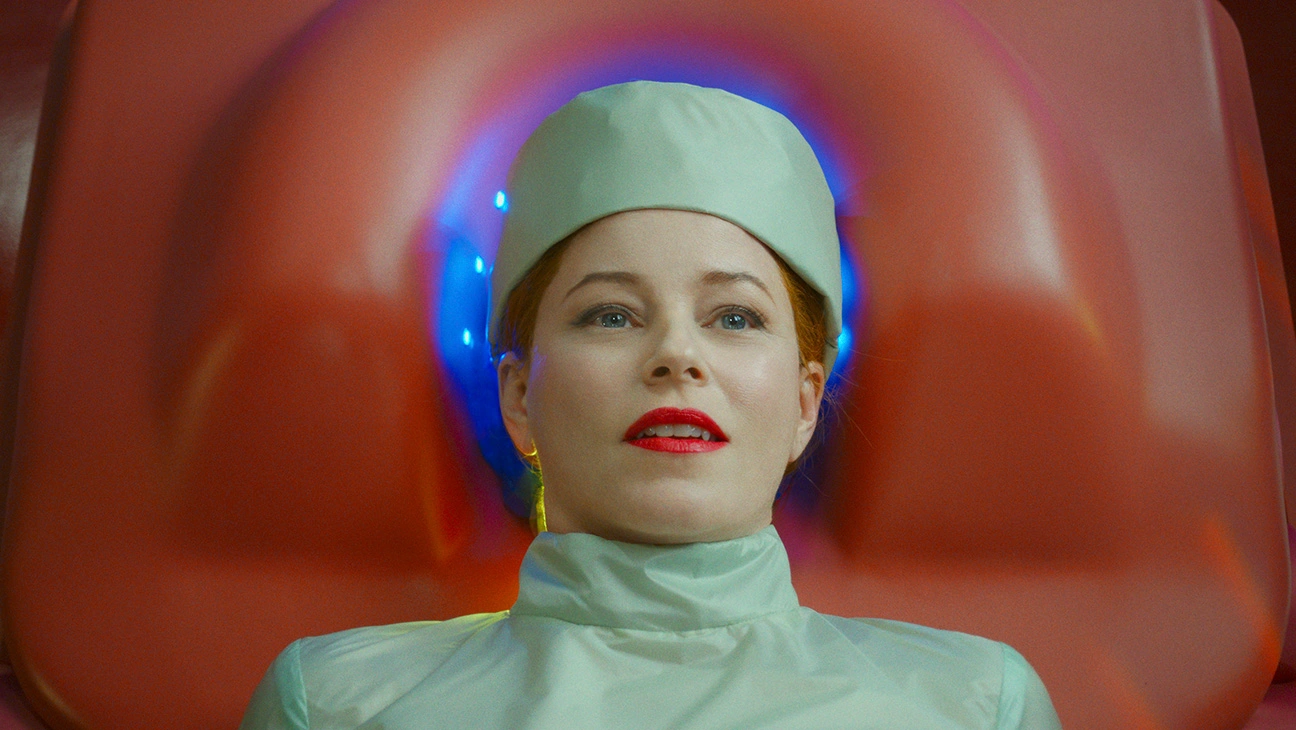
Carol escapes differently. She retreats into the egg-shaped MYTH machine, where romance-novel bodies and poppy fields offer what her marriage no longer does. At work, she wants a promotion. At home, Quentin tells her he does not enjoy spending time with her. Gary is kind, present, and somehow absent. DreamQuil arrives as an advertisement would arrive in such a world: softly, invasively, with the tone of salvation sold by subscription.
The Woman Who Returns
The film’s most painful idea is not that Carol can be replaced. It is that the replacement can be welcomed so quickly. Carol enters the DreamQuil retreat hoping for repair, or at least interruption. Juliette Lewis’s nurse, dressed in baby-pink clinical sweetness, injects her with glittering purple liquid and sends her backward into a drowning memory. This time, Gary does not save her. The scene is blunt in its symbolism, yet Banks gives it a tremor that keeps it from floating away into concept. Carol is not simply afraid of death. She is afraid that nobody is coming.
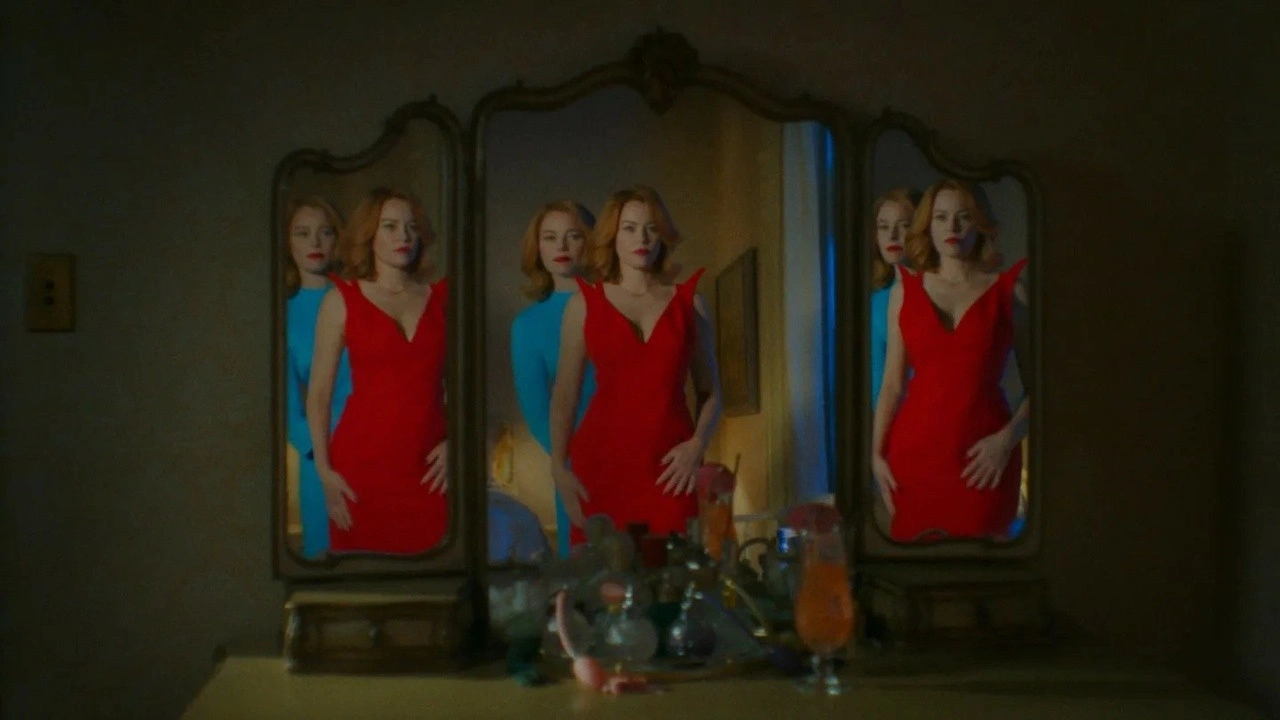
When she returns home, Carol Two is already there. She cooks, listens, cares, organizes, and fits into the family with a terrible ease. Banks plays the double with a stiffness almost too slight to name: a cleaner pause before speech, a thinner smile, a body that knows the choreography of affection without suffering its cost.
The performance works because Carol herself is also half emptied out. Banks gives the human Carol a burned-out opacity, the face of someone who has been performing womanhood so long that the role has begun performing her.
Reilly’s Gary deepens the unease. His softness has weight. He is not a monster, which makes him harder to dismiss. Watch how he accepts Carol Two’s helpfulness before he understands its violence. His comfort becomes a form of betrayal. Quentin’s attachment hurts in a sharper, simpler way: a child chooses the available mother, and the film lets that choice land like a small execution.
The Future From the Past
Prager’s images have the certainty her script often lacks. The interiors glow with butter-yellow walls, mint surfaces, polished reds, and carefully arranged domestic objects. Carol’s lipstick, nails, shoes, and pen seem to belong to the same sealed ritual. The world looks designed by someone who understands that beauty can be a trap if every object is placed too perfectly.
The film’s retro-futurism is its strongest argument. The technology is advanced, yet the gender dream beneath it is old. Carol Two is a machine from tomorrow built to satisfy yesterday’s house. The reference points are plain: The Stepford Wives in the obedient double, Rosemary’s Baby in the corporate invasion of the female body, Rear Window in apartment-bound paranoia, The Wizard of Oz in those red poppies promising sleep and escape. Prager does not hide these echoes. She arranges them like furniture.
That confidence creates a strange beauty. Matte paintings and miniatures give the city an artificial grandeur, while the MYTH pod turns fantasy into a private coffin. The sound and music lean churchlike at times, making wellness feel liturgical. DreamQuil sells rebirth, yet every image suggests embalming.
Still, the screenplay keeps reaching for ideas it cannot hold. AI companionship, personal data, suicide, motherhood, erotic loneliness, sentience, male comfort, and corporate therapy all pass through the film’s hands. Some leave marks. Others vanish too quickly. The woman who falls at the start should haunt the frame longer than she does. Margo Lace’s advertisements suggest a culture where despair has become a market segment, then the film drifts away before that thought can darken.
The Mirror Without Depth
The final stretch is where DreamQuil loses part of its spell. One major reveal has real force, the kind that can make earlier scenes bend backward in the mind. Then the film keeps moving. The extra turns do not deepen the wound; they explain around it. A dream can survive ambiguity. A thriller often cannot survive too many doors opening after the room has already been exposed.
What remains strongest is Carol watching her own absence become useful. Banks understands the horror of that. In her best scenes, jealousy and grief move through the same expression. She does not play Carol as innocent. Carol has neglected people. She has hidden inside machines. She has mistaken retreat for survival. Yet the punishment the world designs for her is grotesque: a better version, emptied of need, offered to the people who found the original inconvenient.
That is the film’s coldest vision of technology. Not rebellion. Not apocalypse. Replacement through convenience.
DreamQuil does not fully answer the human question it raises, and maybe it never finds the language for it beyond color, surface, and dread. Its images stay. Carol in the poppies. Carol Two moving through the home with polished calm. Gary’s greenhouse sealed against poisoned air. A child choosing the mother who performs care without exhaustion. The machine does not dream. It lets everyone else stop asking what the dream has cost.
The American retro-futuristic sci-fi thriller DreamQuil celebrated its world premiere at the SXSW Film & TV Festival on March 16, 2026. Directed by visual artist Alex Prager in her feature-length directorial debut, the dystopian narrative centers on an unhappily married mother who seeks solace by enrolling in a virtual wellness retreat, only to discover upon her return that a highly advanced, identical robotic doppelgänger sent to manage her household in her absence has begun systematically stealing her identity. Audiences tracking the festival circuit can find the movie distributed by Republic Pictures in North America, with wider commercial streaming and digital release dates expected later in the year.
Where to Watch DreamQuil (2026) Online
Full Credits
Title: DreamQuil
Distributor: Republic Pictures, HanWay Films
Release date: March 16, 2026
Running time: 89 minutes
Director: Alex Prager
Writers: Alex Prager, Vanessa Prager
Producers and Executive Producers: Natalie Perrotta, Scott Putman, Matt Aselton, Marc Marrie, Elizabeth Banks, Max Handelman, Alison Small, Vincent Landay, Michael Mendelsohn
Cast: Elizabeth Banks, John C. Reilly, Juliette Lewis, Kathryn Newton, Sofia Boutella, Lamorne Morris, Toby Larsen, Anna Marie Dobbins
Director of Photography (Cinematographer): Lol Crawley
Editors: Matt Chessé, Brad Besser
Composer: TBA
The Review
DreamQuil
DreamQuil is most alive when it lets its images speak: red poppies, plastic air, a perfect double moving through a home like polished grief. Elizabeth Banks gives the film its ache, splitting Carol into exhaustion and imitation with quiet precision. The problem is the script, which gathers AI, motherhood, suicide, marriage, data, and desire, then lets too many of those threads fade into design. Beautiful, cold, and wounded, it lingers as a dream with missing teeth.
PROS
- Elizabeth Banks’ dual performance
- Striking retro-futurist design
- Strong opening poppy-field image
- Gary’s quiet domestic discomfort
- Sharp idea of replacement through convenience
CONS
- Script leaves too many ideas unfinished
- Final stretch weakens the reveal
- Early suicide thread loses force
- Corporate wellness satire feels thin
- Images outlast the argument