
















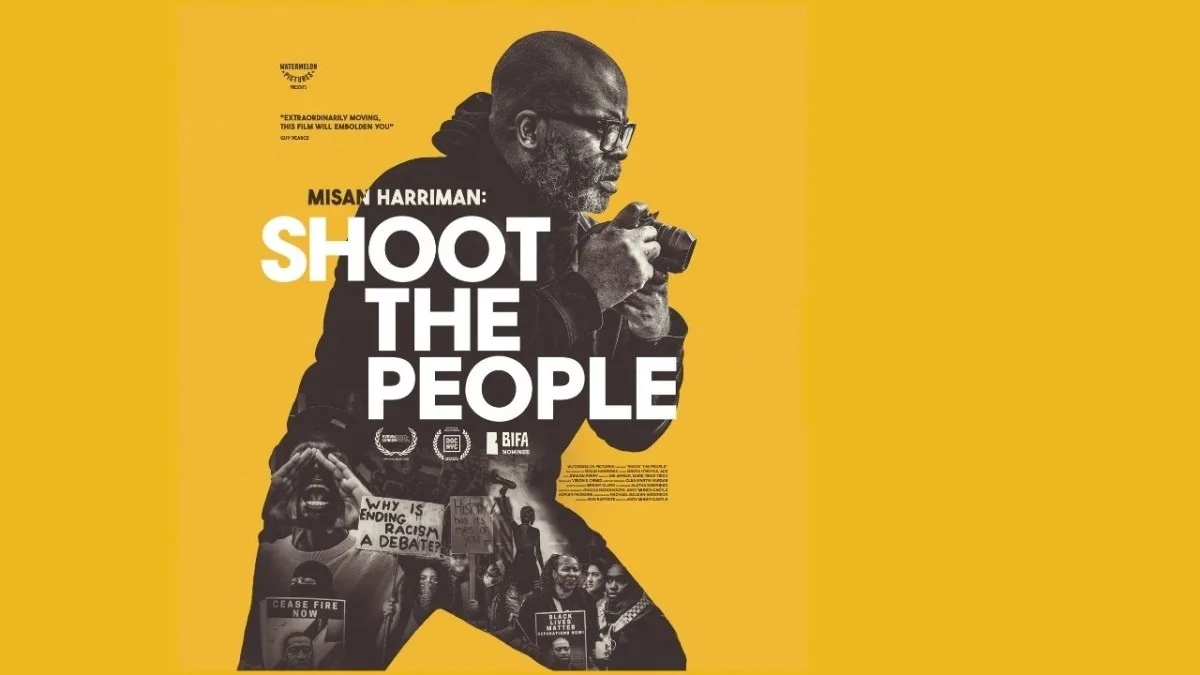

A protest photograph asks for a strange kind of stillness: the world is burning, and yet the face must hold. Shoot the People, Andy Mundy-Castle’s documentary about British-Nigerian photographer Misan Harriman, understands that paradox before it understands everything else. Its strongest images come from that pause between motion and memory, where a crowd becomes a face, a slogan becomes a wound, and the camera becomes a moral instrument that cannot heal what it records.
The film follows Harriman through the U.K., the U.S., South Africa, and pro-Palestinian protest spaces, charting the rise of an artist whose work went viral during the 2020 Black Lives Matter demonstrations after George Floyd’s murder. It also places him inside a public life that now includes a historic British Vogue cover and an Oscar nomination for The After. That tension matters. Harriman is both in the crowd and apart from it, carrying the camera like a passport into grief.
An Archive Still Bleeding
Mundy-Castle does not approach protest as distant history. He builds the film from materials that still feel hot to the touch: vertical phone videos, social media clips, news audio, archival fragments, and Harriman’s black-and-white photographs. The phone footage gives us chaos in its native shape, narrow and frantic, the visual grammar of the pandemic years. Harriman’s stills interrupt that motion. They do not calm it. They trap it.
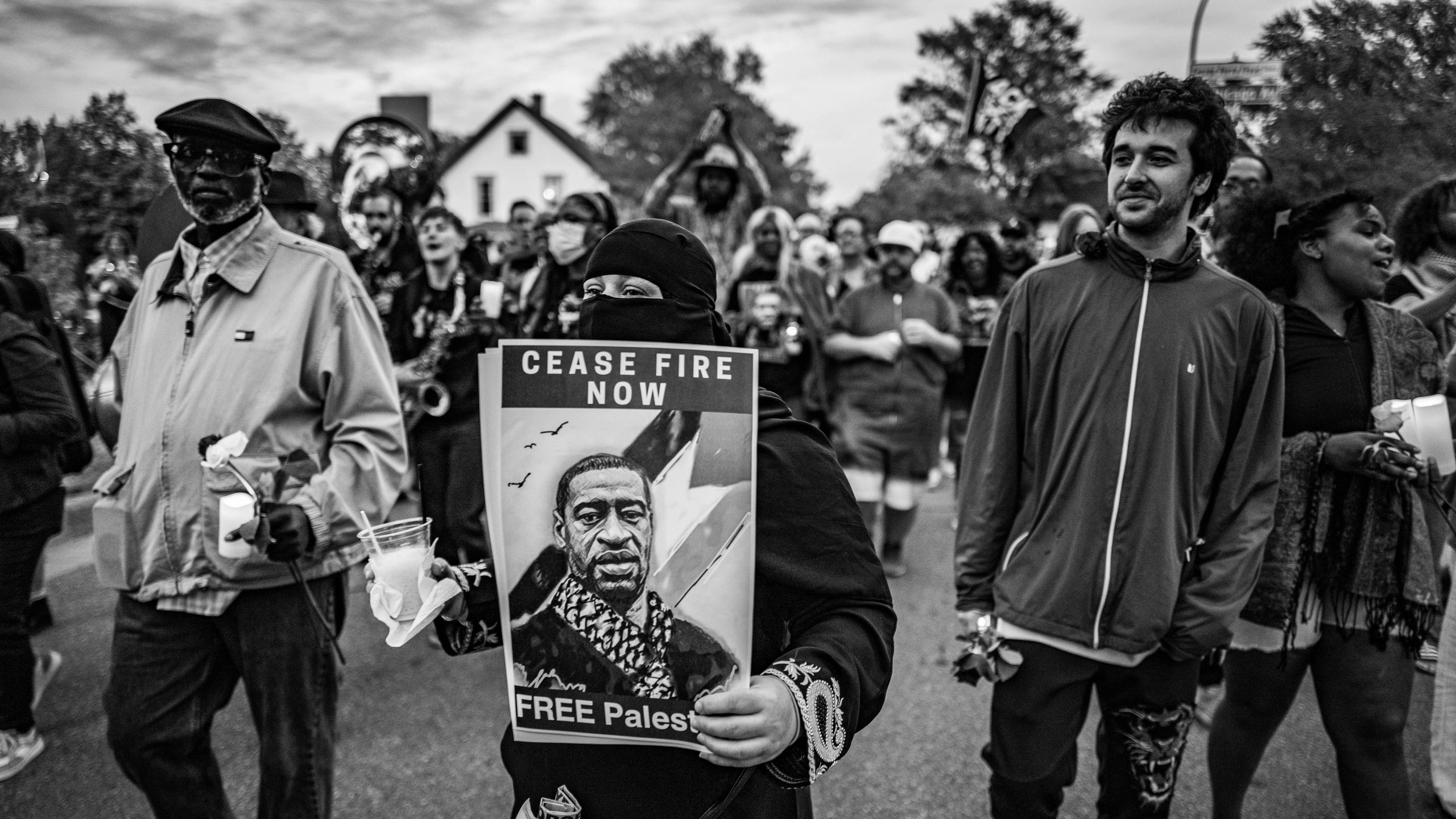
The contrast is often powerful. A color news clip may rush through a march or a police line, then one of Harriman’s shadowed photographs lands with the force of a held breath. His images of demonstrators, mourners, and organizers depend on faces rather than spectacle. They ask the viewer to look at the person before looking at the cause, which is where the film’s ethical charge begins.
Nik Ammar’s string-forward score keeps that charge alive. The music strums beneath the images with a restless pulse, pushing sorrow toward action. Near the end, the use of Nicholas Britell’s “Agape” from If Beale Street Could Talk is an almost dangerous choice because the piece carries so much tenderness already. Here, it works because the film does not use it to sweeten pain. It lets the melody brush against the images like light against a bruise.
The Man Near the Lens
Harriman makes for a calm, watchful subject, which is both his gift and the film’s difficulty. He speaks of keeping empathy “in the room,” and the phrase could have sounded polished, ready for a panel discussion or an awards-season interview. In the film, it gains weight because Mundy-Castle keeps returning him to physical presence: street level, among signs, chants, bodies, weather, and fatigue.
The documentary is attentive to lineage. Harriman is not framed as the first person to discover protest through a camera, thank God. The film nods toward those who photographed struggle before him, then places his work in conversation with activists, historians, community figures, and Martin Luther King III. Those encounters matter because they stop the film from becoming a shrine to one man’s sensitivity. Still, the shrine keeps threatening to appear.
The most revealing passages are the ones where Mundy-Castle presses gently against Harriman’s public ascent. The British Vogue milestone sits beside images of collective pain. The Oscar red carpet sits beside his statement that he would rather be photographing protests against the Academy. The contradiction is human, not damning. A Black artist from Nigeria reaches places that were never designed for him, then finds those places morally airless. The camera gives him purpose; fame gives him rooms. The film sees the cost of needing both.
Watching From Safety
The cruel question beneath Shoot the People is simple: what does witnessing change? Harriman’s photographs preserve truth, but preservation is not justice. The film knows this, which is why its finest moments carry a kind of despair under their beauty. A photograph can outlive the chant. It can move from a street to a gallery wall to a newspaper page. The dead remain dead. The displaced remain displaced. The arrested remain named in systems that do not tremble because an image exists.
Mundy-Castle’s documentary is sharpest when it turns that discomfort toward the viewer. To watch footage of Palestine, Black Lives Matter protests, and South African struggle from behind a screen is to occupy a protected position. The film does not absolve that position. It lets us feel the uneasy pleasure of admiring the image while another person pays the bodily price of being inside it.
Watermelon Pictures’ involvement gives the film a pointed place inside present political cinema, particularly given the distributor’s connection to Palestinian stories. This is one of the film’s quieter complications: its frame often remains Western-centered, with Harriman as the guide through suffering that belongs to many communities. At times, that structure narrows what it means to follow a movement. Then the film returns to the demonstrators themselves, to their faces, their signs, their endurance, and the frame opens again.
Hope appears here, but it is not clean. It flickers in the stubborn act of showing up, in the photographer raising the camera, in the person who agrees to be seen. The image cannot save the world. It can refuse to let the world pretend it did not see.
The documentary feature film titled Shoot the People officially arrives in theaters on July 10, 2026, distributed by Watermelon Pictures. This documentary follows the professional trajectory of Oscar-nominated photographer and activist Misan Harriman as he captures global social movements. Viewers can track his journey from documenting the 2020 Black Lives Matter protests to historical resistance movements across the United States, South Africa, and the United Kingdom.
Where to Watch Shoot the People (2026) Online



Full Credits
Title: Shoot the People
Distributor: Watermelon Pictures
Release date: July 10, 2026
Rating: Mature Themes (IFCO)
Running time: 95 minutes
Director: Andy Mundy-Castle
Writers: Andy Mundy-Castle
Producers and Executive Producers: Wyn Baptiste, Andy Mundy-Castle, Joanna Natasegara, Adrian Padmore
Cast: Misan Harriman, Martin Luther King III, Ilhan Omar, David Meyer
Director of Photography (Cinematographer): Johann Perry
Editors: Maeve O’Boyle
Composer: Nik Ammar
The Review
Shoot the People
Shoot the People carries its finest power in the pause after motion, when Misan Harriman’s photographs hold a face long enough for comfort to curdle into responsibility. Andy Mundy-Castle’s film can lean too closely toward artist portraiture, yet its protest archive, uneasy view of fame, and aching musical choices give it a moral pulse that stays alive after the screen goes dark. The image cannot repair the wound. It can keep the wound visible.
PROS
- Harriman’s arresting black-and-white images
- Strong protest archive structure
- Restless, mournful score
- Honest tension around fame
- Faces placed before spectacle
CONS
- Western frame narrows scope
- Harriman can dominate the movements
- Some platform-like passages
- Political change remains painfully distant